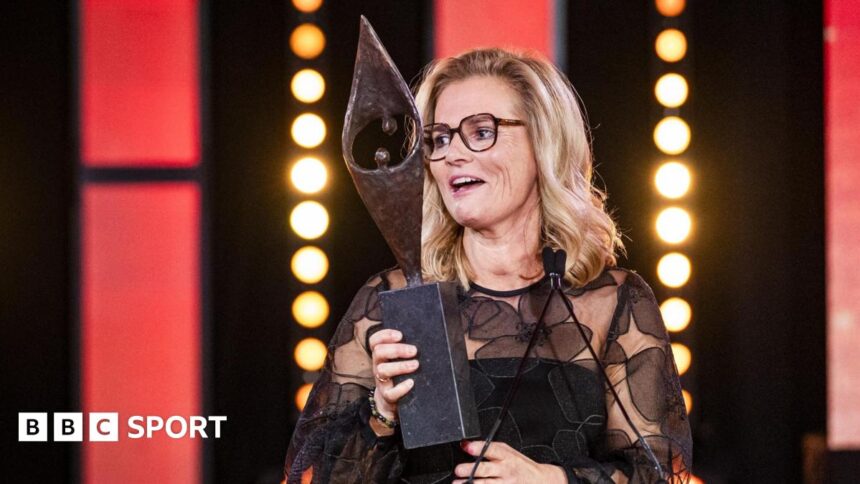
Sarina Wiegman Shatters Glass Ceiling as First Woman Named Dutch Coach of the Year
In a historic moment that resonates far beyond the touchlines, Sarina Wiegman has been crowned Dutch Coach of the Year. At the prestigious national sports gala in Arnhem, an event orchestrated by the Netherlands’ Olympic and Paralympic committees, the 56-year-old mastermind behind the Lionesses’ success etched her name into the annals of sporting history. This landmark achievement, coming on the heels of a string of individual accolades, is not merely a personal triumph for Wiegman. It is a seismic shift, a long-overdue recognition that the pinnacle of coaching intellect and leadership is not defined by gender. Wiegman’s victory, a first for a woman in the award’s history, stands as a powerful testament to a career built on tactical genius, unwavering composure, and a transformative impact on the women’s game globally.
A Legacy Forged in Silverware and Solidarity
To understand the magnitude of this honor, one must look at the unparalleled body of work that precipitated it. Sarina Wiegman’s coaching pedigree is defined by a cold, hard statistic: three European Championship titles. She masterminded the Netherlands’ home-soil triumph in 2017, a victory that catalyzed a footballing revolution in her homeland. Then, in 2022, she steered England to their first major trophy in over half a century, ending the nation’s agonizing wait for footballing glory in a packed Wembley Stadium. This relentless consistency at the very highest level showcases a coach of extraordinary adaptability and man-management skill, capable of molding different squads with distinct footballing cultures into champion outfits.
Her recent award haul is staggering:
- Fifth-time winner of The Best FIFA Women’s Coach award (2025).
- Women’s Coach of the Year at the 2025 Ballon d’Or ceremony in September.
- Now, the historic Dutch Coach of the Year accolade, breaking a male-dominated tradition.
This trifecta of honors within a single year underscores a universal truth: Wiegman is not just the best women’s coach in the world; she is one of the finest coaches in football, period. Her teams are characterized by tactical discipline, fluid attacking patterns, and a formidable mental resilience—a signature “Wiegman mentality” that has become her trademark.
More Than a Trophy: The Ripple Effect of Representation
While the trophies and titles glitter, the core of Wiegman’s latest achievement lies in its symbolic power. Upon receiving the award, her message was immediately and purposefully forward-looking. “I hope I can be an inspiration to a lot of people especially girls and women,” she posted on Instagram. This is not a perfunctory statement from Wiegman; it is the central mission that now underpins her legacy. For decades, the pathway to top-tier, respected coaching roles for women has been obstructed by deep-seated bias and a lack of visible role models at the summit.
Wiegman’s coronation as Dutch Coach of the Year actively dismantles that barrier. It provides an irrefutable reference point. It shows a young girl with a tactical clipboard not just that she can coach a women’s team, but that she can be recognized as the best coach in the entire country, competing against and beating her male counterparts in the eyes of the sporting establishment. This alters the psychological landscape, making the audacious goal seem attainable. Football analysts note that her success is forcing a long-overdue conversation about the valuation of coaching expertise across both the men’s and women’s games, challenging the outdated hierarchy that has persisted for generations.
The Inevitable Question: What’s Next for a Trailblazer?
Wiegman’s historic win inevitably sparks speculation about her future trajectory. Having conquered international football with two different nations, could the next challenge lie in club football? Or does she set her sights on an unprecedented third consecutive Euros title with England? More provocatively, her success makes a compelling case for a seismic shift in the men’s game. The question is no longer “Can a woman coach men?” but rather “When will a forward-thinking club or federation appoint a proven winner like Wiegman to a top men’s role?”
Her skill set—exceptional man-management, strategic acumen, tournament prowess, and peerless player development—is precisely what elite men’s clubs spend millions pursuing. While the social and media hurdles remain significant, Wiegman’s Dutch Coach of the Year award fundamentally changes the context of that discussion. It legitimizes the argument on pure sporting merit. The prediction here is not an immediate move, but rather that Wiegman’s continued success will make the eventual appointment of a woman to a major men’s head coaching role in Europe not a shock, but an inevitable, merit-based decision.
A New Playbook for the Future of Football
Sarina Wiegman’s journey from a pioneering player in the Netherlands to the most decorated coach in the women’s game is now capped with a nation’s highest coaching honor. This award is a watershed, a moment that future historians of sport may pinpoint as a critical turning point. It validates the quality burgeoning in women’s football and places it on an equal podium. The “inspiration” Wiegman hopes to provide is already materializing; coaching courses report increased female enrollment, and a new generation of female tacticians now has a clear, proven blueprint for success.
In conclusion, Sarina Wiegman’s naming as Dutch Coach of the Year transcends a single trophy. It is a cultural reset. It reaffirms that greatness in coaching is genderless. As she continues to build her legacy with England and beyond, her greatest impact may ultimately be measured not in the medals around her neck, but in the countless women and girls she has empowered to step into the technical area, clipboard in hand, ready to draw up their own dreams. The beautiful game has found one of its finest ever teachers, and in honoring her, the Netherlands hasn’t just awarded a coach—it has opened a door for everyone who will follow.
Source: Based on news from BBC Sport.