Joshua vs. Paul: The Scale Tells a Story of Power, Stipulation, and Spectacle
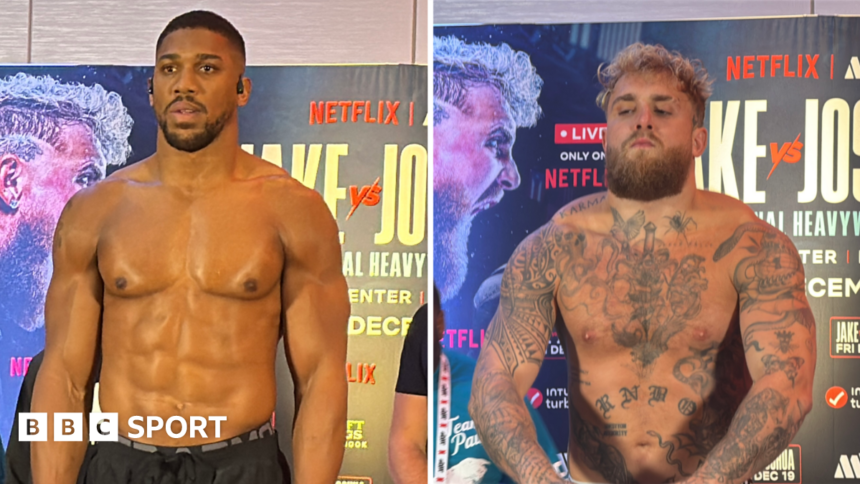
The ritual of the weigh-in is boxing’s final, silent act of intimidation before the violence begins. For Friday’s unprecedented clash between Anthony Joshua and Jake Paul, the scales didn’t just reveal numbers; they narrated a tale of two vastly different worlds colliding. In a stark visual that underscores the entire bizarre nature of this event, the two-time unified heavyweight world champion Anthony Joshua weighed in nearly two stone heavier than the YouTuber-turned-prizefighter Jake Paul. This physical disparity, however, comes wrapped in a contractual oddity that speaks volumes about the delicate balance between sport and entertainment.
The Numbers Don’t Lie: A Tale of Two Physiques
As the fighters faced off in Miami, the official readings confirmed the obvious. Anthony Joshua, a chiseled monument of a heavyweight who has shared the ring with the likes of Wladimir Klitschko and Oleksandr Usyk, tipped the scales at a solid 17st 5lb (110kg). In the opposite corner, Jake Paul, who has meticulously built his boxing resume against mixed martial artists and fellow influencers, came in at a lean 15st 7lb (98kg).
This 28-pound gap is significant, but the real story is in the stipulation. In a highly unusual move for a heavyweight contest, Joshua was contractually bound to weigh under 17st 7lb (111kg). This clause acts as a symbolic and practical equalizer, attempting to bridge the experience chasm between a man with 28 professional wins and a former Olympic gold medalist, and a novice with 12 pro bouts. It forces AJ to perhaps come in lighter and potentially less powerful than he might against a traditional foe, while allowing Paul to avoid facing a fully unleashed 18+ stone juggernaut.
- Anthony Joshua: 17st 5lb / 110kg | Record: 28-4 (25 KOs)
- Jake Paul: 15st 7lb / 98kg | Record: 9-1 (6 KOs)
- Weight Disparity: Nearly 2 stone / 28 pounds / 12kg
- Key Stipulation: Joshua contractually limited to under 17st 7lb.
Expert Analysis: Decoding the Strategic Implications
This weight clause is the linchpin of the fight’s competitive intrigue. Let’s break down what it means for each fighter from a tactical standpoint.
For Anthony Joshua, the weight limit is a double-edged sword. On one hand, coming in at 110kg suggests a focus on speed and endurance over crushing power. This is a Joshua reminiscent of his earlier, more mobile years. He will likely look to use his superior technical skills, piston-like jab, and proven power at this weight to break down Paul from range. The risk? He may lack the sheer mass to easily manhandle or walk through a determined opponent, and if Paul’s chin holds, AJ’s engine will be tested over eight professional rounds—a distance he hasn’t contested in years.
For Jake Paul, the strategy is clear. His team negotiated this clause for a reason. At 98kg, he will be the quicker, presumably more agile fighter. His game plan will hinge on movement, volume punching, and exploiting any hesitation or stamina fade from Joshua. Paul possesses a decent right hand and has shown improving technique. His path to an unthinkable victory involves making the fight messy, surviving the early onslaught, and trying to outwork Joshua in the later rounds, banking on the champion overlooking him.
However, the experience gulf is cavernous. Joshua has been in with elite killers; Paul has not. The professional eight-round bout with regulation 10oz gloves means this is a real, sanctioned fight with real consequences. These are not the pillow-like 14oz or 16oz gloves often used in exhibitions. The 10oz gloves offer less padding, increasing the likelihood of a knockout, which heavily favors the proven concussive puncher: Anthony Joshua.
Predictions: The Spectacle vs. The Sport
Predicting this fight requires separating the carnival hype from pugilistic reality. The weigh-in, with its dramatic face-off and clear physical difference, was pure spectacle. The fight itself, however, will be governed by the harsh laws of the ring.
The most likely scenario sees Anthony Joshua treating this with the professional seriousness he has shown in recent camps. He will respect Paul’s power enough to not be reckless early but will methodically break him down. Expect a stiff jab to control distance, followed by powerful right hands to the body and head. Paul’s resilience is the great unknown, but it is difficult to envision him weathering sustained, clean punishment from a hitter of Joshua’s caliber. A mid-rounds stoppage, perhaps between rounds 4 and 6, seems the most logical outcome.
The “Jake Paul upset” narrative hinges on a perfect storm: Joshua suffering from extreme complacency, Paul landing a once-in-a-lifetime lucky shot, or AJ’s stamina catastrophically failing. While Paul is athletic and dedicated, the jump from fighting Nate Diaz and Tyron Woodley to fighting a peak, motivated Anthony Joshua is a leap into another stratosphere of boxing.
The wildcard is the fight’s context. Held at the Kaseya Center in Miami, with a global audience split between boxing purists and Paul’s legion of fans, the atmosphere will be electric and strange. Could this pressure affect Joshua? It’s possible, but his resume suggests he is immune to such stages.
Conclusion: A Necessary Chapter in Boxing’s Modern Era
The weigh-in for Joshua vs. Paul did more than provide a photo opportunity; it framed the entire event. The nearly two-stone weight difference, artificially constrained by contract, is a perfect metaphor for the fight itself: a natural, massive force being deliberately reined in for the sake of marketable competition.
Whether one views this as a gross mismatch, a genius business move, or a fascinating cultural moment, its significance is undeniable. It represents the full convergence of boxing’s storied legacy with the new economy of influencer-driven entertainment. For Anthony Joshua, it is a lucrative showcase to a new, younger audience. For Jake Paul, it is the ultimate validation test, a chance to prove the skeptics wrong against the most formidable foe imaginable.
When the first bell rings, the stipulations and social media stats will fade away. What will remain is a 28-pound weight advantage, a canyon of experience, and the unforgiving reality of a professional boxing ring. The scales have told their story. On Friday night, the fists will write the final, decisive chapter.
Source: Based on news from BBC Sport.