No Fear, No Illusions: The Spectacle and Serious Risk of Paul vs. Joshua
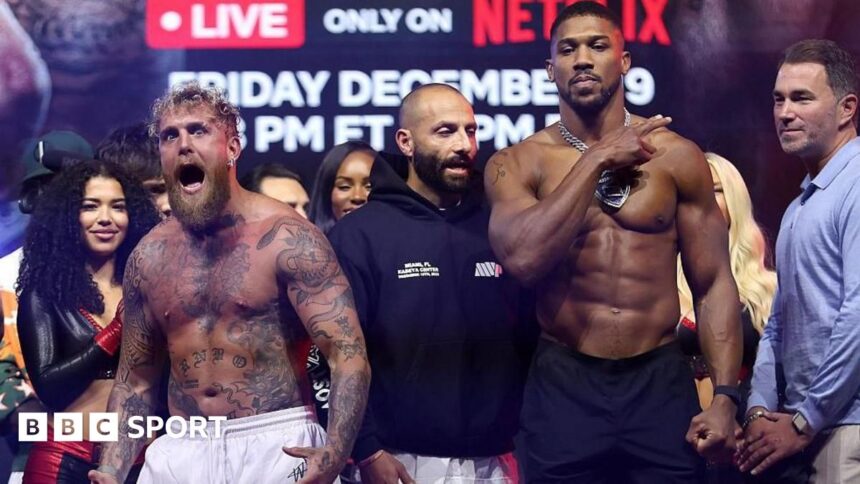
The heavyweight landscape has always been a theater of the absurd and the sublime, but never before has it staged a production quite like this. In one corner, Anthony Joshua, the two-time unified world champion, a colossus carved from the traditional path of Olympic glory and brutal professional apprenticeship. In the other, Jake Paul, the digital-age disruptor, a social media empire builder who weaponized viral fame into a boxing career that the purists decry and the algorithms adore. Their collision is billed as a spectacle, a financial windfall, a cultural moment. But beneath the glittering veneer of pay-per-view hype lies a stark and serious risk that looms larger than any punch either man has ever thrown.
From Coronation to Carnival: A Decade of Divergent Paths
When Anthony Joshua made his professional debut against Emanuele Leo in 2013, fresh from Olympic gold in London, the boxing world treated it like the start of a coronation. The narrative was clear: a chiseled, respectful ambassador for the sport, destined to reclaim the heavyweight throne for a nation. His journey was mapped in blood, sweat, and championship rigors—a brutal education under the bright lights of world title fights.
At roughly the same time, a 16-year-old prankster from Ohio named Jake Paul was posting six-second Vine videos—chatting to pineapples in supermarkets and climbing into strangers’ shopping trolleys for a laugh. His arena was the smartphone screen, his currency attention. His path to the ring wasn’t paved with amateur medals, but with YouTube clicks, Disney Channel scripts, and a masterclass in modern self-promotion.
More than a decade later, through wildly different routes, the pair have arrived at the same improbable place. Not as champion and challenger in the traditional sense, but as the two biggest box-office draws in the sport, their names capable of breaking the internet and banking records. This convergence is the defining story of boxing’s fractured present: sporting meritocracy meeting the attention economy head-on.
“I Won’t Carry Him”: Joshua’s Mindset and The Physical Chasm
Anthony Joshua’s declaration, “I won’t carry Jake Paul for one second,” is more than just pre-fight bravado; it is a mission statement. It signals a refusal to participate in the exhibition-style narrative that has characterized many influencer bouts. For Joshua, this is a serious fight, and his approach will reflect that. The physical and experiential gulf between them is a canyon:
- Experience: Joshua has shared the ring with the who’s who of the heavyweight division for a decade—Klitschko, Ruiz, Usyk, Fury. Paul’s record, while improving, is built against aged MMA legends and fellow influencers.
- Power: Joshua possesses genuine one-punch, fight-ending knockout power that has felled elite heavyweights. Paul’s power at cruiserweight is notable, but untested against a man of Joshua’s size and chin.
- Pedigree: Joshua’s technical foundation, built over years in the British amateur system, is profound. Paul is a surprisingly dedicated and improving student, but remains a postgraduate of a very new, unorthodox school.
The central, unsettling question is not about competitive intrigue, but about physical safety. The risk is asymmetrical. Joshua has everything to lose—legacy, standing, the roadmap back to a title. Paul has everything to gain—credibility, a seismic upset, eternal bragging rights. But he also faces the most dangerous opponent of his life by an almost incalculable margin.
The Spectacle’s Shadow: What’s Really at Stake?
This event is a masterstroke in commercial packaging. It will harness the crossover appeal of Jake Paul’s global, younger audience and fuse it with Joshua’s established sporting fanbase. The promotion will be ubiquitous, the social media frenzy unprecedented, and the financial rewards staggering for both men. It is the ultimate validation of Jake Paul’s disruptive model.
Yet, the spectacle casts a long shadow. For boxing’s traditionalists, this fight represents a further erosion of the sport’s competitive integrity. It bypasses rankings, merit, and the established contender queue for pure economic might. It risks reducing the heavyweight division, historically the sport’s crown jewel, to a sideshow for the highest bidder.
For Joshua, the calculus is complex. A dominant, early knockout is expected. Anything less—a struggle, a moment of vulnerability, or even a clumsy, protracted victory—could be framed as a moral loss. The legacy risk for AJ is nuanced: a win does little to burnish his standing among the all-time greats, while a loss, or even a poor performance, could be catastrophically damaging.
Expert Analysis & Predictions: The Inevitable and The Unthinkable
From a purely technical standpoint, analysis is straightforward. Anthony Joshua is a vastly superior fighter in every quantifiable metric of the professional heavyweight boxing. His jab should be a piston-like weapon to control distance. His power in the right hand is a threat that Paul has never encountered. Joshua’s professionalism and experience in 12-round championship fights suggest he will be patient, systematic, and destructive.
Jake Paul’s path to victory is a puncher’s chance, wrapped in a psychological gambit. His advantages are intangible: the nothing-to-lose mentality, potential over-aggression from Joshua seeking a statement, and the unpredictable rhythm of a novice. He is strong, confident, and has shown a capable right hand. However, expecting him to withstand the sustained, calculated pressure of an elite heavyweight—one who has vowed not to play games—is a monumental ask.
Prediction: The most likely outcome is a clinical and emphatic Anthony Joshua victory within the first four rounds. The size, power, and class differential will prove insurmountable. Joshua will start cautiously, measure with the jab, and unleash a fight-ending combination once he finds his range. The spectacle will be brief and brutal.
The serious risk is that in the pursuit of that spectacular knockout, or in the chaos Paul might try to create, the line between competition and danger is blurred. Boxing’s inherent peril is magnified when the gap in skill and power is this vast.
Conclusion: A Crossroads for the Sweet Science
The “no fear” mantra from Jake Paul’s camp is believable; his courage in entering this arena is undeniable. But fear is not the point. This fight is about the spectacle’s powerful allure and the very real, very serious risk that simmers beneath its surface. It is a cultural event that highlights boxing’s modern duality: its ability to command the global conversation while simultaneously grappling with its soul.
When the opening bell rings, the viral videos, the promotional tours, and the social media metrics will fade into silence. What will remain is a boxing ring, a referee, and a profound disparity in experience and force. Anthony Joshua will be there to work, not to carry. And in that truth lies the ultimate conclusion to this bizarre, captivating, and perilous chapter in heavyweight history. The spectacle may sell the fight, but the sport will inevitably decide it.
Source: Based on news from BBC Sport.