FIFA’s Next Frontier: How ‘Out of Bounds’ Tech and 3D Offside Could Revolutionize Football
The beautiful game is on the cusp of another technological leap. For years, contentious decisions surrounding whether the ball crossed the touchline or a player was a fraction offside have fueled post-match debates, manager fury, and fan conspiracy theories. While VAR has brought a measure of clarity, its limitations in these precise, millimeter-accurate scenarios remain a source of frustration. Now, FIFA is quietly testing a suite of innovations that promise to bring near-instant, definitive answers to two of football’s most perennial controversies: when the ball is out of play, and when a player is offside.
Beyond the Naked Eye: The “Out of Bounds” Technology
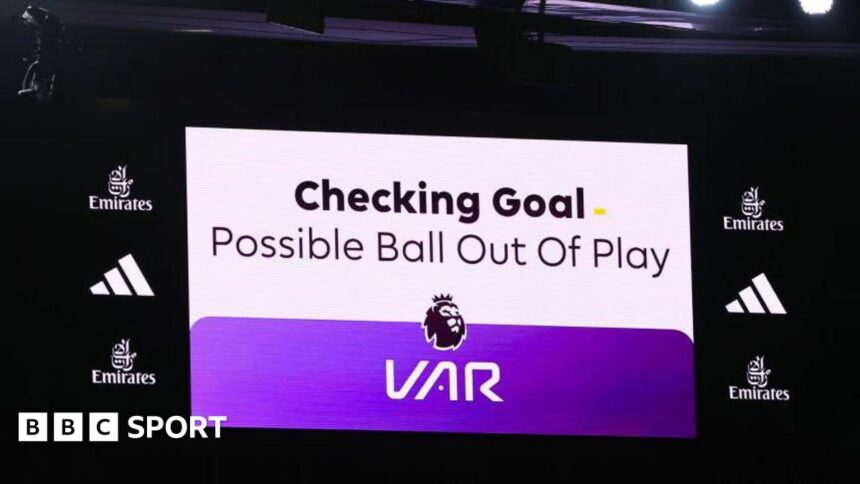
The recent Intercontinental Cup in Qatar served as more than just a trophy decider; it was a live laboratory. Among the most intriguing experiments was the trial of a new ‘Out of Bounds’ technology. This system is designed to do what slow-motion replays from limited camera angles often cannot: provide an irrefutable, real-time verdict on whether the entire ball has crossed the entire line before a crucial play, like a goal, develops.
Imagine a scenario where a winger, under pressure, whips in a cross from the byline that leads to a stunning overhead kick goal. The defending team erupts, insisting the ball had rolled out of play. Current VAR protocol relies on available broadcast cameras, which may not have a perfect, perpendicular view of the line. The decision becomes a judgment call, often leaving one side feeling grievously wronged. FIFA’s new tech aims to eliminate this ambiguity entirely.
How does it work? While FIFA is keeping the exact sensor details under wraps, similar systems in other sports and conceptual designs suggest a few possibilities:
- Embedded Microchips: A sensor inside the ball communicates with a network of receivers around the pitch to pinpoint its exact position in relation to the lines.
- High-Speed Camera Arrays: A series of ultra-high-frame-rate cameras focused solely on the boundary lines could triangulate the ball’s position with extreme accuracy.
- Magnetic or Radio Frequency Fields: Technology creating an invisible field along the lines could detect the moment the ball, containing a passive circuit, breaks it.
The objective is clear: deliver an automated, immediate signal to the video assistant referee the moment the ball goes out, much like Goal-Line Technology. This could prevent incorrect goals from standing and stop play faster for legitimate out-of-bounds calls, potentially improving the game’s flow.
A Clearer View: The Evolution of Offside with 3D Recreation
Parallel to the out-of-play trials, FIFA is refining its approach to the offside rule with an expanded ‘Real-time 3D Recreation’ system. This is an evolution of the semi-automated offside technology (SAOT) successfully used at the 2022 World Cup in Qatar. While SAOT provided precise skeletal tracking of players, the new enhancement focuses on clarity and perspective for both officials and fans.
The breakthrough here is the creation of two unique virtual feeds. These aren’t just computer-generated lines on a broadcast image; they are fully rendered 3D recreations of the offside moment from the most critical viewpoints:
- The Goalkeeper’s Perspective: This feed visually replicates what the last defending goalkeeper could actually see, helping assess “line-of-sight” judgements for players in offside positions who might be interfering with play.
- The Assistant Referee’s Perspective: A virtual recreation of the view down the line from the assistant referee’s position, providing context for why a call was or wasn’t made in real time.
This addresses a major point of confusion. The current offside graphic, while accurate, can feel detached from the reality on the pitch. By showing the play from the goalkeeper’s eyes, it becomes intuitively clearer whether an offside player was truly blocking vision or impacting the defender’s decision. This isn’t just about accuracy—it’s about transparency and understanding. Making these feeds available to broadcasters means fans at home are brought into the decision-making process, potentially reducing anger and increasing acceptance of tight calls.
Analysis: The Potential Impact on the Premier League and Global Game
The implications of these technologies, particularly for a league as fast-paced and scrutinized as the Premier League, are profound. The contentious incidents in the Premier League involving potential ball-out-of-play situations before goals have been a staple of “Match of the Day” drama. Implementing definitive technology would erase those debates overnight.
From an officiating standpoint, these tools represent a shift from reactive assistance to proactive, automated certainty. Referees and VARs would be empowered with data that removes guesswork. This could lead to:
- Increased Referee Authority: With black-and-white data for line calls, the referee’s on-field decision, supported by an instant buzz, could become more authoritative.
- Reduced VAR Review Time: Quick, automated alerts for out-of-bounds and offside would slash the time spent on forensic video reviews, addressing a major criticism of VAR’s impact on game flow.
- A New Standard of Fairness: The core promise is a competition decided more by skill and less by official error. It levels the playing field for all teams, regardless of the magnitude of the match.
However, challenges remain. The cost of implementing such sophisticated systems across every top-flight stadium globally will be significant. There’s also the philosophical debate: does removing every millimeter of human error from line calls also strip away a layer of the game’s organic, debated humanity? Football must balance the pursuit of perfect justice with the preservation of its essential, flowing spirit.
The Future of Football Officiating: Predictions and Conclusions
The trials in Qatar are not mere experiments; they are a clear signal of intent. FIFA’s investment in this technology indicates a future where its use in elite competition is inevitable. We can predict a staggered rollout:
Short-term (Next 2-3 years): Expect the enhanced 3D offside system, with its goalkeeper-view feed, to be implemented in major UEFA competitions and top leagues following its success. The ‘Out of Bounds’ tech will likely undergo more extensive testing in various competitions to ensure flawless reliability.
Medium-term (By 2026 World Cup): It is highly plausible that the next Men’s World Cup will feature a fully integrated system: semi-automated offside with 3D perspectives combined with automated out-of-bounds detection. This would represent the most technologically advanced tournament in history.
The Long View: The ultimate goal is a seamless, integrated “smart pitch” system. Imagine a single tracking infrastructure that monitors ball position, player position, and biometric data in real-time, feeding a unified officiating command center. The focus will then shift from “did it happen?” to faster and clearer communication of the “why” to fans in the stadium and at home.
In conclusion, FIFA’s latest tests are more than just tech upgrades; they are a redefinition of accuracy in football. The combination of ‘Out of Bounds’ technology and immersive Real-time 3D Recreation for offsides aims to build a new era of trust in officiating. While debates about the soul of the game will continue, the trajectory is set. The future of football is one where the most infamous lines in sport—the touchline and the offside line—are guarded not just by humans in real time, but by digital sentinels offering incontrovertible truth. The result promises to be a fairer, clearer, and even more compelling spectacle for the world’s most popular sport.
Source: Based on news from BBC Sport.