‘We Suffered Together’: Ruben Amorim’s Pragmatic Pivot Seals Vital Man Utd Win Over Newcastle
The final whistle at Old Trafford brought not just three points, but a collective exhale. A 1-0 victory over Newcastle United, secured by a moment of pure, predatory instinct from teenager Patrick Dorgu, was more than a Premier League win. It was a testament to a manager’s willingness to temporarily shelve his ideals for the gritty reality of the result. For Ruben Amorim, the celebrated football idealist, this was a victory forged not in fluid, attacking waves, but in shared sacrifice. As he later put it, the defining characteristic of the performance was simple: “We suffered together.”
The Ideologist’s Pragmatic Pivot
Ruben Amorim arrived at Manchester United as a disciple of a specific, attacking creed. His reputation, built at Sporting CP, was of a 3-4-3 evangelist, a coach whose teams dominated possession, pressed with ferocious intensity, and won with stylistic swagger. It is a philosophy that has won titles and admirers. Yet, against a physically imposing Newcastle side desperate to climb the table, the blueprint was discarded. The Christmas present for the Stretford End was wrapped not in familiar red ribbon, but in the gritty brown paper of pragmatism.
The most glaring signal was the formation switch. Out went the customary three-at-the-back system. In its place, Amorim deployed a compact, resilient 4-2-3-1. This was not a tweak; it was a tactical overhaul designed for a specific battle. The double pivot in midfield sat deeper, shielding a back four that was instructed to prioritize shape over expansive build-up. The wide players had stringent defensive duties. This was United set up to absorb, to frustrate, and to strike on the break—a stark contrast to the proactive control Amorism typically demands.
This shift speaks volumes about Amorim’s maturation on the Premier League stage. It revealed a crucial layer to his management: tactical flexibility. The best coaches are not slaves to a system, but masters of adaptation. Faced with an injury list and an opponent’s specific threat, Amorim chose the result over the dogma. “You must respect the game, the opponent, and the moment,” he stated post-match. “Sometimes the game asks you to fight first, to play later. Today, it asked us to fight for 95 minutes.”
Dorgu’s Diamond Moment in a Match of Grit
With the game locked in a midfield stalemate, chances were at a premium. Newcastle had spells of pressure, but found a United defensive unit, marshalled superbly by Lisandro Martinez, in obdurate mood. The match-winning moment, when it arrived, was a jewel unearthed from the mud of a tactical scrap.
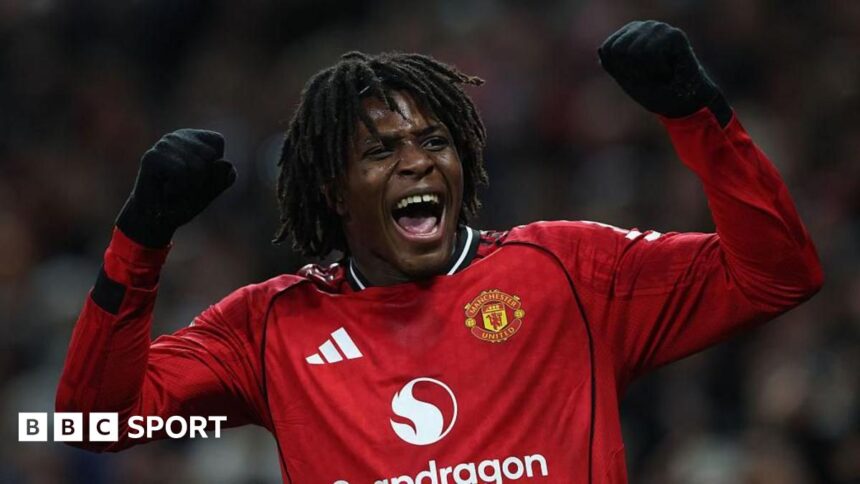
In the 68th minute, a partially cleared corner fell to the edge of the box. There, lurking with intent, was 19-year-old Patrick Dorgu. The Danish full-back, introduced for his energy, did not break stride. He connected with a first-time, sweeping stunning Dorgu volley that arrowed through a crowd of players and into the bottom corner. It was a finish of breathtaking technical assurance, a flash of sublime quality that decided a game defined by resilience.
Dorgu’s impact underscores another key Amorim trait: youth integration. In a high-pressure moment, faith was placed in a young talent, and the reward was instantaneous. This goal was more than a winner; it was a symbol of the club’s evolving identity under Amorim—a blend of streetwise toughness and explosive youthful talent.
Key Factors in United’s Gritty Victory:
- Defensive Discipline: A unified, deep-lying block that limited Newcastle to few clear chances.
- Midfield Battle Won: Casemiro and Mainoo controlled the central zones through positioning, not just possession.
- Clinical Edge: One moment of supreme quality from Dorgu converted the game’s half-chance.
- Collective Mentality: A palpable shift to a “suffer together” mindset, embracing the ugly side of the game.
What This Means for United’s Season and Amorim’s Project
This victory is a potential inflection point. Winning while playing poorly is a hallmark of contenders; winning while playing *differently* is a hallmark of intelligent management. For Amorim’s project, this proves his methods have a necessary second gear. The players have shown they can execute a game plan devoid of aesthetic flourish, which builds a different kind of confidence.
Team cohesion built through such hard-fought wins is often stronger than that built in routs. The shared experience of a defensive rearguard action forges a unique bond. Furthermore, it sends a message to the rest of the league: United under Amorim can win in multiple ways. They are not a one-trick tactical pony.
Looking ahead, the expectation is that Amorim will revert to his core principles against lesser-equipped opponents at Old Trafford. The 3-4-3 will return. But the experience against Newcastle provides a crucial tactical blueprint for tough away days and clashes with top-four rivals. It adds a string to United’s bow that was previously untested.
Conclusion: The Mark of a Mature Manager
Ruben Amorim’s Manchester United journey was always going to be about more than just implementing a philosophy. It was about evolving it to survive and thrive in the Premier League’s relentless crucible. The 1-0 win over Newcastle may not feature in a season-ending highlight reel of beautiful goals and sweeping moves, but it might just be remembered as one of the most important.
It was the day the idealist became a realist, without compromising his ultimate vision. It was the day the team proved their mettle was as hard as their manager’s tactical resolve. By choosing to suffer together, United found a new way to win, and Amorim took a significant step from being a coach with a compelling idea to a manager capable of delivering when it matters most. The victory was narrow, but the lesson was vast: in the pursuit of long-term glory, sometimes you must first be willing to grind.
Source: Based on news from BBC Sport.