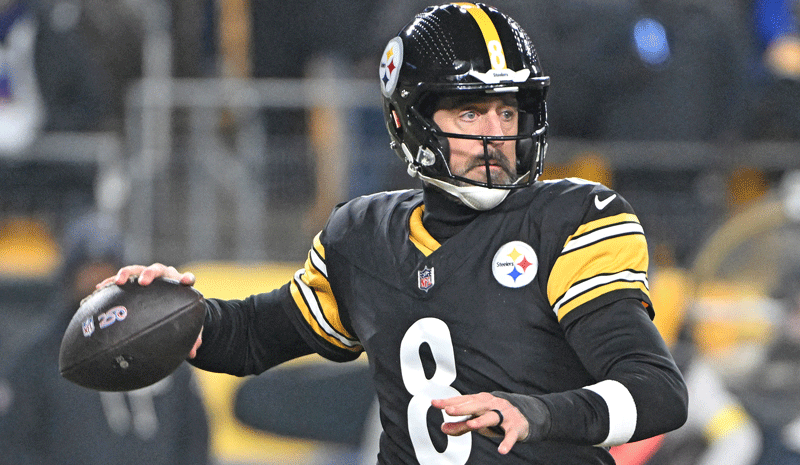
Texans’ Defensive Juggernaut Steamrolls Steelers, Casts Shadow Over Rodgers’ Future
Under the glaring lights of a win-or-go-home Monday night, the Houston Texans didn’t just secure a playoff victory; they delivered a statement of arrival and, potentially, a farewell to a legend. In a game that simmered with defensive tension for three quarters, the Texans erupted in a stunning fourth-quarter barrage, dismantling the Pittsburgh Steelers 30-6 to claim the last ticket to the NFL’s Divisional Round. The dominant performance, however, was overshadowed by the looming specter of the end for one of the game’s all-time greats, as Aaron Rodgers’ season—and possibly his career—ended not with a bang, but a whimper against an unforgiving Houston defense.
A Defensive Stranglehold and a Quarterback’s Agony
The script for Wildcard Weekend’s finale was written in bold, defensive ink. Two of the league’s most physical units, renowned for creating turnovers and harassing quarterbacks, promised a trench war. For 45 minutes, that prediction held true. The scoreboard read a tense 7-6 in favor of Houston, a game hanging on every third-down stop and every field position flip.
For Aaron Rodgers, the night was a slow-burning frustration. The Steelers’ offensive line, overmatched from the start, offered little protection against the Texans’ relentless, schemed-up pressure. Houston defensive coordinator DeMeco Ryans dialed up a masterclass in defensive play-calling, mixing simulated pressures with timely blitzes that consistently muddied Rodgers’ reads. The future Hall of Famer was sacked four times, hit on countless other dropbacks, and forced into uncharacteristic rushed throws. The Steelers’ only points came from two field goals, a testament to the Texans’ red-zone defiance. This was not the fairy-tale ending Pittsburgh envisioned when they signed the four-time MVP to a one-year deal.
The Floodgates Open: Houston’s Fourth-Quarter Onslaught
Then, the dam broke. The Texans’ offense, which had sputtered for much of the night, found a spark with a methodical drive capped by a short touchdown run early in the fourth. That score seemed to uncork the pent-up energy of the entire Texans squad, but particularly their defense. What followed was a defensive scoring clinic that turned a close game into a historic rout.
- Pick-Six Fury: On the ensuing Steelers possession, under duress yet again, Rodgers forced a pass over the middle. Texans linebacker Christian Harris read it perfectly, stepping in front of the receiver and racing 38 yards untouched to the end zone. The stadium erupted, sensing the kill.
- Strip-Sack Exclamation Point: Minutes later, with the game slipping away, Rodgers dropped back once more. Houston’s rookie sensation defensive end, Will Anderson Jr., beat his man cleanly, hammering the ball loose from behind. The ball squirted into the end zone where it was pounced on by linebacker Denzel Perryman for another defensive touchdown. Two defensive scores in under four minutes of game time.
This league-leading defense didn’t just protect a lead; they built it themselves. The fourth-quarter explosion showcased a unit playing with supreme confidence and speed, a direct reflection of their head coach’s philosophy.
The Rodgers Question: A Glittering Career Meets a Grim Reality
As the Texans celebrated their ascent, the camera repeatedly found Aaron Rodgers on the Pittsburgh sideline, a towel draped over his head, his gaze distant. The 42-year-old quarterback had spoken openly throughout the season about the possibility of this being his final campaign. If this was indeed the curtain call, it was a brutally unfitting finale for a player of his stature.
His season in Pittsburgh was a paradox—flashes of the old magic interspersed with the reality of age, recovery from a major injury, and a supporting cast that failed to meet the moment. The Steelers’ gamble on a one-year Rodgers resurrection ended not in a Super Bowl run, but in a one-sided demolition where he was rendered a non-factor. The post-game questions will now swirl relentlessly:
- Does the competitive fire still burn after such a physically punishing defeat?
- Does he have the desire to undergo another grueling offseason of rehab and preparation?
- Would any team, seeing tonight’s evidence, provide a situation markedly better than this one?
While Rodgers will take his time to decide, the image of him being overwhelmed by a younger, faster defense serves as a potent symbol of the NFL’s inexorable march forward.
Divisional Round Outlook and Lasting Implications
The Houston Texans now march forward, a young team peaking at the perfect time. Their victory was comprehensive: dominant defensive performance, timely offensive execution, and superior coaching. They have announced themselves as a legitimate threat, not just a feel-good story. The challenge escalates dramatically in the next round, likely on the road against a top-seeded AFC powerhouse, but they carry with them the fearlessness and defensive identity that can travel anywhere.
For the Pittsburgh Steelers, the offseason begins with profound questions. The potential retirement of Rodgers triggers an immediate and massive quarterback search. The offensive line requires a significant overhaul. The roster, built to win now with a veteran QB, may face a transitional phase. This loss wasn’t just a playoff exit; it was a potential pivot point for the entire franchise.
In conclusion, Monday night’s game delivered a stark tale of two trajectories. The Houston Texans, led by their ferocious defense, are a team soaring into the future, their confidence and championship potential growing by the quarter. Conversely, the Pittsburgh Steelers and Aaron Rodgers are left to ponder a past that collided violently with the present. The Texans’ 30-6 triumph was more than a score; it was a declaration of a new force in the AFC and, in all likelihood, the somber, final note of one of football’s most brilliant symphonies. The league turns its page, even as it pauses to respect the legend who may have just written his final chapter.
Source: Based on news from Yahoo Sports.