49ers Legend and 1970 NFL MVP John Brodie Dies at 90
The San Francisco 49ers, a franchise synonymous with quarterback excellence, is mourning the loss of a foundational pillar. John Brodie, the iconic 49ers quarterback and 1970 NFL MVP, passed away on Friday at the age of 90. The team announced the news, prompting an outpouring of reverence for a player whose legacy is woven into the very fabric of Bay Area sports. Brodie was not a mercenary from another region; he was a local son who became a local legend, embodying an era of 49ers football that bridged the gap between the franchise’s early days and its eventual dynasty.
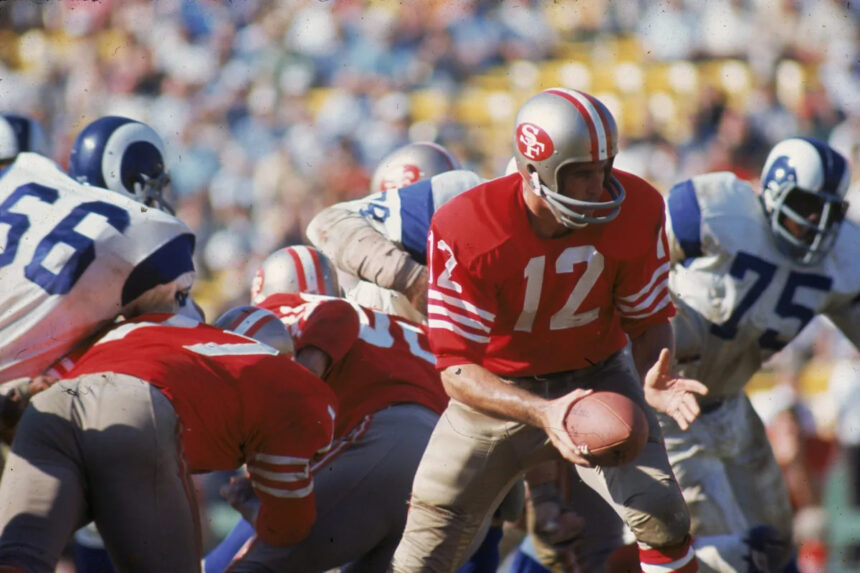
In an age before the West Coast Offense and Lombardi trophies, it was John Brodie’s golden arm that defined professional football in San Francisco. For 17 seasons, from 1957 to 1973, he was the constant under center, a model of durability and prolific production. While his career lacked the championship rings that would later glitter on the fingers of Joe Montana and Steve Young, Brodie’s stature among the faithful never dimmed. He was the original 49ers quarterback great, a 49ers Hall of Famer whose retired No. 12 jersey hangs as a testament to his enduring impact.
The Bay Area’s Own: From Stanford Star to 49ers Icon
John Brodie’s story is one of remarkable geographic and athletic symmetry. Born and raised in the Bay Area, he starred at Stanford University, just a short drive from Kezar Stadium, where the 49ers then played. In 1957, the team made the hometown hero the third overall pick in the NFL Draft. This wasn’t just a selection; it was an adoption. The community watched one of their own ascend to lead their professional team, creating a bond that transcended statistics.
His early career was spent in a quarterback competition with another legend, Y.A. Tittle, before Brodie firmly took the reins in the 1960s. He played with a gunslinger’s confidence and a technician’s mind, known for his quick release and deep-ball accuracy. Brodie’s career unfolded during a period of significant transition for the NFL and the 49ers, yet his performance consistently placed him among the league’s elite passers.
- NFL MVP (1970): The pinnacle of his career, leading the league in passing yards and touchdowns.
- 2x Pro Bowl Selection: Recognized as one of the game’s best.
- 3x Passing Touchdown Leader: Lead the NFL in TD passes in 1965, 1970, and 1971.
- Franchise Longevity: Played his entire 17-year career with the 49ers, a rarity in any era.
The 1970 MVP Season: A Vintage Year for a Vintage Quarterback
The 1970 campaign stands as the definitive chapter in John Brodie’s football biography. At 35 years old, in his 14th professional season, Brodie authored a masterpiece. He led the NFL with 2,941 passing yards and 24 touchdown passes, piloting the 49ers to a 10-3-1 record and the NFC West championship. His precision and leadership were unmatched that season, earning him the coveted NFL Most Valuable Player award.
This season cemented his legacy. It was a testament to his resilience and evolving skill, proving that a quarterback could peak well into his thirties. The 49ers’ playoff run that year ended in a heartbreaking loss to the Dallas Cowboys in the NFC Championship Game, a game that denied Brodie a Super Bowl appearance. Yet, the MVP honor solidified his place in history, proving that individual brilliance could shine even without the ultimate team accolade. It was a season that validated the faith of 49ers fans and showcased Brodie’s talent on the national stage.
Bridging Eras: Brodie’s Place in 49ers Quarterback Pantheon
Analyzing John Brodie’s legacy requires context. He played in an era with different rules, where protecting the quarterback was not a priority and passing statistics were harder to accumulate. Despite this, his career numbers are staggering: 31,548 passing yards and 214 touchdowns. He remains second in franchise history in passing yardage, trailing only Joe Montana.
His role was that of a bridge. He was the superstar who kept the 49ers relevant and competitive throughout the 1960s and early 70s, maintaining the franchise’s offensive identity after the departure of Y.A. Tittle and before the arrival of the Montana/Young dynasty. Owner John York perfectly captured this sentiment in his statement, noting that his own fandom began by watching Brodie play. For a generation of fans, Brodie was the 49ers. His loyalty—spending his entire career with one team in an era before free agency—and his local roots created a unique, unbreakable bond with the community.
“The 49ers family is saddened to learn of the passing of one of the franchise’s all-time great players,” York said. “He displayed an incredible commitment towards his teammates and his support of the organization never wavered after his playing days.”
A Legacy Beyond the Stats: The Original 49ers Quarterback
John Brodie’s influence extends beyond record books. He was a fierce competitor, known for his intense focus and will to win. After his football career, he found success as a broadcaster and on the Senior PGA Tour, demonstrating the same competitive fire on the golf course. His multifaceted life as an athlete showcased a relentless drive for excellence.
For the modern 49ers organization, Brodie’s legacy is a foundational stone. He established the standard for quarterback play in San Francisco—a standard of production, toughness, and longevity that every successor would be measured against. Players like Montana and Young didn’t just arrive to a franchise in need; they arrived to a franchise with a proud quarterback history that began with Brodie.
Predictions for His Lasting Impact: As the 49ers continue to build their future, Brodie’s story will be told as the origin point of their quarterback lineage. His number retirement ensures that every fan who enters Levi’s Stadium sees his “12” alongside “16” and “8,” a chronological tribute to the men who defined the position for this franchise. Historians and analysts will increasingly contextualize his MVP season as one of the great late-career performances in NFL history. His legacy is secure not as a quarterback who didn’t win a title, but as the iconic figure who carried the torch for two decades and made the 49ers’ eventual championships possible by sustaining the franchise’s spirit and identity.
Conclusion: A Bay Area Legend Remembered
The passing of John Brodie marks the end of an era for the San Francisco 49ers and their fans. He was the quintessential local hero, a player whose career arc—from Stanford star to franchise icon—may never be replicated. In an age of player movement, his 17-year tenure with a single team stands as a monument to loyalty and mutual devotion.
While the Super Bowl rings eluded him, John Brodie achieved something perhaps more profound for a Bay Area native: he became the eternal quarterback of a city and a region’s heart. He won an MVP, he retired a number, and he earned the unwavering respect of every 49er who followed. His career was not a prelude to greatness; it was greatness defined on its own terms. The deep passes, the quick release, the fierce competitiveness—these are the memories that will endure. John Brodie wasn’t just a 49ers great; he was the original, and his legacy will forever be a cornerstone of the franchise’s proud history.
Source: Based on news from Yahoo Sports.