John Brodie, 49ers Legend and 1970 NFL MVP, Dies at 90
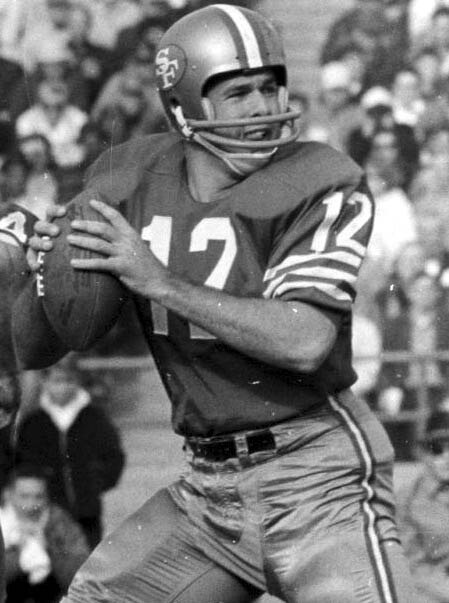
The San Francisco 49ers, a franchise synonymous with quarterback excellence, has lost one of its foundational pillars. John Brodie, the iconic signal-caller who spent his entire 17-year career with the team and authored one of the most remarkable late-career resurgences in NFL history, passed away on Friday at the age of 90. His death marks the end of an era for a pre-dynasty 49ers team, where his prolific arm and fierce competitiveness laid the groundwork for the West Coast offensive fireworks to come.
- The Golden Arm of the Golden Gate: Brodie’s Legacy Forged in San Francisco
- The Magnificent 1970 MVP Season: A Quarterback’s Masterclass
- From Teammate to Friend: The Enduring Bond with the 49ers Family
- Analysis: Brodie’s Place in the Pantheon and a Lasting Influence
- A Final Pass: Remembering a 49ers Icon
The Golden Arm of the Golden Gate: Brodie’s Legacy Forged in San Francisco
In an age of single-wing tailbacks and ground-and-pound football, John Brodie was a forward-thinking passer, a gunslinger before the term was commonplace. Drafted third overall in 1957 out of Stanford, he became the face of the franchise during an era when the 49ers were often brilliant but fell just short of championship glory. For nearly two decades, his name was synonymous with the San Francisco 49ers, a constant through changing times and a direct bridge from the days of Y.A. Tittle to the dawn of the Bill Walsh era.
Brodie’s career statistics, impressive even by today’s standards, tell the story of a consistently elite quarterback operating in a different NFL. He retired in 1973 ranking in the top three all-time in pass attempts, completions, and passing yards. His 214 touchdown passes stood as a testament to his daring and accuracy. Yet, numbers alone cannot capture his impact. He played with a swagger and an intellectual approach to the game, often calling his own plays and dissecting defenses with a surgeon’s precision.
- 17 Seasons: All with the San Francisco 49ers (1957-1973).
- 31,548 Career Passing Yards: A massive total for his era, ranking 3rd all-time upon retirement.
- 214 Career Touchdown Passes: Showcasing his prolific scoring ability.
- 2-Time Pro Bowler (1965, 1970) and First-Team All-Pro (1970).
The Magnificent 1970 MVP Season: A Quarterback’s Masterclass
While Brodie was a star throughout the 1960s, his legacy was cemented in 1970 with a season for the ages. At 35 years old, an age when most quarterbacks of his generation were long retired, Brodie delivered a masterclass in quarterbacking that earned him the league’s highest individual honor. He led the NFL in passing yards (2,941), touchdown passes (24), and completion percentage (59.3%), piloting the 49ers to a 10-3-1 record and the NFC West championship.
This was not a lifetime achievement award; it was a recognition that he was, unequivocally, the best player in football that year. He edged out formidable competition like Dallas’s Duane Thomas and Minnesota’s Alan Page for the 1970 NFL Most Valuable Player award. The season culminated in a heartbreaking NFC Championship Game loss to the Dallas Cowboys, a game that denied Brodie his best shot at a Super Bowl. Nevertheless, the MVP season stands as a powerful testament to his longevity, skill, and unwavering will to win, proving that a quarterback’s peak could come after a decade and a half of warfare in the trenches.
From Teammate to Friend: The Enduring Bond with the 49ers Family
The news of Brodie’s passing resonated deeply within the 49ers organization, highlighting a relationship that extended far beyond his retirement. In an official statement, 49ers co-chairman Dr. John York offered a poignant and personal tribute. “As a kid, my 49ers fandom began by watching John play quarterback on television,” York said. “He displayed an incredible commitment toward his teammates and his support of the organization never wavered after his playing days. John became a dear friend of mine, and he will always be remembered as an important part of 49ers history.”
This sentiment underscores a critical aspect of Brodie’s legacy: his enduring loyalty to the 49ers. In an era of increased player movement, his career is a monument to franchise stability. He was a constant presence, a mentor to younger players, and a revered elder statesman. The organization’s social media post, mourning the passing of “Edward J. DeBartolo Sr. 49ers Hall of Famer John Brodie,” formally linked him to the team’s ownership legacy, signifying his integral role in the fabric of the club.
Analysis: Brodie’s Place in the Pantheon and a Lasting Influence
Expert analysis of John Brodie’s career must position him as a crucial evolutionary link in NFL history. He was not a system quarterback; he was the system for the 49ers for a generation. Playing in an offensive scheme that relied heavily on his decision-making and arm talent, Brodie demonstrated that a pass-centric attack could be successful, foreshadowing the offensive revolutions that would later define the league and, ironically, the 49ers themselves under Bill Walsh.
His influence can be seen in the lineage of 49ers quarterbacks who followed. While stylistically different, the expectation of quarterback excellence in San Francisco—the mandate to carry the team with intelligence and passing prowess—was established by Brodie. He proved a superstar quarterback could thrive in the Bay Area, setting a standard that Joe Montana, Steve Young, and others would not just meet but elevate to a championship level. His career is a reminder that legends are not defined solely by rings, but by how they shape their franchise’s identity and inspire those who follow.
A Final Pass: Remembering a 49ers Icon
The passing of John Brodie is a somber moment for the NFL community and a profound loss for the 49ers Faithful. He was the quintessential franchise quarterback, a bridge between eras, and the author of one of the most inspiring MVP seasons the league has ever witnessed. His commitment to a single team, his brilliance on the field, and his lasting friendship with the organization embody the values of loyalty and excellence.
Our deepest condolences go out to his wife, Sue, his entire family, and his countless friends and former teammates. While the flags at Levi’s Stadium may fly at half-staff, the legacy of John Brodie—his golden arm, his competitive fire, and his unwavering presence—will forever be held at full mast in the annals of San Francisco 49ers history. He wasn’t just a player for a team; for 17 years, he was the heartbeat of a city’s football dreams.
Source: Based on news from Deadspin.
Image: CC licensed via en.wikipedia.org