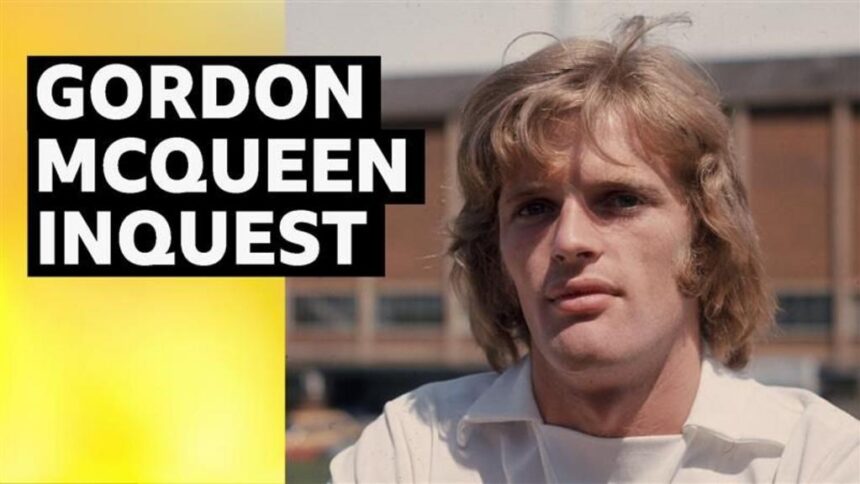
‘Football Doesn’t Need to Take Lives’: The McQueen Verdict and the Beautiful Game’s Unseen Injury
The roar of the crowd, the thud of a perfectly struck pass, the triumphant arc of a ball meeting forehead in a decisive header. For generations, these have been the symphonies of football. But a coroner’s quiet courtroom in West Yorkshire has sounded a dissonant, devastating note, one that threatens to redefine the sport’s very physicality. The finding that repeatedly heading a football is “likely” to have contributed to the neurodegenerative disease that killed Scotland and Manchester United legend Gordon McQueen is not just a verdict on a life tragically cut short; it is a seismic ruling on the game’s future.
A Daughter’s Plea: From Personal Grief to Public Campaign
Gordon McQueen, the towering, charismatic defender known for his aerial prowess, died in June 2023 at the age of 70 after a battle with vascular dementia and a motor neurone disease (MND) overlap syndrome. The inquest heard he was exposed to “repetitive head impacts” during his 20-year career. In the aftermath, his daughters, broadcaster Hayley McQueen and Anna Forbes, transformed their profound loss into a powerful call for action.
Their statement, anchored by the poignant line “Football doesn’t need to take lives”, cuts to the heart of the matter. This isn’t about eradicating a fundamental skill, but about evolving its practice with brains and lives at the forefront. “We hope that heading the ball is now taken more seriously and is more controlled,” they urged, highlighting a legacy far beyond trophies and caps. Their advocacy shifts the conversation from abstract medical studies to the raw, human cost—a father lost too soon, his final years shrouded in an illness potentially born on the pitch.
The Unavoidable Science: Heading and Neurodegenerative Risk
The coroner’s finding aligns with a growing and incontrovertible body of scientific evidence. The link between sub-concussive impacts—blows to the head that don’t cause immediate, visible concussion symptoms—and long-term brain injury is now firmly established in contact sports. Every header, every clash of heads, every accidental elbow transmits force through the skull, potentially causing microscopic damage that accumulates over time.
Key research, including the landmark FIELD study from the University of Glasgow, found that former professional footballers were 3.5 times more likely to die from neurodegenerative diseases than the general population. For defenders, a role synonymous with aerial duels, the risk was even higher. This isn’t about one tragic anecdote; it’s a statistical pattern with Gordon McQueen’s case as a heartbreaking data point. The diseases implicated—Chronic Traumatic Encephalopathy (CTE), dementia, and MND—represent a spectrum of suffering that robs individuals of their identity, memory, and physical autonomy.
- Sub-concussive Impacts: The silent, cumulative damage from repeated heading.
- CTE Pathology: A protein called tau forms tangles in the brain, only definitively diagnosed post-mortem.
- Positional Risk: Central defenders and forwards, who contest more aerial balls, show higher incidence rates.
The Game in Transition: What Changes Are Already Happening?
Football’s authorities, often slow to react, can no longer plead ignorance. The McQueen verdict adds immense legal and moral weight to the need for proactive measures. Changes are already underway, primarily focused on the game’s youngest participants:
In England, Scotland, and Northern Ireland, guidelines now ban heading in training for primary school children and gradually introduce it at older age groups. The FA advises a maximum of ten higher-force headers per week in professional training. But critics argue this is tinkering at the edges. The inquest into McQueen’s death, following similar findings for England’s 1966 World Cup hero Nobby Stiles and others, begs the question: is this enough for the professional and adult game?
Potential future mitigations being debated include:
- Advanced Concussion Protocols: Permanent “concussion spotters” with the power to remove players, and extended mandatory leave for any head impact.
- Equipment Innovation: Can ball technology evolve to significantly reduce impact force without altering the essence of the game?
- Limits in Training: Drastically reducing, or even eliminating, repetitive heading drills for professionals, treating the skill with the same caution as full-contact tackling in practice.
- Legal and Insurance Repercussions: Clubs and federations may face increased liability, forcing systemic change from a financial perspective.
The Future of the Header: Prediction and Preservation
Predicting football’s trajectory is fraught. The header is iconic—from Hurst to Charlton, Ronaldo to Haaland. Its removal seems unthinkable. Yet, the sport has evolved before: the back-pass rule, tackle from behind bans, and VAR all faced resistance but were adopted for safety and fairness. The most likely path is not elimination, but a fundamental re-contextualization of the header’s risk.
We may see a future where heading becomes a highly regulated, sparingly used tactical option rather than a routine exertion. Coaching philosophy may shift further towards a possession-based, ground-oriented game. The most profound change, however, will be cultural. The “hard man” archetype, who bravely heads a heavy, wet ball or plays through a dizzying clash, must be retired not as a hero, but as a risk to his own future. Player unions will have a pivotal role in demanding safer working conditions.
The ultimate legacy of Gordon McQueen, Nobby Stiles, and others may be a sport where talent is not measured by a willingness to incur unseen, long-term damage. As Hayley McQueen and Anna Forbes powerfully remind us, the goal is to protect the people who make the game beautiful. Preventative measures in football are no longer a debatable option; they are an ethical imperative.
Conclusion: A Legacy Beyond the Pitch
The coroner’s conclusion in Gordon McQueen’s inquest is a line in the sand. “Football doesn’t need to take lives” is more than a headline; it is a mandate. The beautiful game is facing its ugliest truth: that a skill celebrated for decades carries a latent, deadly cost. While the header will likely remain, its practice from grassroots to the professional pinnacle must be transformed by science, regulated with courage, and guided by the voices of those, like the McQueen family, who have paid the highest price. The challenge now is to honour these fallen giants not just with tributes, but with decisive action that ensures future generations can enjoy the game they loved, without fearing the final whistle on their health.
Source: Based on news from BBC Sport.