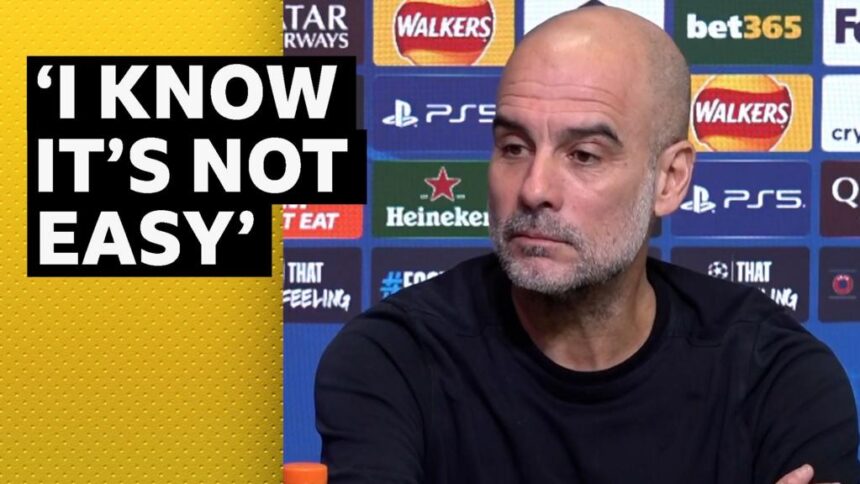
Pep Guardiola’s Fiery Defense: A Clash of Pressure, Principle, and Premier League Power
The final whistle at the Etihad brought relief for Manchester City after a hard-fought 2-0 victory over Wolverhampton Wanderers. But the real drama was just beginning. In a post-match press conference that crackled with tension, manager Pep Guardiola found himself not dissecting Erling Haaland’s brace, but locked in a heated exchange with a reporter over comments he made about rookie Premier League referee Farai Hallam. What unfolded was a revealing glimpse into the immense pressure cooker of a title race, the perennial debate over officiating, and the unyielding principles of one of football’s most successful managers.
The Spark: Guardiola’s Post-Wolves Outburst
Following a match where City dominated but faced stubborn resistance, Guardiola’s initial comments strayed from his team’s performance. He expressed frustration with what he perceived as a pattern of decisions, specifically referencing referee Farai Hallam, who was taking charge of only his second-ever Premier League game. While Guardiola later issued an apology to Hallam personally, he staunchly defended the sentiment behind his outburst. This created the perfect storm: a manager’s raw emotion clashing with the media’s scrutiny of his influence on the discourse surrounding match officials.
The subsequent press conference confrontation was not about a single yellow card or penalty shout. It was a meta-debate on the pressure on Premier League officials, the rights of managers to critique, and the line between observation and intimidation. Guardiola, visibly agitated, argued his point was being misrepresented, transforming a discussion on match analysis into a tense standoff over narrative and respect.
Beyond the Headlines: Anatomy of a Heated Exchange
To understand the depth of this clash, one must look at the converging pressures:
- The Title Race Crucible: Every match for City is a must-win. In such an environment, every 50/50 decision feels monumental. Guardiola’s frustration is often a spillover from this relentless pressure.
- The Rookie Referee Factor: Mentioning Hallam’s inexperience directly tapped into a sensitive league-wide conversation about the development and support for new officials at the highest level.
- Media Dynamics: The reporter’s line of questioning challenged Guardiola’s potential influence on future officiating of City games, a charge the Catalan vehemently rejected as a mischaracterization of his intent.
At its core, Guardiola’s defense was not of a specific complaint, but of a manager’s right to be emotionally honest in post-match reactions, within reason. He argued that his later apology showed necessary respect for the individual, while his initial comments reflected the genuine, high-stakes emotions of the dugout. This distinction between personal respect and professional critique became the battleground.
Expert Analysis: The Tightrope of Manager-Referee Relations
This incident is a microcosm of a perennial issue in modern football. The Premier League’s intensity, amplified by VAR and hyper-analysis, has placed referees under an unprecedented microscope. Managers like Guardiola, Jurgen Klopp, and Mikel Arteta are charismatic, powerful figures whose words carry immense weight. When they speak critically about officiating, it reverberates through fan bases and media cycles, potentially shaping public perception.
Guardiola’s stance raises critical questions:
- Is there a “cooling-off” period needed before managers face microphones?
- Does contextualizing a referee’s experience help or hinder their development?
- Where is the line between legitimate tactical observation and psychological pressure on officials?
While the Professional Game Match Officials Limited (PGMOL) has mechanisms for private feedback, the public theater of post-match interviews often becomes the default arena for grievances. Guardiola’s clash underscores the lack of a clear, mutually agreed-upon framework for this communication. His apology, while significant, follows a familiar pattern: emotional public criticism, followed by measured private clarification, leaving the public discourse permanently charged.
Predictions: Ripple Effects for City and the Premier League
The immediate fallout from this exchange will be multifaceted. For Guardiola and City, we can anticipate:
A Short-Term Siege Mentality: Guardiola will likely use this as a unifying tool, portraying his team and staff as being under scrutiny from all sides. This can galvanize a squad in the final, decisive weeks of the season.
Increased Scrutiny on City’s Games: Ironically, the incident will likely draw more attention to refereeing decisions in Manchester City’s matches, not less. Every call, for or against them, will be analyzed through this new lens.
For the Premier League and PGMOL, the predictions are more structural:
- Enhanced PR & Dialogue: The league may seek more proactive communication about officiating standards and the development pathway for referees like Hallam.
- Potential for Stricter Guidelines: While “bringing the game into disrepute” rules exist, governing bodies may look to more clearly define acceptable post-match commentary to protect officials.
- Focus on Support Systems: The spotlight on a rookie referee will intensify internal discussions about how best to mentor and shield officials during their early top-flight assignments.
Conclusion: More Than Just a Spat
Pep Guardiola’s fiery defense of his referee remarks after the Wolves win was far more than a testy press conference moment. It was a collision of football’s modern realities: the manager as a monumental figure, the unbearable pressure of the title chase, and the fragile, vital authority of the match official. While his apology to Farai Hallam was a necessary and professional step, Guardiola’s refusal to back down from the essence of his frustration reveals a man fighting for what he sees as the emotional truth of management.
This episode will not be the last of its kind. The Premier League’s gold-standard status is built on this very intensity—of play, of passion, and of opinion. The challenge for all stakeholders is to ensure that the heat of competition, so brilliantly embodied by figures like Guardiola, does not burn the essential foundations of respect and fairness upon which the sport depends. The beautiful game’s ongoing drama is played out not just on the grass, but in these verbal duels where pressure, principle, and power are perpetually in contest.
Source: Based on news from BBC Sport.