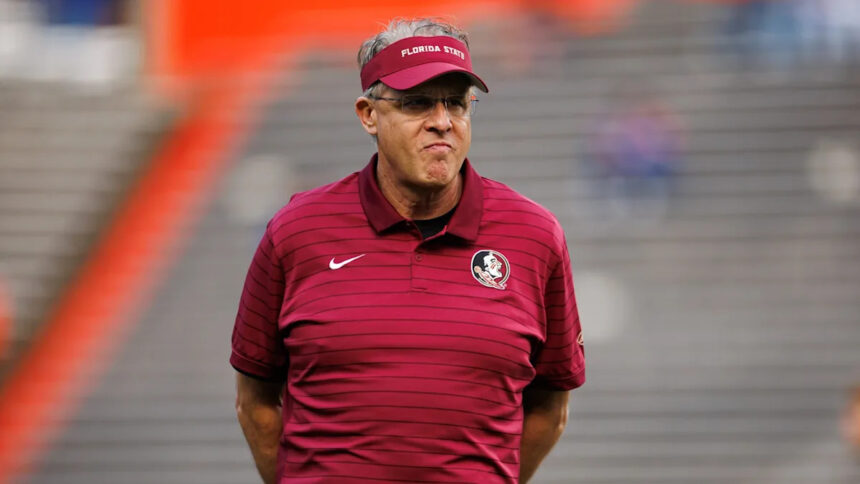
Gus Malzahn Retires: An Offensive Innovator Steps Away After 35 Years
The coaching carousel of college football is perpetual, but on Monday, one of its most distinctive rides came to a quiet and final stop. Gus Malzahn, the offensive architect whose name became synonymous with breakneck tempo and power-running innovation, announced his retirement from coaching at age 60. The Florida State offensive coordinator’s decision closes a 35-year chapter that saw him reach the pinnacle of the sport, influence a generation of play-callers, and leave an indelible mark on every program he touched.
The Hurry-Up No More: Malzahn’s Sudden Exit
In a move that caught many off guard, Malzahn released a statement from Tallahassee that was as direct as his offensive philosophy. “After 35 years, it’s time for me to step away from coaching,” Malzahn said. “I am excited to spend more time with my family and focus on the next chapter of my life.” The announcement came just months after he orchestrated one of the nation’s most potent offenses at Florida State, a fact that underscores the personal nature of his choice. For a coach who built his legacy on relentless pace and forward motion, the decision to finally step off the gas is a profound moment of reflection.
Malzahn’s final season was a testament to his enduring genius. In 2025, his Florida State offense led the ACC in both total offense and rushing offense. The Seminoles’ attack was a spectacle, posting nine 400-yard outputs and achieving a historic feat: back-to-back games with over 700 yards for the first time in the school’s storied history. He exits not with a whimper, but with an explosive final act that reminded everyone of the chaos his schemes could unleash.
A Career Forged in Innovation: From High School to The Plains
Gus Malzahn’s path was unorthodox. He cut his teeth as a legendary high school coach in Arkansas, winning state titles with an offensive system that was years ahead of its time. His playbook, literally sold as “The Hurry-Up, No-Huddle: An Offensive Philosophy,” became a cult classic and paved his way to the college ranks. His rise was meteoric.
- Arkansas State (2012): A one-year head coaching stint resulted in a Sun Belt championship.
- Auburn (Offensive Coordinator, 2009-2011): He revolutionized college football with the read-option, piloting Cam Newton and the Tigers to the 2010 BCS National Championship.
- Auburn (Head Coach, 2013-2020): He returned as head coach, leading the Tigers to a national championship appearance in his first season (2013) and securing an SEC title. His tenure was defined by thrilling victories, a Heisman runner-up in Nick Marshall, and iconic moments like the “Kick Six.”
- UCF (Head Coach, 2021-2024): He reinvigorated the Knights, making them a consistent force in the American Athletic Conference and transitioning them into the Big 12.
- Florida State (Offensive Coordinator, 2025): His final role was a resounding success, proving his system could seamlessly adapt and dominate in a new environment.
Malzahn’s legacy is that of an offensive innovator who forced defensive coordinators to completely rethink their approach. He blended the physicality of traditional SEC football with the spacing and tempo of modern spread attacks, creating a hybrid that was brutally effective.
What’s Next for Florida State’s Offense?
Florida State head coach Mike Norvell moved swiftly to ensure continuity, promoting from within. Tim Harris Jr., who served as co-offensive coordinator and receivers coach under Malzahn, has been elevated to the role of sole offensive coordinator. This is a strategic and stabilizing move.
Harris, a respected recruiter and developer of talent, was deeply involved in the 2025 offensive explosion. His promotion signals Norvell’s desire to maintain the system’s core principles—tempo, physical run game, explosive plays—while perhaps integrating more of his own pass-game concepts. The transition should be one of evolution, not revolution. The Seminoles return a wealth of talent, and Harris’s challenge will be to prove that the offensive success was not solely the product of Malzahn’s mind, but of a sustainable and adaptable system he helped co-pilot.
The key question for the Seminoles will be: Can they retain the ruthless efficiency in the running game while expanding the aerial attack? Harris’s work with the receivers suggests a commitment to balance, but replacing a legendary play-caller like Malzahn is an immense task, regardless of the preparation.
The Lasting Impact of a Coaching Maverick
Gus Malzahn’s retirement marks the end of an era for a specific brand of college football. In an age where offense continues to trend toward pass-heavy, air-raid derivatives, Malzahn remained stubbornly and successfully committed to a run-first, quarterback-run-centric identity. His influence is everywhere.
Coaches at all levels have borrowed from his packaged plays, his tempo mechanics, and his use of pre-snap motion to create numerical advantages. He proved that innovation could thrive in the most conservative conference in America. While his final years at Auburn were marked by heightened expectations and seismic pressure, his overall record—a national title as a coordinator, a SEC championship as a head coach, and successful rebuilds at two different Group of Five programs—is one of remarkable achievement.
His departure also highlights the increasing demands and shortened shelf life of major college coaching. At 60, Malzahn is younger than many of his active peers, suggesting the grind of the year-round cycle—recruiting, transfer portal management, NIL fundraising—played a role in his decision to seek a quieter life.
Conclusion: A Final Whistle
Gus Malzahn leaves the field on his own terms, with his offensive philosophy still producing video-game numbers. He was more than just a coach; he was a system originator, a trendsetter who changed how the game was played. From the Friday night lights of Arkansas to the brightest Saturday stages in the SEC and ACC, his hurry-up, no-huddle ethos left opponents gasping and fans exhilarated.
For Florida State, the Tim Harris Jr. era begins with a high bar set and a blueprint in place. For the sport, it loses one of its true offensive visionaries. And for Gus Malzahn, the man who made football move faster than anyone thought possible, the next chapter promises a slower, well-earned pace. The hurry-up offense is finally, and permanently, huddled.
Source: Based on news from Yahoo Sports.