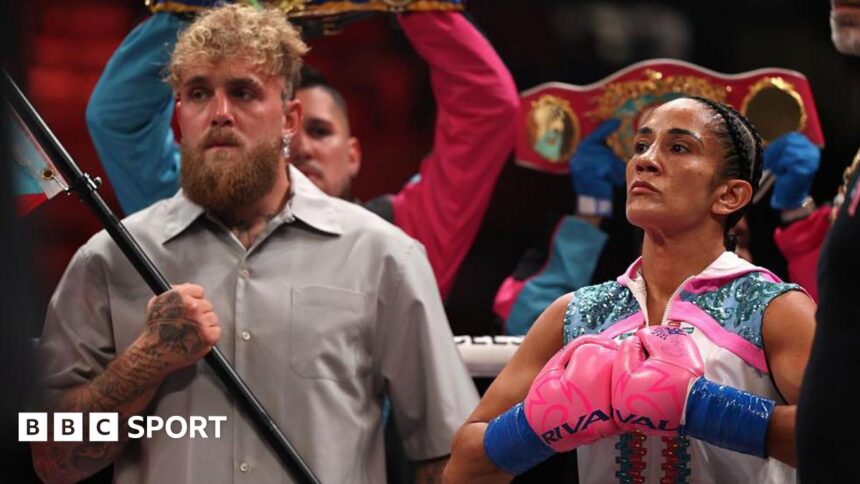
Serrano vs. Paul: A Champion’s Stance on Identity, Loyalty, and the “Fake American” Label
The world of combat sports is no stranger to controversy, but the latest firestorm ignited not in the ring, but on social media, pitting promoter against fighter in a debate over national identity. Seven-division boxing world champion Amanda Serrano, a proud Puerto Rican, has publicly criticized her longtime promoter and ally, Jake Paul, for his comments calling global music icon Bad Bunny a “fake American.” This rare public disagreement between the MVP (Most Valuable Promotions) partners cuts to the heart of complex issues of patriotism, cultural pride, and the nuanced relationship between Puerto Rico and the United States.
The Spark: A Super Bowl Comment Ignites a Firestorm
During the Super Bowl halftime show at Levi’s Stadium, Bad Bunny—born Benito Antonio Martínez Ocasio in Puerto Rico—delivered a vibrant, Spanish-language performance celebrating his heritage. In response, Jake Paul took to X, stating he “turned off the halftime show” because he “can’t support” Bad Bunny, whom he accused of “publicly hat[ing] America.” The inflammatory “fake American” label attached to the six-time Grammy winner quickly drew backlash.
For Amanda Serrano, the comment struck a personal chord. As the first athlete signed to Paul’s Most Valuable Promotions in 2021—and later granted a historic “lifetime” contract—Serrano has been a cornerstone of Paul’s boxing venture. Yet, her loyalty to her *Boricua* roots proved stronger. In a clear and measured response, Serrano stated Paul was “wrong” for his characterization, defending Bad Bunny’s right to celebrate his culture on a global stage. This moment laid bare a fundamental tension between Paul’s often provocative, headline-driven persona and the cultural sensitivities of the very community one of his flagship athletes represents.
Beyond the Ring: The Complex Puerto Rican Identity
To understand the weight of Serrano’s rebuttal, one must grasp the unique status of Puerto Rico. As a U.S. territory, Puerto Ricans are born as U.S. citizens, yet the island is not a state. This creates a layered identity that is both American and distinctly Puerto Rican. For many on the island and in the diaspora, cultural pride and national sentiment are not mutually exclusive with American citizenship.
- Cultural Sovereignty: Figures like Bad Bunny and Amanda Serrano are modern symbols of *Boricua* excellence. Their success on the world stage is seen as a point of immense national pride for Puerto Rico, independent of U.S. affiliation.
- The Patriotism Paradox: Puerto Ricans serve in the U.S. military at high rates, yet many feel a primary allegiance to their island. Criticizing U.S. policy or celebrating Puerto Rican independence is not synonymous with “hating America,” but often an expression of a complicated colonial history.
- Serrano’s Platform: By speaking out, Serrano used her platform to educate. Her stance underscores that Puerto Rican artists and athletes can be grateful for opportunities in the U.S. while fiercely protecting and promoting their cultural identity.
Jake Paul’s comment, likely intended as a piece of his typical inflammatory content, failed to account for this profound nuance. It reduced a complex socio-political identity to a binary of “real” versus “fake,” a framing Serrano found necessary to correct.
Promoter vs. Protégé: Can the MVP Alliance Weather the Storm?
The business relationship between Jake Paul and Amanda Serrano has been mutually transformative. Paul’s promotion has secured Serrano historic paydays and landmark events, most notably the first women’s boxing main event at Madison Square Garden. Serrano, in turn, has provided legitimacy and world-class credibility to the MVP brand. This incident, however, tests the foundation of that partnership.
Analysis of the Dynamic: This is not a mere contractual alliance; it has been portrayed as a genuine friendship and a shared mission to uplift women’s boxing. Public disagreements are rare. Serrano’s decision to publicly call out Paul suggests the issue was one of core principle she could not ignore. For Paul, the controversy presents a dilemma: double down on his divisive commentary style or recalibrate to maintain harmony with his most valuable asset.
The business implications are significant. Serrano’s fanbase is deeply rooted in the Puerto Rican and broader Latino community. Alienating that base would be catastrophic for her marketability and, by extension, for MVP. Paul’s savvy as a promoter will be tested in how he manages this rift. A private reconciliation is almost certain, but the public perception of a crack in the MVP facade is now a reality.
Predictions: Repercussions and Evolving Roles
This clash is more than a one-off news cycle; it signals potential shifts in the boxing landscape and the personas of those involved.
- Serrano’s Ascendant Voice: Expect Amanda Serrano to leverage this moment to solidify her role not just as a champion, but as a cultural ambassador. Her brand will increasingly intertwine with advocacy for Puerto Rican identity and pride, potentially expanding her influence far beyond boxing.
- Paul’s Calculated Pivot?: Jake Paul is a master of attention, but even he must recognize when a line has been crossed with a key business partner. A strategic, if not fully apologetic, softening of his stance on such cultural issues is likely. He may reframe his “anti-woke” persona to avoid direct conflict with the identities of his own fighters.
- Impact on MVP Recruitment: Other fighters, particularly those from diverse international backgrounds, may now view MVP with slight caution. The promotion’s ability to attract global talent could hinge on demonstrating respect for the complex identities of its athletes, not just their marketability.
- The “Bad Bunny Effect”: In the broader sports and entertainment crossover sphere, this incident highlights the growing power of Latino audiences. Dismissing or misunderstanding their cultural icons is a proven recipe for backlash.
Conclusion: A Champion Defines What Real Representation Means
Amanda Serrano’s defense of Bad Bunny was not merely about correcting a comment; it was a defining moment of authentic representation. In a single public statement, she championed the right of Puerto Ricans—and by extension, all people with multifaceted identities—to define their own patriotism and belonging. She demonstrated that true strength lies not in parroting divisive labels, but in articulating a more inclusive and educated perspective.
While her professional future remains tied to Jake Paul and MVP, Serrano has made it unequivocally clear that her cultural integrity is not negotiable. The “fake American” controversy reveals a growing pain for MVP: as it evolves from a disruptive startup to a major player in boxing promotion, its content must mature alongside its champions. In the ring, Amanda Serrano fights for titles and legacy. Outside of it, as she just proved, she fights for the dignity of her people, and in doing so, lands the most impactful punch of her career.
Source: Based on news from BBC Sport.