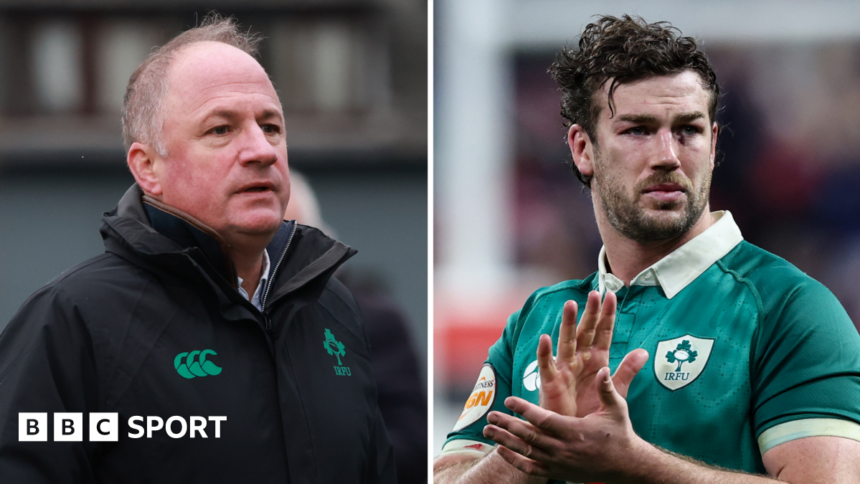
Ireland’s Paris Flop Must Become Fuel for Italian Job, Says Humphreys
The roar of the Stade de France has faded, leaving in its wake an unfamiliar silence in Irish rugby. The 36-14 scoreline from Paris wasn’t just a defeat; it was a stark, uncharacteristic dismantling. For a team and a nation accustomed to setting the standard, the opening weekend of the Six Nations felt like a sudden, jarring step back into a past many thought was consigned to history. Now, as a buoyant Italy arrives in Dublin, the question isn’t just about winning, but about identity. Performance director David Humphreys has labelled the Parisian performance as “fuel.” On Saturday, Ireland must prove they can ignite it.
A Parisian Reality Check: Dissecting the French Flop
Andy Farrell’s post-match diagnosis was blunt and damning: a “lack of intensity.” It was a phrase that cut to the core of Ireland’s issues. This was not a case of being beaten by moments of magic; it was a systemic failure to match the physical and psychological furnace lit by the French. The line speed was sluggish, the breakdown was a contested mess, and the usually imperious set-piece creaked under immense pressure. Caelan Doris and his fellow forwards, so often the engine of this team, found themselves on the back foot, outmuscled and outmanoeuvred.
David Humphreys, the former fly-half turned performance director, pulled no punches in his assessment. “We didn’t perform,” he stated, a simple sentence loaded with disappointment. For a squad built on meticulous preparation and emotional control, the performance was a profound anomaly. The defeat exposed several critical areas:
- Passive Defence: The French gainline was conquered with alarming ease, allowing Romain Ntamack and Antoine Dupont to operate on the front foot.
- Breakdown Breakdown: Ireland’s precision at the ruck, a hallmark of their success, was missing, leading to slow ball and turnovers.
- Kicking Game Misfire: The tactical kicking, usually a weapon of territorial control, was often aimless, handing possession and initiative back to a deadly French counter-attack.
This was a collective off-day, a perfect storm of Irish underperformance and French ferocity. The challenge now is to ensure it remains an aberration, not a trend.
From Fuel to Fire: The Aviva Stadium Response
The true measure of this Irish team under Andy Farrell has never been its ability to win—they have done that consistently—but its capacity to respond to adversity. The 2023 Grand Slam campaign was built on resilience. Now, they face a different type of test: rebounding from a comprehensive beating. Humphreys’ insistence that the experience “has to be fuel” is the central theme of this week’s preparation. Pride has been wounded, and the Aviva Stadium crowd will demand a response that speaks of character.
Expect a seismic shift in physicality. The focus at training will have been elemental: tackle height, clearout ferocity, and line-speed. Players like Tadhg Beirne, Peter O’Mahony, and the returning Garry Ringrose (if fit) will be tasked with reigniting the emotional pulse of the side. The leadership group, perhaps caught quiet in Paris, must be vocal and visceral from the first whistle. This is not just about fixing technical flaws; it’s about re-establishing a performance identity built on relentless aggression and accuracy.
The selection will be fascinating. Does Farrell stick with the core that has served him so well, trusting them to put it right? Or does he inject fresh energy, perhaps giving a start to the explosive Calvin Nash or the robust Stuart McCloskey? Whatever the lineup, the directive will be clear: restore the fundamentals, play in the right areas of the pitch, and unleash the attacking structure that has terrorised teams for two years.
The Italian Storm: A Danger Transformed
Gone are the days when Italy in Dublin was a guaranteed five-point banker. The visitors arrive not as plucky underdogs, but as a legitimate threat, soaring on the confidence of a historic home victory over Scotland. In Ange Capuozzo, they possess one of the tournament’s most electric open-field runners. In Tommaso Menoncello, they have a powerhouse centre. And in Michele Lamaro, they have a captain who embodies their new, gritty defiance.
Coach Gonzalo Quesada has instilled a more pragmatic, street-smart edge to their undeniable flair. They will look to disrupt, to challenge Ireland’s potentially fragile confidence at source, and to pounce on any lingering indecision. Their set-piece is robust, and their willingness to play from anywhere means Ireland’s discipline and defensive shape must be lightyears ahead of the Paris showing. Underestimating this Italian side would be a catastrophic error. They are the tangible, dangerous embodiment of the “one game at a time” cliché—and they have already won theirs.
Prediction: A Performance, Not Just a Result
The result, in many ways, feels like a foregone conclusion. Ireland at the Aviva, wounded and angry, are a formidable prospect. The bookmakers’ points spread is wide. But the true metric for success on Saturday will not be the winning margin. It will be the performance intensity, the visible correction of the Paris wrongs, and the reassertion of a dominant mindset.
Expect a ferocious opening quarter. Ireland will seek to dominate the collision, win the penalty battle, and build scoreboard pressure to suffocate Italian belief. The key battles will be in the half-back duel, where Jamison Gibson-Park must rediscover his tempo, and in the back-field, where Hugo Keenan will be crucial nullifying Capuozzo’s magic.
- Key for Ireland: Start fast, win the gainline, and execute with cold precision. Emotion must be channelled, not chaotic.
- Key for Italy: Survive the early storm, frustrate at the breakdown, and exploit any hint of Irish anxiety with counter-attacks.
The prediction is for Ireland to win, and win comfortably in the end—perhaps by 20-25 points. But the story will be in the manner of the victory. A stuttering, error-strewn win will leave questions lingering for the trip to Twickenham. A powerful, cohesive, and ruthless display will see Paris framed as the necessary jolt that re-energised a championship campaign.
Conclusion: The Championship Re-Starts Here
For Ireland, the 2024 Six Nations effectively begins now. The trip to Paris was a brutal preamble, a reminder of the fine margins at this elite level. David Humphreys and Andy Farrell have been handed a powerful motivational tool in that defeat. How the players use it will define their tournament.
Saturday against Italy is not merely about bouncing back. It is about reclamation. Reclaiming their physicality, their accuracy, and their status as relentless contenders. The Aviva Stadium crowd will be a part of that process, demanding a response that realigns the season’s narrative. Ireland flopped in Paris. In Dublin, they must not just win, but announce, emphatically, that the flop was a one-off. The fuel is in the tank; now, they must burn it.
Source: Based on news from BBC Sport.