Ice Hockey’s Geopolitical Face-Off: IIHF Chief Pushes for Russia and Belarus Return
The frozen surface of an ice hockey rink has long been a stage for breathtaking athleticism and fierce national rivalries. But since February 2022, it has also become one of international sport’s most prominent geopolitical arenas. As the war in Ukraine continues, the International Ice Hockey Federation (IIHF) is now skating into a storm of controversy. Its President, Luc Tardif, has openly called for the reintegration of the banned Russian and Belarusian national teams, igniting a fierce debate that pits the desire for a “complete” sport against the principles of solidarity and consequence. This move signals a potential seismic shift in international sports policy, with the hockey world watching anxiously to see if the dam of sanctions will break.
A Golden Stain: The Shadow of Pyeongchang and the Current Ban
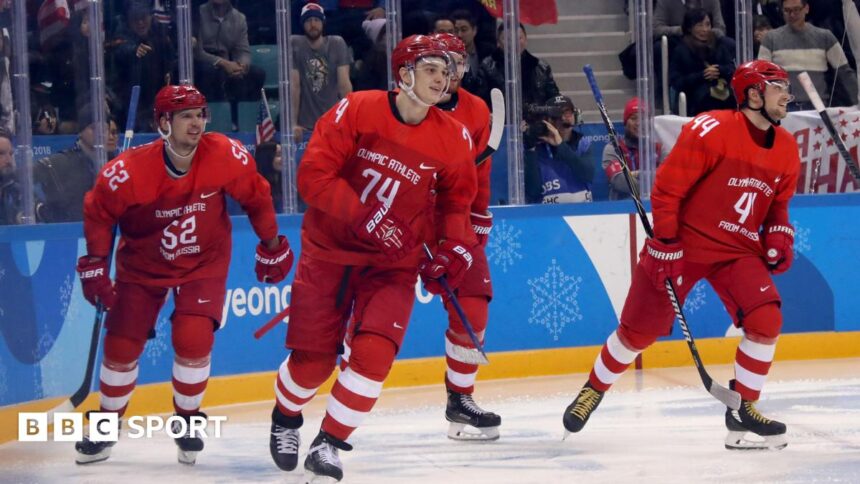
To understand the weight of Tardif’s statement, one must first look back. The specter of Russian participation under a cloud is not new. At the 2018 Pyeongchang Winter Olympics, the Russian national team was banned following a state-sponsored doping scandal. Yet, a team of “Olympic Athletes from Russia” (OAR) took the ice and, in a dramatic final against Germany, captured the men’s gold medal. That victory was bittersweet and controversial; the Olympic anthem played, but not the Russian one, creating a lasting image of a nation both present and punished. It set a complex precedent for separating athletes from state actions.
The current ban is far more absolute. In the wake of Russia’s full-scale invasion of Ukraine, which was facilitated in part by Belarusian territory, the IIHF took a decisive stance. In February 2022, it indefinitely suspended both national teams and clubs from all IIHF competitions, including the Men’s World Championship. This move was aligned with broader sporting sanctions and was widely seen as a necessary moral stand. For over two years, the sport’s global calendar has proceeded without two of its traditional powers, particularly Russia, a nation with a storied hockey history and a perennial contender for medals.
The President’s Pitch: Luc Tardif’s Case for Reinstatement
Attending the ice hockey events at the Milan-Cortina 2026 Winter Olympics test venue, IIHF President Luc Tardif made his position strikingly clear. His comments were not a vague hope but a direct advocacy. “We want as soon as possible Belarus and the Russians back,” Tardif stated. He framed this desire around the integrity of competition and the isolation of athletes: “We try to see what’s going on. Every day you watch the news to hope that something will come better.”
Tardif’s argument likely rests on several pillars familiar in the “sports and politics” debate:
- Sporting Integrity: A world championship without Russia, a top-tier nation, is seen by some as diminished in competitive quality.
- Athlete Welfare: The notion that athletes, who dedicate their lives to the sport, should not pay the price for geopolitical conflicts.
- Global Family: The ideal of hockey as a unifying global community that should remain inclusive.
- Precedent of Pyeongchang: The 2018 model provides a possible blueprint for a return under a neutral flag, though current IIHF rules would first require the suspension to be lifted.
However, this perspective faces immediate and profound challenges. The war continues with no end in sight, and the sanctions regime across all facets of international relations remains largely intact. Tardif’s daily news check underscores the painful reality: there is no positive geopolitical development to use as a justification for reinstatement.
The Chilling Rebuttal: Why Reintegration is a Legal and Ethical Minefield
Opposition to Tardif’s push is vehement and rooted in both ethical and practical concerns. For Ukraine and its allies, the return of Russian and Belarusian teams while their nations wage war would be seen as a catastrophic normalization and a betrayal of the Ukrainian hockey community, which has been devastated by the conflict.
The practical hurdles are equally daunting:
- Safety and Security: Could Ukrainian athletes, or those from nations strongly supporting Ukraine, safely compete in a tournament featuring Russian teams? The risk of protests, incidents, or boycotts is extremely high.
- Sponsorship and Hosting: Major corporate sponsors and potential host countries for World Championships may withdraw support, fearing association with a politically toxic event.
- The “Neutral Flag” Dilemma: Even if a return under a neutral banner were proposed, critics argue that Russian athletes’ success would inevitably be co-opted by the state for propaganda purposes, as seen after Pyeongchang 2018.
- Alignment with IOC Stance: While the International Olympic Committee has paved a cautious path for individual Russian and Belarusian athletes as “Neutral Individual Athletes” at the 2024 Paris Summer Games, team sports present a far more complex symbol of national representation. The IIHF’s decision on a *team* carries heavier symbolism.
Furthermore, many ask: what has changed to warrant a reversal? Without a tangible de-escalation or peace process in Ukraine, reinstatement could be viewed as the IIHF unilaterally deciding that the sports world has moved on, regardless of the ongoing suffering on the ground.
The Power Play Ahead: Predictions for the Future of International Hockey
The path forward is fraught with difficulty. Tardif’s public comments suggest he is testing the waters, likely gauging reaction from national federations, sponsors, and the broader public. The ultimate decision will not be his alone but will require a vote by the IIHF Congress.
Several scenarios could unfold:
Scenario 1: A Slow Thaw with Conditions. The most likely outcome is a protracted stalemate. The IIHF may begin formulating a set of strict conditions for return—far beyond neutral flags—that are tied to a genuine ceasefire or peace agreement. This kicks the can down the road but establishes a framework.
Scenario 2: A Splintered Sport. If the IIHF votes to reinstate Russia and Belarus prematurely, it could trigger a boycott by key nations like the United States, Canada, Sweden, Finland, and the Czech Republic. This would fracture the sport’s premier events and potentially lead to alternative tournaments, crippling the IIHF’s authority.
Scenario 3: The 2026 Olympic Compromise. All eyes are on Milan-Cortina 2026. Pressure from the IOC to find a solution for team sports may force a messy compromise. We might see a repeat of the “OAR” model, but under even stricter scrutiny and amid louder protest, making the hockey tournament a focal point of controversy rather than celebration.
Conclusion: More Than Just a Game
Luc Tardif’s call for the return of Russian and Belarusian ice hockey is a stark reminder that sport does not exist in a vacuum. It is a powerful cultural and political force. While the desire for a complete world championship is understandable from a purely sporting perspective, the world today is not in a “purely sporting” moment. The IIHF now faces its most difficult power play: balancing the soul of its sport against the grim realities of war. The decision it makes will define its legacy and send a message far beyond the hockey rink. Will it be a message that prioritizes medals over morality, or will it uphold that some lines, once crossed, cannot be simply erased by the sound of a puck hitting a stick? The next move is theirs, and the entire sporting world is on the bench, watching.
Source: Based on news from BBC Sport.