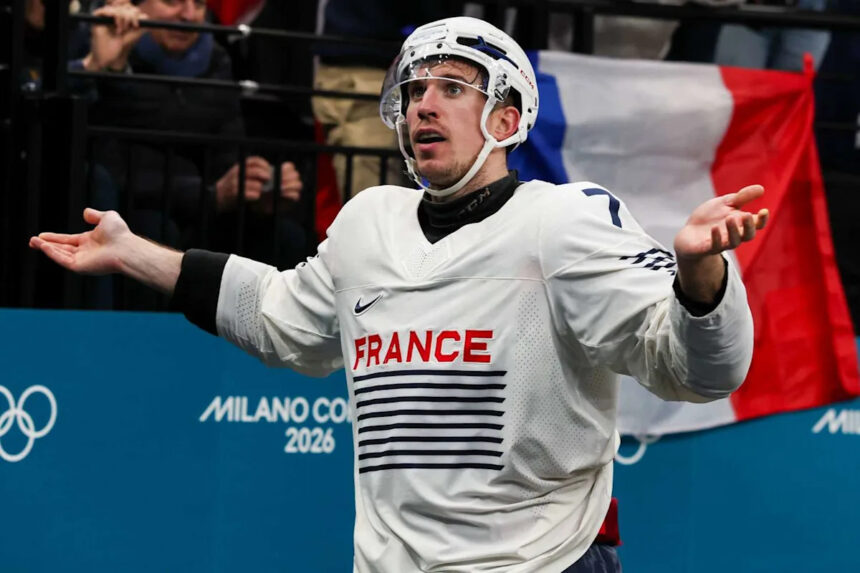
Olympic Dreams Shattered: Pierre Crinon’s Suspension for Taunting Fans Ignites Debate on Sportsmanship
The Olympic spirit, built on ideals of respect and excellence, collided violently with the raw, unfiltered emotions of high-stakes hockey this week. In a stunning decision that has sent shockwaves through the international hockey community, French defenseman Pierre Crinon has been suspended from the 2026 Milan Cortina Winter Olympics following an on-ice brawl and a subsequent, inflammatory walk of shame that crossed a line in the eyes of Olympic officials. The incident, stemming from France’s lopsided 10-2 loss to Canada, underscores the fragile balance between passion and propriety on the world’s grandest athletic stage.
A Fight on the Ice, A War of Words Off It
The flashpoint occurred in the third period of a game already decided. With Canada leading handily, tensions that had simmered all game finally boiled over. Pierre Crinon and Canada’s notorious physical force, Tom Wilson, dropped the gloves in a rare Olympic hockey fight. Such bouts are uncommon in the Olympics, where the IIHF’s stricter rules and the tournament’s prestige typically temper NHL-style enforcer tactics. Both players received game misconducts and were ejected. For Wilson, a player whose career is punctuated by suspensions and physical play, the scene was familiar. For Crinon, it was a moment that would define his Olympic career—and not for the reason he intended.
The real transgression, according to the Olympic Disciplinary Committee, happened next. As Crinon made the long, solitary walk from the ice to the locker room, he passed a section of raucous, jeering Canadian fans. Instead of ignoring them or keeping his head down, the French defenseman engaged. Reports and video show him making aggressive gestures, shouting back, and essentially egging on the jeering fans. This act of defiance, a moment of poor judgment in the heat of humiliation, was deemed a “clear violation of the fundamental principles of Olympism” and resulted in the unprecedented pre-emptive suspension for the next Games.
Expert Analysis: Where Does the Line Lie?
The suspension has sparked fierce debate. We spoke to several hockey analysts and sports ethicists to break down the layers of this complex incident.
The Precedent of Punishment: “The suspension is severe but not without purpose,” notes Dr. Alina Kostova, a sports sociologist. “The Olympics market themselves on a higher ideal. Fighting, while penalized, is sometimes tacitly understood as part of hockey’s emotional fabric. But directly inciting and taunting spectators? That targets the very environment of respectful competition the IOC strives to protect. They are making an example to protect their brand.”
The Wilson Factor: A key subplot is the status of Tom Wilson. Wilson’s teammates defended his involvement in the fight, framing it as a response to heavy physical play earlier in the game. Crucially, Wilson was not suspended beyond his game ejection. This disparity highlights a nuanced, if controversial, distinction in the eyes of officials. “Wilson fought within the confines of the game,” suggests former NHL referee and current rules analyst, James Kowalski. “His punishment ended with his ejection. Crinon’s actions continued after he was no longer an active participant in the contest. He brought the conflict outside the boards and into the spectator realm, which is a categorical no-go.”
The fallout for French hockey is significant. Losing a top defenseman for the next Olympics before a single qualifying game is played is a brutal blow. It forces a strategic rethink and leaves a cloud over the program.
- Leadership Void: Crinon, expected to be a veteran leader in 2026, is now completely removed from the equation.
- Morale Impact: The incident could either fracture the team or bind them closer in a “us against the world” mentality.
- Recruitment Shadow: The French Ice Hockey Federation must now manage the reputation of their program to future talents.
Predictions for Milan Cortina 2026 and Beyond
This decision will cast a long shadow toward Italy. We can anticipate several immediate consequences:
1. A Zero-Tolerance Atmosphere: Officials in Milan will be hyper-vigilant about player conduct toward fans and opponents alike. Any similar provocation will likely be met with swift, harsh penalties, potentially during the Games themselves.
2. The “Crinon Rule”: Look for the IIHF and IOC to potentially codify stricter language regarding player-fan interactions in their rulebooks, making explicit what was previously an implicit understanding of decorum.
3. A Changed Player Mentality: Players will be acutely aware that the camera follows them all the way to the tunnel. The “walk of shame” will become a “walk of silence,” as athletes consciously suppress emotion to avoid catastrophic career repercussions.
4. Legacy of the Incident: For Crinon, this is a defining, devastating moment. For Wilson, it’s a footnote. For the Olympics, it becomes a case study in enforcing sportsmanship. The narrative in 2026 will inevitably circle back to this moment when any on-ice scuffle occurs.
A Stark Reminder of the Olympic Stage
The suspension of Pierre Crinon is more than a disciplinary action; it is a philosophical statement. The International Olympic Committee has drawn a bright, uncompromising line. On the ice, within the flow of a brutally physical sport, certain violent exchanges may be penalized but are understood as part of the game’s currency. The moment a player turns that aggression toward the spectators—the very people the Olympics aim to inspire and unite—the transgression changes in kind.
Crinon’s story is a tragic one of a single, heated moment erasing years of Olympic aspiration. It serves as a stark reminder to every athlete who will don their nation’s colors in Milan Cortina: you are not just a hockey player, a skier, or a skater on that stage. You are an Olympic ambassador. The arena is sacred ground, and the eyes watching see more than just the game. They judge the spirit in which it is played, from the opening face-off to the lonely walk away from it all. In the end, Pierre Crinon didn’t lose his Olympic spot because of a fight. He lost it because he forgot where he was, and what the five rings on his jersey truly represent.
Source: Based on news from Yahoo Sports.