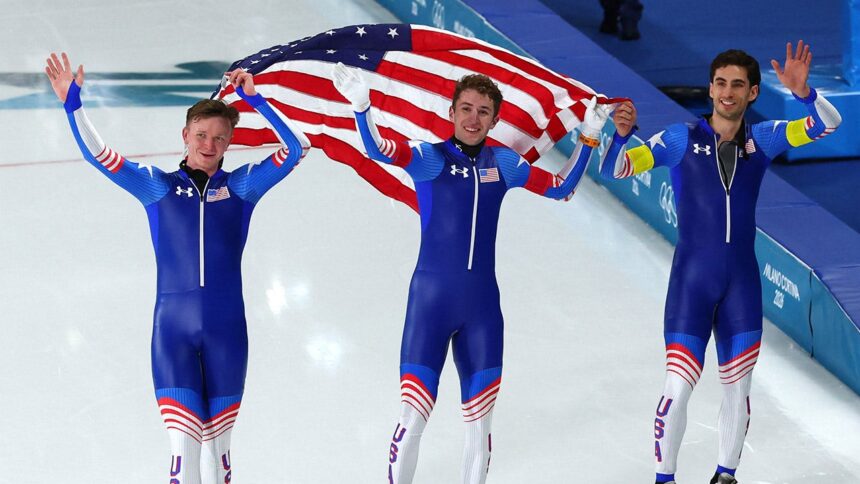
Team USA Speedskating Claims Hard-Fought Silver in Thrilling Team Pursuit at Milan-Cortina 2026
In a deafening, flag-waving cauldron of sound at the Oval Lingotto, the United States men’s speedskating team authored a chapter of resilience and raw speed, capturing the silver medal in the team pursuit at the 2026 Winter Olympics. The trio of Ethan Cepuran, Casey Dawson, and Emery Lehman, linked in synchronicity and shared purpose, stopped the clock at 3:43.71, a time that secured second place on the podium behind a dominant, host-nation Italian squad. The result marks a monumental achievement for American long-track skating, a testament to strategic planning and the unbreakable bond forged over thousands of laps together.
A Symphony of Speed and Strategy on Olympic Ice
The men’s team pursuit is a unique blend of individual power and collective harmony. Two teams of three skaters start on opposite sides of the oval, racing not just against the clock, but in a direct, head-to-head duel over eight laps. The final time is taken from the third skater to cross the line, demanding impeccable pacing, drafting technique, and communication. For Team USA, their run was a masterclass in execution under immense pressure.
From the starting gun, the American unit—identifiable by their colored armbands (Cepuran in white, Dawson in red, Lehman in yellow)—found a rapid, sustainable rhythm. Ethan Cepuran, the powerful engine of the group, set a fierce early pace. Casey Dawson, a model of efficient technique, held the middle position, conserving energy in the slipstream. Veteran Emery Lehman, competing in his fourth Olympics, provided the tactical brain and closing strength. Their silver-medal performance was not a surprise to insiders but the culmination of a four-year cycle focused solely on this event.
“What you saw today was the result of a thousand small decisions,” said a former Olympic coach analyzing the race. “Their transitions were seamless, their exchanges clean. They skated a smart, conservative first half and unleashed everything they had in the final three laps. Against most of the world, that time wins gold. They were simply beaten by a better team on the day.”
Italy’s Golden Glory on Home Ice
The narrative of the night, however, belonged to the host nation. The Italian trio of Davide Ghiotto, Andrea Giovannini, and Michele Malfatti delivered a performance for the ages, decimating the field with a stunning time of 3:39.20. Skating in front of a raucous home crowd that reached a fever pitch with every stride, the Italians displayed a level of speed and cohesion that proved untouchable.
Their gold medal was built on a foundation of explosive starts and relentless acceleration. Led by the phenomenal Davide Ghiotto, a favorite in the distance events, the Italians never faltered. The contrast in styles was evident: where the Americans relied on metronomic consistency, the Italians attacked the ice with audacious power. The 4.51-second margin of victory in a race this precise underscores the historic nature of their performance. The deafening roar that greeted their final lap was a fitting tribute to a team that peaked perfectly on the grandest stage.
- Gold Medal (Italy): 3:39.20 – A dominant, front-running display fueled by home crowd energy.
- Silver Medal (USA): 3:43.71 – A technically superb and strategically perfect race from the Americans.
- Bronze Medal (Norway): 3:44.15 – Edging out Canada in a photo-finish for the final podium spot.
Decoding the USA’s Podium Path: Key Factors for Success
The United States’ return to the Olympic podium in this event—their first medal since 2010—was not accidental. It was the product of a deliberate and modernized approach to a discipline that demands specialization.
Specialized Training Units: Unlike past cycles, Cepuran, Dawson, and Lehman spent the majority of the last two years training specifically as a pursuit unit. They logged countless miles together, learning each other’s breathing patterns, strengths, and weaknesses. This created an almost telepathic understanding on the ice.
Technical Precision: The team pursuit is won and lost in the exchanges—the moments where the lead skater peels away and swings up the bank, allowing the next man to take over. The U.S. team’s exchanges were clinically sharp, losing minimal speed and maintaining their precious momentum. This technical edge was clear when compared to teams that struggled with sloppy transitions.
Veteran Leadership and Youthful Power: The blend of experience was crucial. Emery Lehman’s Olympic wisdom provided calm, while the younger legs of Cepuran and Dawson supplied the explosive power. This balance allowed them to navigate the intense pressure of an Olympic final with clear heads and full hearts.
The Future of American Speedskating: What’s Next After Silver?
This silver medal serves as both a crowning achievement and a launching pad. For the athletes involved, it validates the sacrifices of a lifetime. For the U.S. speedskating program, it signals a return to relevance in the team events and provides a blueprint for sustained success.
Looking ahead to the 2030 Games, the immediate question is team continuity. Will this same trio continue? Emery Lehman may contemplate his future, but his role as a mentor is invaluable. Ethan Cepuran and Casey Dawson now have Olympic medalist experience to build upon. The pipeline behind them, including skaters who pushed them in domestic competitions, will be inspired and hungry.
“This medal changes everything for the program,” predicts a sports analyst specializing in Olympic sports. “It proves to the next generation that the podium is attainable. It attracts funding and attention. The challenge now is to institutionalize this pursuit model, not just rely on one special group. If they can build a deep pool of skaters competing for these three spots, the USA can transform from podium contender to a consistent favorite.”
The prediction for the next quadrennial is one of fierce competition within Team USA itself, which will only raise the overall level. The goal will unmistakably shift from chasing silver to hunting gold.
Conclusion: A Medal Forged in Partnership and Perseverance
As Ethan Cepuran, Casey Dawson, and Emery Lehman stood on the podium in Milan, the silver medals around their necks reflected not just individual brilliance, but the luminous power of a shared endeavor. They were beaten by an Italian team that was sublime on the night, but they were not defeated. In the grueling, precise world of team pursuit, their second-place finish is a monumental victory for American speedskating.
This achievement transcends a single time or ranking. It is a story of three athletes who committed to each other and to a singular pursuit. They provided a moment of collective pride and demonstrated that in a sport often defined by individual clocks, the strongest unit can still carve its name into Olympic history. The echo of their blades on the Lingotto ice will resonate for years to come, a foundational sound for the future of U.S. speedskating.
Source: Based on news from Fox Sports.