Sidney Crosby’s Olympic Exit: Canada’s Quarterfinal Hopes Shaken by Captain’s Injury
The air was sucked out of the arena in a collective gasp. Sidney Crosby, the stoic, indomitable heart of Team Canada for a generation, was laboring to the bench, his face etched with a rare mix of pain and frustration. A sequence of punishing hits from a relentless Czechia forecheck had culminated in the unthinkable: Canada’s captain, its talisman, was done for the night. The announcement from Hockey Canada that Crosby was ruled out for the remainder of the Olympic quarterfinal with a lower-body injury sent a seismic shock through the tournament, casting a pall over Canada’s gold medal aspirations and igniting immediate concern for the 38-year-old legend. In a flash, a quest for a historic third gold medal became a desperate fight for survival without its most important player.
A Torrent of Hits and a Painful Exit
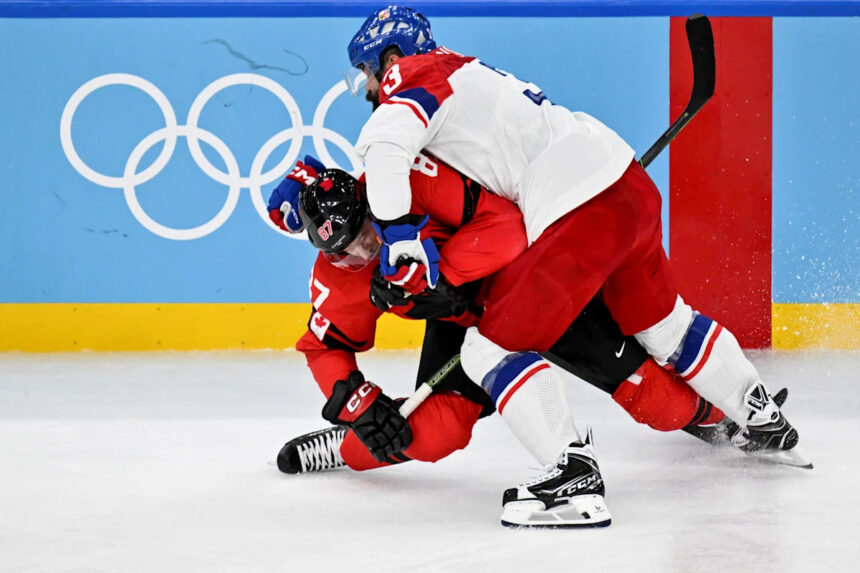
The injury did not occur in a vacuum. It was the culmination of a targeted, physical second period where Czechia, trailing in play but not in spirit, made a conscious effort to wear down the Canadian star. The sequence began with heavy, but clean, checks from veteran defenseman Radko Gudas and forward Ondřej Palát. Czechia’s game plan was clear: finish every check on 87. The decisive blow came late in the period. As Crosby moved the puck along the offensive zone boards, he was pinched between the oncoming Martin Nečas and a backtracking Gudas. The sandwich hit was thunderous, sending Crosby awkwardly into the stanchion.
What happened next was telling. The famously resilient Crosby pushed himself up, took a testing stride, and was immediately seen shaking out his right leg. It was a subtle, almost instinctive gesture that betrayed a significant issue. He skated gingerly to the bench under his own power, but the damage was done. After a brief consultation with team medical staff, a grim-faced Crosby limped decisively down the tunnel to the locker room. He would not return to the bench, a solitary figure exiting the stage at a moment his team needed him most, with Czechia holding a precarious 2-1 lead.
Analyzing the Impact: Beyond the Scoreboard
The immediate tactical loss for Canada was immense. Crosby is not just a top-line center; he is the team’s strategic compass, its most trusted defensive forward, and its primary face-off weapon. His absence created a cascading series of problems for the Canadian coaching staff:
- Lineup Cascade: His departure forced a complete reshuffling of forward lines, disrupting chemistry and role definitions mid-game.
- Leadership Void: On-ice poise and crisis management, Crosby’s hallmarks, were suddenly absent during a high-pressure elimination game.
- Matchup Nightmare: Czechia gained a massive advantage, no longer needing to deploy its top defensive pairings against the Crosby line.
- Power Play Disruption: Canada’s primary power-play unit, orchestrated from the half-wall by Crosby, lost its quarterback and most creative distributor.
Yet, the impact transcends Xs and Os. Sidney Crosby carries an aura. For his teammates, his presence is a security blanket. For opponents, it is a looming threat that dictates their entire game plan. His removal from the equation provided a palpable psychological boost to Czechia, who visibly grew in confidence, while injecting a seed of doubt into the Canadian squad. The question hanging over the remainder of the game was not just “Can they score?” but “Can they win without him?”
A Legacy Interrupted: Crosby’s Olympic Journey
To understand the gravity of this moment, one must appreciate Crosby’s singular Olympic legacy. This was his third Games, and his record was pristine: two tournaments, two gold medals, each capped with iconic moments. In 2010 in Vancouver, it was the “Golden Goal” in overtime against the United States, a nation-defining moment. In 2014 in Sochi, he was a dominant two-way force, leading Canada to a suffocatingly defensive championship. He arrived at these Olympics not as a complementary piece, but as the undisputed leader, chasing a third gold that would place him in the most rarefied air in hockey history.
At 38, this likely represented his final Olympic appearance. The prospect of it ending not with a medal ceremony, but in a quiet locker room while his teammates battled on, is a brutally unfair narrative twist for a player whose career is defined by climactic triumphs. The injury raises immediate questions about his availability for a potential semifinal, but the larger shadow is cast over what should have been a celebratory farewell to the international stage for one of Canada’s greatest sporting icons.
What’s Next for Canada and Crosby’s Immediate Future?
The immediate future for Team Canada is a stark, single-elimination reality. Advancing past a surging Czechia team just became exponentially harder. The burden now falls on the remaining leadership core—veterans like Patrice Bergeron and young stars like Connor McDavid—to galvanize the group. The strategy must adapt to a more collective, “by-committee” approach to offense and leadership.
For Sidney Crosby, the focus shifts to diagnosis and recovery. The specific nature of the lower-body injury—whether it’s a knee, ankle, or muscular issue—will determine any potential return this tournament. Hockey Canada will be notoriously tight-lipped, but history suggests the severity of the limp and his inability to return to the bench are ominous signs.
- Best-Case Scenario: A severe bruise or charley horse that responds to intense treatment, making him a possibility for a semifinal if Canada advances.
- Worst-Case Scenario: A ligament sprain or tear that not only ends his Olympics but could impact the remainder of his NHL season with the Pittsburgh Penguins.
The coming days will be filled with MRI scans, treatment tables, and anxious waiting. Canada’s medal hopes now hang in a precarious balance, directly tied to the health of its captain.
Conclusion: An Unceremonious Crossroads
Sidney Crosby’s injury is a stark reminder of the fragile line between glory and heartbreak in sports. In a tournament defined by national pride and fleeting opportunity, Canada’s most reliable constant has been forcibly removed. The image of Crosby limping down the tunnel is one that will haunt Canadian hockey fans, a jarring interruption to a storybook career that has always seemed destined for triumphant endings.
Whether this is the final, unceremonious note of Crosby’s Olympic saga or merely a dramatic hurdle he overcomes remains to be seen. One thing is certain: the path to the podium for Canada, once viewed as a march led by its iconic captain, has now become a treacherous, uncertain climb. The team’s character, depth, and resilience are facing their ultimate test, not just against opponents on the ice, but against the crushing weight of an unexpected and profound loss. The remainder of this tournament will be defined by how Canada responds to the silence left by the absence of its greatest voice.
Source: Based on news from Yahoo Sports.