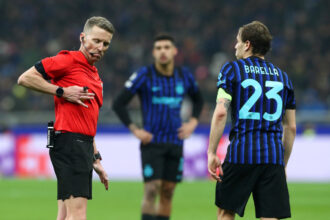
Bodo/Glimt’s Arctic Fury: The Unstoppable Underdogs Conquer Inter Milan in Champions League History
The air in the San Siro, a cathedral steeped in European footballing legend, carries a certain weight. It has borne witness to the greatest players and the most storied clubs. On Tuesday night, that hallowed air was thick with a different kind of history—not one of expected glory, but of seismic, improbable shock. From a town 200 miles inside the Arctic Circle, a team with a fraction of the budget and a boundless reservoir of belief, FK Bodo/Glimt, did the unthinkable. They didn’t just advance past three-time champions Inter Milan; they announced to the world that their fairy tale is written in the permanent ink of sheer, unadulterated sporting will.
From the Arctic Circle to the Centre of the Footballing Universe
To understand the magnitude of Bodo/Glimt’s achievement, one must first comprehend the geography of their ambition. Bodo is a remote Norwegian city of just over 50,000 people, where winter is defined by the polar night and the northern lights. Their Aspmyra Stadium holds less than 8,000 spectators. Their entire squad valuation is less than the annual salary of a single Inter Milan superstar. This is not a backdrop from which Champions League knockout heroes typically emerge.
Yet, under the innovative leadership of manager Kjetil Knutsen, Glimt have forged an identity that transcends resources. They play a brand of relentless, high-pressing, attacking football that has dominated Norwegian football and now, astonishingly, is dismantling Europe’s elite. Their journey to this point was already legendary, having stunned Manchester City and beaten Atletico Madrid in the league phase. But the knockout rounds are a different beast, a realm where pedigree and experience are supposed to prevail. Inter Milan, finalists just nine months prior, embodied that very pedigree.
Anatomy of an Upset: Tactics, Temperament, and Tenacity
Holding a 3-1 lead from the first leg in the Arctic cold was a monumental feat, but it also set a perilous stage. The trip to Milan was viewed as a formality for an Inter side renowned for its defensive solidity and tactical nous under Simone Inzaghi. What unfolded was a masterclass in strategic courage from the underdogs.
Bodo/Glimt did not park the proverbial bus. Instead, they executed Knutsen’s philosophy with icy precision. They pressed Inter’s backline aggressively, disrupting the build-up play of Alessandro Bastoni and Benjamin Pavard. They played through Inter’s own press with daring verticality and breathtaking one-touch combinations. The key to their success lies in a system greater than any individual:
- Collective Pressing Machine: Every player, from striker to full-back, operates as a synchronized unit to win the ball high, turning defense into instant attack.
- Uncanny Clinical Edge: Against the run of play and with limited possession, Glimt’s attackers convert chances at a rate that belies their underdog status.
- Psychological Fortitude: Playing in the San Siro’s cauldron would unnerve most teams. Glimt, seasoned by their group-stage shocks, treated it as just another pitch.
When the final whistle blew, securing their aggregate victory, it was not a fluke. It was the result of a perfect tactical blueprint meeting unwavering conviction. They didn’t hope for a result; they engineered it.
What This Means for the Future of European Football
Bodo/Glimt’s run is more than a charming story; it’s a potential paradigm shift. It challenges the financial determinism that has come to dominate modern football. Their success proves that with a clear identity, exceptional talent identification, and a culture of belief, the gap between Europe’s haves and have-nots can be bridged on the pitch.
This victory sends a powerful message to every club outside the traditional “big five” leagues. It validates projects built on sporting intelligence over pure financial muscle. For the Champions League itself, Glimt are the ultimate asset—they inject pure, unpredictable drama and remind everyone why the game is played. The knockout play-off round, designed to give more teams a chance, has produced its greatest ever advertisement.
The Road Ahead: How Far Can the Yellow Horde Go?
Now in the round of 16, the question shifts from “Can they?” to “How far can they go?” The expert analysis suggests that no one in the draw will want to face them. Bodo/Glimt are the ultimate wildcard, a team unburdened by fear and unconstrained by expectation.
Predictions for their next phase are fraught with difficulty, but several factors are in their favor:
- Fearless Momentum: They have now slain giants from England, Spain, and Italy. No opponent holds an aura of invincibility for them.
- The Element of Surprise: While their style is known, its execution at this level remains disorienting for opponents used to a different kind of chess match.
- Nothing to Lose: Every further step is a bonus, freeing them to play with the same attacking verve that got them here.
The challenges are obvious: squad depth, the increasing pressure, and the sheer quality of remaining opponents. But to doubt them now is to ignore the evidence of the past months. They have earned the right to be considered a legitimate threat, not just a happy accident.
Conclusion: A Legacy Forged in the Midnight Sun
Bodo/Glimt’s victory over Inter Milan is not merely a result. It is a historical moment that will be recounted for generations. It is a testament to the power of a unified vision, a testament to the fact that in football, heart, intellect, and execution can sometimes outweigh billions. They have not just navigated their way into the Champions League last 16; they have stormed the gates with a blueprint for the ambitious underdog.
From the Arctic twilight of northern Norway to the brightest lights in world football, the Yellow Horde marches on. They have redefined what is possible, proving that in the beautiful game, the size of your dream matters infinitely more than the size of your budget. Europe, you have been warned. The fairy tale is not over; it’s just getting to the good part.
Source: Based on news from BBC Sport.