Darlings of Italian Football: How Atalanta Salvaged National Pride in Europe
The script was written, and it was a tragedy for Italian football. As the final whistle blew in Dortmund on a rain-slicked Wednesday night, the narrative was supposed to be one of collective continental failure. Instead, it was rewritten by a club from Bergamo, a city etched into the soul of modern Italy. With a dramatic, stoppage-time penalty, Atalanta didn’t just knock out Borussia Dortmund; they punched a hole through a gathering storm of pessimism and, in their own indomitable style, became the unlikely saviours of Italian football pride.
The Brink of an Unwanted History
To understand the magnitude of Atalanta’s rescue act, one must first appreciate the abyss they peered into. The week had been a disaster for Serie A’s European ambitions. Inter Milan, last season’s finalists and a symbol of resurgent Italian power, suffered a humiliating defeat to Norwegian outsiders Bodo/Glimt. Simultaneously, the first-leg results for Italy’s other Champions League representatives were dire.
- Atalanta trailed a talented Dortmund side 3-2 after a chaotic match in Bergamo.
- Juventus, the domestic standard-bearer for a decade, were in a 3-0 hole against Galatasaray in Istanbul.
The mathematics were stark and humiliating. For the first time since the 1987-88 season—when the tournament was still the European Cup—there was a very real possibility of a Champions League last 16 with zero Italian representation. The spectre of this historic low loomed large, threatening to undo years of narrative-building about Serie A’s climb back to relevance. Italian football was on the brink, its fate resting on two monumental second-leg comebacks.
La Dea’s Divine Intervention in Dortmund
While Juventus staged a valiant but ultimately futile fightback in Turin, falling just short, all eyes turned to Westfalenstadion. Atalanta, the club known as La Dea (The Goddess), faced a daunting task. They needed to win in one of Europe’s most formidable fortresses. What unfolded was a masterpiece of tactical resilience and raw heart.
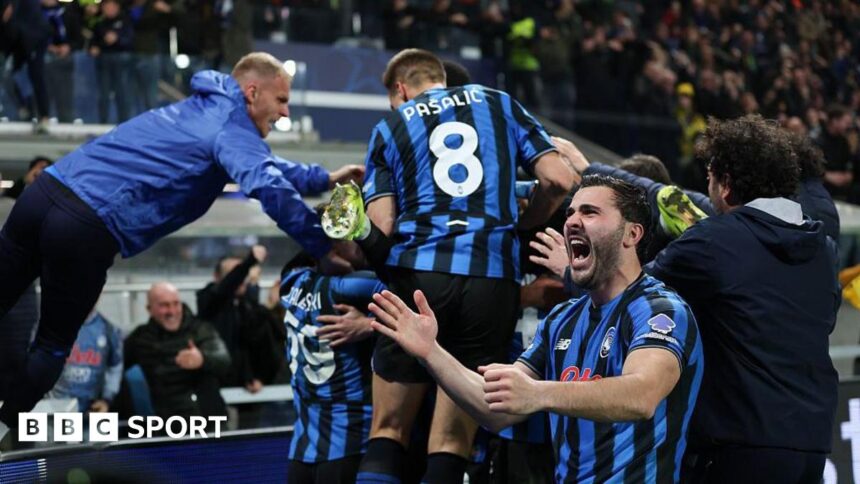
Gian Piero Gasperini’s side didn’t just play; they imposed their unique, frenetic identity. They pressed Dortmund into uncharacteristic errors, turned defence into attack in breathtaking transitions, and displayed a mental fortitude that belies their relative inexperience at this elite level. The equalizer on aggregate from Luis Muriel was a reward for their unwavering belief. Then, deep into added time, fate intervened. A handball, a VAR check, and the weight of a nation’s hopes fell onto the shoulders of Robin Gosens. The German wing-back, a symbol of Atalanta’s astute scouting, kept his nerve, sending the goalkeeper the wrong way and sending Bergamo into ecstasy.
This was more than a victory; it was a statement. Atalanta, with a fraction of the budget of their continental peers, had not just advanced. They had salvaged Italian prestige with a performance that encapsulated everything admirable about modern football: courage, style, and collective will over individual star power.
Expert Analysis: Why Atalanta is Italy’s Perfect Ambassador
Atalanta’s role as standard-bearer is richly ironic and profoundly fitting. For years, they have been the darling underdogs of European football, celebrated for their thrilling, attack-minded philosophy under Gasperini. They are not funded by petrodollars or sustained by historic commercial might. Their success is built on a world-class academy, visionary recruitment, and a tactical system so distinct it has its own name: ‘Gasp-ball’.
In this moment of crisis for the Italian game, their success is the most potent rebuttal to its critics. It proves that Serie A can produce teams that are not just defensively sound but are entertaining and progressive. While other Italian giants have stumbled in Europe, Atalanta’s model has shown remarkable sustainability and scalability. They represent a pathway, a proof of concept that resonates far beyond Italy’s borders. Their victory wasn’t a fluke; it was the validation of a project, and it arrived at the precise moment the nation needed it most.
Key to their success:
- System Over Stars: Gasperini’s 3-4-3 is a machine that empowers players, making the whole greater than the sum of its parts.
- Scouting Genius: Transforming unknowns like Gosens, Papu Gomez, and Joakim Maehle into elite performers.
- Fearless Identity: They play the same way against Dortmund or Brescia, a commitment to philosophy that earns respect.
Predictions: What This Means for Atalanta and Serie A
The immediate future is a tantalizing Champions League quarter-final draw. Atalanta, with nothing to lose and everything to gain, will be the team no heavyweight wants to face. Their chaotic, high-octane style is a great equalizer in one-off matches. A deep run is possible, further cementing their Cinderella story and bringing crucial coefficient points to Serie A.
For Italian football at large, this should be a wake-up call. Atalanta’s success highlights the stagnation in certain quarters of the domestic game. It underscores that tactical innovation and bold project-building can compete with financial muscle. The hope for Serie A must be that Atalanta’s blueprint inspires others, that their courage becomes contagious. The league’s reputation, so carefully rebuilt in recent seasons, was hanging by a thread woven in Bergamo.
A Conclusion Forged in Bergamo
In March 2020, Bergamo was the global epicenter of the COVID-19 pandemic, a city suffering unimaginable loss. The image of military trucks carrying away the dead became synonymous with the tragedy. Football, rightly, felt insignificant. Yet, sport also has a role in the long healing process, in providing a symbol of resilience and joy.
For Atalanta to now be the team that lifts not just a city, but an entire footballing nation, from the depths of sporting despair is a story of profound symmetry. They have, once again, shown the strength of their community and the power of their idea. By refusing to follow the script of Italian failure, by scoring that late penalty in Dortmund, Atalanta became more than a football club. They became the darlings who carried the flag when it was heaviest, salvaging pride, igniting hope, and reminding the world that the heart of Italian football beats strongest in the most unexpected places.
Source: Based on news from BBC Sport.