The Carrick Conundrum: Is Not Appointing Him Manchester United’s Biggest Gamble?
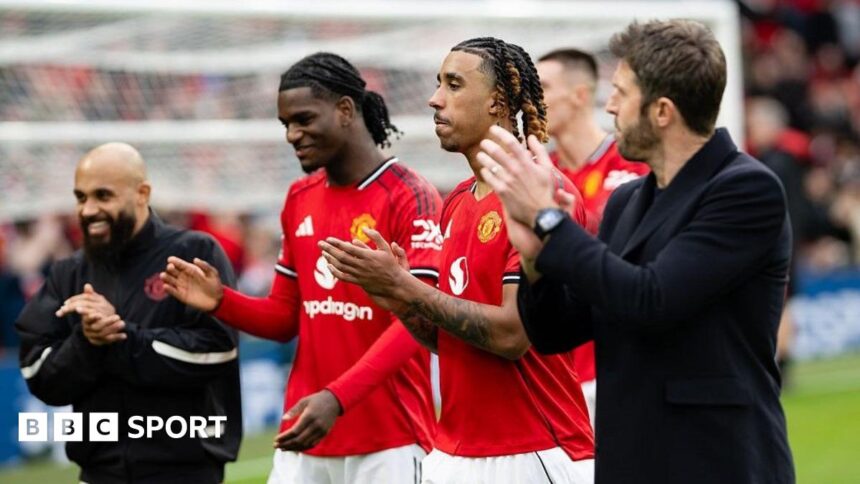
The final whistle at Selhurst Park brought more than just three points. It delivered a statement, wrapped in the composure of a 2-1 comeback win against a dangerous Crystal Palace. While Benjamin Sesko’s clinical brace stole the headlines, the narrative unfolding in the Manchester United dugout grew louder, more compelling, and impossible to ignore. As the club’s hierarchy continues its deliberate, global search for a permanent manager, a pressing question now demands an answer: in seeking to avoid a perceived gamble on an inexperienced legend, would the bigger gamble be not to give Michael Carrick the Manchester United job?
Beyond the Results: The Carrick Calm in the Storm
Judging Michael Carrick’s interim tenure purely on statistics—four wins, two draws, one loss—tells only half the story. The true measure of his impact lies in the context and the character displayed. He inherited a squad low on confidence, fractured in structure, and navigating the intense media vortex that follows Ole Gunnar Solskjaer’s departure. His immediate task was not revolution but stabilization.
The victory at Palace, however, provided a new data point. For the first time in his seven-game stint, Carrick’s United trailed at half-time. This was a new test: a tactical puzzle against a well-drilled Patrick Vieira side, compounded by the psychological hurdle of a deficit. The response was telling. The second-half performance was a masterclass in in-game management, showcasing a clarity of instruction and a resilient mentality that had been absent for much of the season.
This speaks to Carrick’s most significant, albeit understated, achievement: restoring foundational principles. His United are not yet a fluid spectacle, but they have rediscovered core tenets that had eroded:
- Defensive Discipline: A more structured, less chaotic shape out of possession.
- Midfield Control: Prioritizing security and intelligent distribution, a hallmark of his own playing career.
- Strategic In-Game Adjustments: As seen at Palace, an ability to read the match and change its course.
He has done this not with bombast, but with a quiet authority that commands respect from a dressing room that knows his pedigree.
The “Proven” Candidate Paradox: A Riskier Bet?
United’s pursuit of a “proven” world-class manager is understandable. The names linked—Mauricio Pochettino, Erik ten Hag—carry impressive portfolios. Yet, this path is itself fraught with its own unique gambles. The Premier League has become a graveyard for managers with stellar reputations built elsewhere. The specific pressures, the relentless scrutiny, and the scale of United’s rebuild are unparalleled.
Appointing an external “superstar” manager brings inherent uncertainties:
- Cultural Adaptation: Will their philosophy translate to the Premier League and this specific squad?
- Rebuild Patience: Do they have the appetite for a multi-year project, or do they seek instant, title-challenging success?
- Dressing Room Dynamics: Can they earn the immediate respect of a group they have no prior connection with?
In contrast, Carrick represents a known quantity with deep institutional knowledge. He understands the fabric of the club, the expectations, and the players’ capabilities intimately. His gamble is one of experience; the “proven” candidate’s gamble is one of fit and adaptation. In a club that has lurched from one identity crisis to another since Sir Alex Ferguson’s retirement, the value of continuity and a clear, club-aligned philosophy cannot be overstated.
The Ferguson Blueprint and the Modern Precedent
History at Old Trafford favors the bold appointment of a visionary, not always the established name. Sir Matt Busby was 36 with no top-flight managerial experience. Sir Alex Ferguson, while a trophy-winner at Aberdeen, was a relative unknown in England tasked with a monumental rebuild. Their success was built on a profound understanding of the club’s soul and a long-term vision.
The modern game offers its own parallels. At Barcelona, Pep Guardiola’s appointment from the B-team was a risk that redefined football. At Real Madrid, Zinedine Zidane’s seamless transition from advisor to three-time Champions League winner is the most relevant example of a club legend translating his understanding into tangible success. These were not safe choices; they were inspirational appointments that galvanized players and fans around a shared legacy.
Carrick’s calm, tactical acumen mirrors elements of these successes. He is not an emotional firebrand but a strategic thinker—a modern manager whose strength lies in preparation and in-game intellect. The players’ response to him suggests he possesses the key ingredient: the ability to lead and improve them.
Verdict: The Safer Gamble Wears a United Pedigree
So, what is the greater risk? Entrusting the next phase of a complex rebuild to a man who has already begun the repair work, who commands the dressing room, and who embodies the club’s core principles? Or starting from scratch with an external vision that may take months, even years, to implement, with no guarantee of success in the Premier League crucible?
The evidence from Carrick’s brief tenure points decisively. He has:
- Steadied a listing ship with minimal fuss.
- Extracted improved performances from key, previously struggling players.
- Demonstrated tactical flexibility and cool-headed management.
- United the fanbase behind a familiar figure representing a connection to past successes.
The victory at Crystal Palace was a microcosm of his effect. It was a win earned through resilience and intelligence, not individual brilliance alone. It answered the question he posed at half-time, and in doing so, posed an even bigger one to the United board.
Prediction: If United’s hierarchy, led by football director John Murtough, overlooks Carrick for a “bigger name,” they will be taking a monumental risk. They risk losing a unifying figure who could offer the stability and identity the club craves. The bigger gamble is not in appointing Michael Carrick; it is in believing that the grass is inherently greener elsewhere, while a man who has grown on the hallowed turf of Old Trafford is ready to cultivate a new era. The safe choice is often the riskiest. For Manchester United, the bold choice—the one that embraces its history while building its future—might just be the safest bet they can make.
Source: Based on news from BBC Sport.