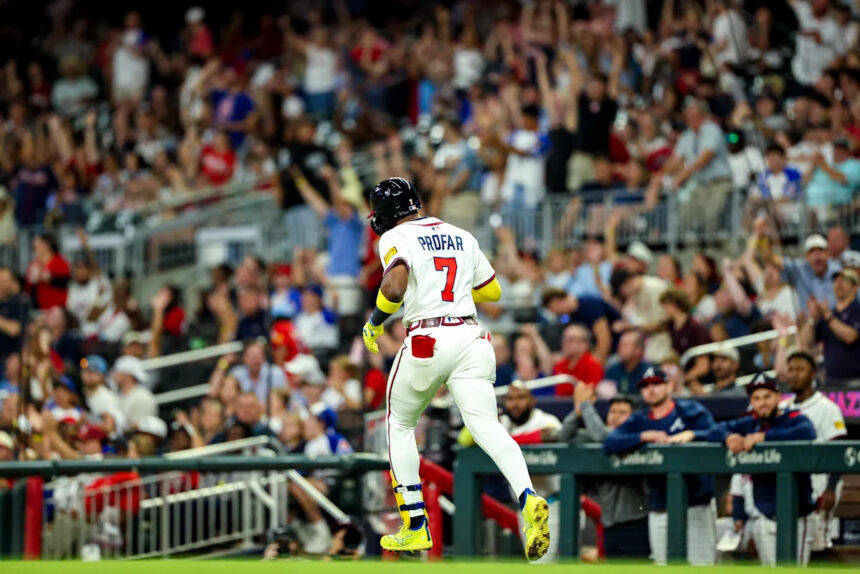
Atlanta Braves Issue Official Statement on Jurickson Profar’s 162-Game PED Suspension
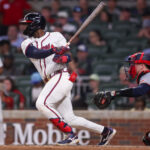
The Atlanta Braves organization, a franchise synonymous with a modern culture of accountability and championship aspirations, found itself addressing an unexpected and severe breach of protocol today. The club issued an official statement regarding outfielder and designated hitter Jurickson Profar’s staggering 162-game suspension for a second positive test for a performance-enhancing substance. The announcement, which sent shockwaves through the baseball world, underscores the harsh and escalating penalties of Major League Baseball’s Joint Drug Agreement and leaves a significant, complex void in the Braves’ competitive landscape.
A Statement of Disappointment and Institutional Principle
Following the initial report from ESPN’s Jeff Passan, the Braves moved quickly to publicly address the situation. The team’s statement, posted on its official social media accounts, was concise, firm, and aligned with league policy. It did not mince words, framing the news as a profound letdown for the franchise.
The full statement read: “We were incredibly disappointed to learn that Jurickson tested positive for a performance-enhancing substance and is in violation of MLB’s Drug Prevention and Treatment Program. Our players are consistently educated about the Program and the consequences if they are found to be in violation. The Atlanta Braves fully support the Program.”
This communication serves multiple purposes:
- Public Accountability: It immediately distances the organization’s values from the player’s actions.
- Support for League Policy: It reinforces the Braves as a partner in maintaining the integrity of the sport.
- Internal Message: It serves as a stark reminder to every player in the clubhouse about the non-negotiable consequences of violating the policy.
The tone is one of institutional disappointment, not personal condemnation, a nuanced but critical distinction for a front office that must manage both public relations and clubhouse morale.
The Stiff Consequences of a Second Violation
Profar’s suspension is not a standard 80-game first-offense penalty. As a second-time offender under MLB’s Drug Prevention and Treatment Program, the sanctions are dramatically increased. The 162-game suspension is effectively a full season, a punitive measure designed to be a career-altering deterrent. According to MLB’s official release, the suspension is set to begin on March 6, 2026.
This future start date is a procedural detail with immense practical implications. Because Profar is currently a free agent, the suspension will commence with the next MLB season in which he is on a major league roster or list. This casts an enormous shadow over his impending free agency. Any team signing him for the 2025 season would do so knowing he would be unavailable for the entire 2026 campaign, a scenario that drastically reduces his market value and likely limits him to a one-year contract at best.
The performance enhancing substance in question has not been publicly disclosed, but the mere fact of a second violation paints a picture of either profound negligence or deliberate defiance of the rules. For a veteran player like Profar, who resurrected his career with a strong 2024 season to re-enter free agency as a coveted bat, the timing is catastrophic.
Ripple Effects on the Braves’ 2025 Roster Construction
From a pure baseball operations perspective, this news fundamentally alters the Braves’ offseason calculus. Profar, who provided crucial left-handed at-bats and versatile outfield depth, was widely considered a priority re-signing for Atlanta. His potential departure to free agency was already a question mark; this suspension likely slams the door on any reunion.
General Manager Alex Anthopoulos now faces a pressing need to fill a major league role he likely assumed Profar would occupy. This development increases the urgency and likely the financial allocation toward finding a left-handed hitting outfielder or designated hitter. Names on the trade and free agent markets just became significantly more important to the Braves’ plans.
Internally, the Braves may now be forced to accelerate their evaluations of younger players or increase the projected roles for existing roster pieces like Jarred Kelenic or Forrest Wall. The loss of Profar’s professional at-bats and clubhouse presence—separate from his violation—creates a tangible hole. Anthopoulos’s reputation for meticulous, contingency-based planning will be tested as he pivots from what was likely “Plan A” for his lineup.
Expert Analysis: A Career at a Crossroads and a League’s Stance
This situation presents a dual narrative: the demise of a personal career arc and the unwavering application of a league policy. For Jurickson Profar, this is a devastating blow. Once the top prospect in all of baseball, his journey has been a rollercoaster of untapped potential, injuries, resurgence, and now, self-inflicted scandal. Having finally posted an All-Star caliber season to set up what could have been his last significant multi-year contract, he has instead guaranteed himself a place in the “what if” pantheon of baseball stories. The trust required for a team to invest in him, knowing a full-season suspension looms, will be in desperately short supply.
For Major League Baseball, the Profar suspension is a stark, public reaffirmation of its drug policy’s escalating penalty structure. It sends an unambiguous message to every player, from rookie to veteran: a second violation will cost you an entire year of your prime, millions of dollars, and your reputation. The league’s statement was clinical and procedural, letting the severe penalty speak for itself.
The Braves’ handling, as seen in their official statement, is a textbook case in crisis management for a sports franchise. They avoided speculation, expressed clear disappointment, affirmed support for the league’s rules, and closed the book on their public commentary. This allows them to navigate the ensuing media cycle with their organizational integrity intact and their focus squarely on adapting their baseball strategy.
Predictions and Lasting Implications
The fallout from this announcement will be felt for years. For Profar, the most likely path forward is a minor league contract with an invitation to spring training in 2025, with a team willing to take a flier on one year of production. His 2026 season is already a write-off. For the Atlanta Braves, the search for left-handed power and outfield stability just intensified. Expect them to be more aggressive players in the market for a hitter, potentially shifting their resource allocation for the remainder of the offseason.
This episode also serves as a sobering reminder of the fine margins in professional sports. A player’s legacy and a team’s championship blueprint can be altered in an instant by off-field decisions. The Braves, an organization that prides itself on a “next man up” mentality and deep roster construction, have had that depth chart unexpectedly and severely tested.
In the end, the Atlanta Braves’ statement was more than just a reaction to one player’s failure. It was a declaration of institutional values in the face of disappointment. While they lose a potential contributor for 2025, they have forcefully reaffirmed their commitment to the rules governing the sport. The challenge now is to turn that principled stance into on-field success, a task made more difficult by the very news they were forced to address. The pursuit of a championship continues, but the path has taken an unexpected and punishing detour.
Source: Based on news from Yahoo Sports.