Did France’s Oscar Jegou Escape a Red Card for Alleged Eye Contact Against Scotland?
The 2024 Six Nations served up another classic at Murrayfield, a breathless 50-40 victory for Scotland that will be remembered for its attacking fireworks. Yet, amidst the ten-try spectacle, a moment of dark controversy has ignited a fierce post-match debate, threatening to cast a long shadow over the result. The focus: a first-half incident involving France’s debutant flanker, Oscar Jegou, and Scotland’s hooker, Ewan Ashman. In the frantic aftermath of a breakdown, did Jegou cross the sport’s ultimate red line?
A Moment of Madness in a Match of Mayhem
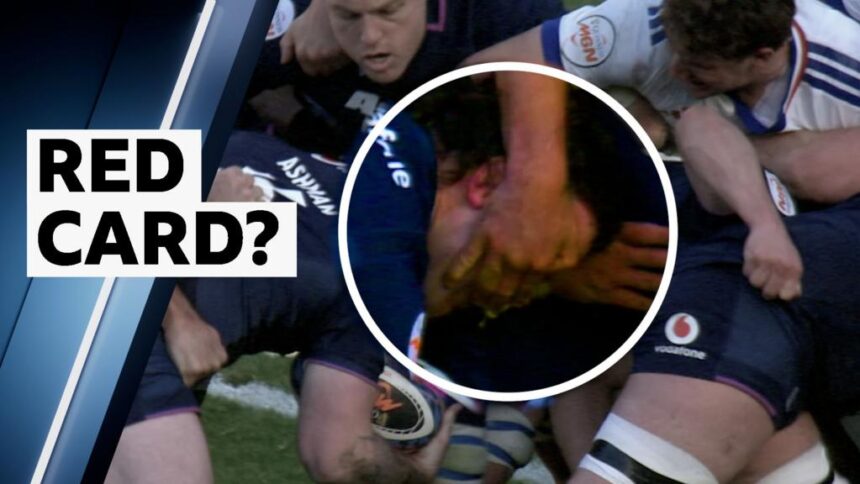
With Scotland building momentum in the first half, a ruck formed near the French 22. As the ball emerged, cameras captured a tangle of bodies. France’s Oscar Jegou, in attempting to clear out, made contact with the head and face area of Scotland’s Ewan Ashman, who was pinned at the bottom of the ruck. Ashman’s immediate and visceral reaction told a story. He sprung to his feet, appealing vehemently to referee Nic Berry, clearly indicating his eye area.
The on-field officials convened. With no clear broadcast angle immediately available, TMO Brian MacNeice reviewed the available footage. The conversation centered on whether the contact was “direct” and “intentional,” the key thresholds for an act of foul play involving the eyes. After several minutes of deliberation, referee Berry announced to a tense Murrayfield: “We don’t have a clear angle of direct contact with the eye. Therefore, it’s a dynamic clear-out that’s caught the head. It’s a penalty only.” The decision was met with a roar of disapproval from the Scottish faithful. Jegou, perhaps fortunate, played on.
Expert Verdict: Nigel Owens Weighs In
To cut through the noise, there is no better authority than former elite referee Nigel Owens. Renowned for his clarity and integrity, Owens dissected the incident with his trademark forensic eye. His analysis suggests Scotland and Ashman had legitimate cause for grievance.
Owens highlighted several critical factors that, in his view, pointed towards a more severe sanction:
- The Action of the Hand: “Look at the direction and the shape of Jegou’s hand,” Owens noted. “It’s not a closed fist for a punch, nor an open palm for a push. The fingers are extended and appear to make contact directly with the eye/face area of Ashman, who is in a vulnerable, stationary position.”
- The Victim’s Reaction: “Ashman’s reaction is instantaneous and specific. He doesn’t clutch his neck or jaw; he goes straight for his eye. That is a very telling instinct from a player. It’s a signal officials must take seriously.”
- The “Clear and Obvious” Threshold: Owens acknowledged the TMO’s dilemma regarding camera angles but argued the available evidence created a compelling picture. “In these situations, you must ask: what is the probable outcome of this action? Given the hand position, the point of contact, and the reaction, the probability is that there was contact with the eye area. In the current climate of protecting player welfare, especially concerning the head and eyes, the benefit of the doubt should be removed.”
Owens’ conclusion was stark: “While I understand the officials’ difficulty without a perfect angle, on balance, this had all the hallmarks of an act that should have resulted in a red card. It was a very lucky escape for Jegou and France.”
The Wider Context: Player Welfare and Consistency
This incident does not exist in a vacuum. It strikes at the heart of rugby’s most sacred covenant: player safety. Eye-gouging, or even reckless contact near the eyes, is considered among the game’s most heinous acts. It is not just a foul; it’s a profound breach of trust that can cause serious, lasting injury.
The sport’s governing bodies have repeatedly vowed a “zero-tolerance” approach. Yet, this case highlights the perennial challenge of officiating consistency. Had a different TMO or referee team been in charge, would the outcome have been the same? The “clear and obvious” standard, while necessary, can sometimes create a loophole where the absence of a single, cinematic camera angle leads to a dangerous act going unpunished.
This creates a dangerous precedent. Players may feel they can operate in the “grey area” of the ruck, testing the limits of what cameras will capture. For the player on the receiving end, like Ashman, the message feels hollow. The incident also overshadows Jegou’s debut. A red card would have been a brutal introduction to Test rugby, but the cloud of controversy now follows him regardless.
Fallout and Future Implications
While the match result stands, the ramifications are ongoing. The Citing Commissioner has a 48-hour window to review the incident and can cite Jegou if they believe the act warranted a red card. Given the high-profile scrutiny and expert opinion, a citing seems a distinct possibility.
- Potential Suspension: If cited and found guilty of making contact with the eye/eye area, Jegou could face a significant suspension, starting at a 12-week entry point which can be mitigated down. This would rule him out of the remainder of the Six Nations.
- France’s Discipline Crisis: This incident is part of a deeply worrying trend for France. They conceded 18 penalties and received two yellow cards in this match alone. Adding a potential red-card citing for gouging speaks to a systemic lack of discipline that head coach Fabien Galthié must address urgently.
- Scotland’s Moral Victory: For Scotland, the expert validation will be cold comfort. They won the game, but the feeling of injustice over the incident lingers. It raises the painful “what if” scenario: playing 60 minutes against 14 men could have transformed an epic win into a more comfortable one.
The Final Whistle: A Stain on a Classic
Scotland 50-40 France will live long in the memory as one of the great Six Nations matches. It was a testament to attacking ambition, resilience, and drama. Yet, the Jegou-Ashman incident is an unwelcome stain on that tapestry. The expert analysis from a figure of Nigel Owens’ stature strongly suggests the wrong decision was reached on the field.
Rugby’s commitment to player welfare is constantly under the microscope. To maintain its credibility, the game must ensure that its darkest arts are eradicated, and that requires officials to have the courage to make big calls based on the totality of evidence—even when one perfect camera angle is missing. Oscar Jegou may have escaped a red card at Murrayfield, but the judgment of history, and likely the Citing Commissioner, will be less forgiving. The incident serves as a stark reminder that in the modern game, player safety cannot be left to a matter of camera angles; it must be a non-negotiable principle upheld with unwavering conviction.
Source: Based on news from BBC Sport.