Ibrox Invaded: Police Condemn ‘Shameful’ Old Firm Pitch Clash as Dark Day for Scottish Football
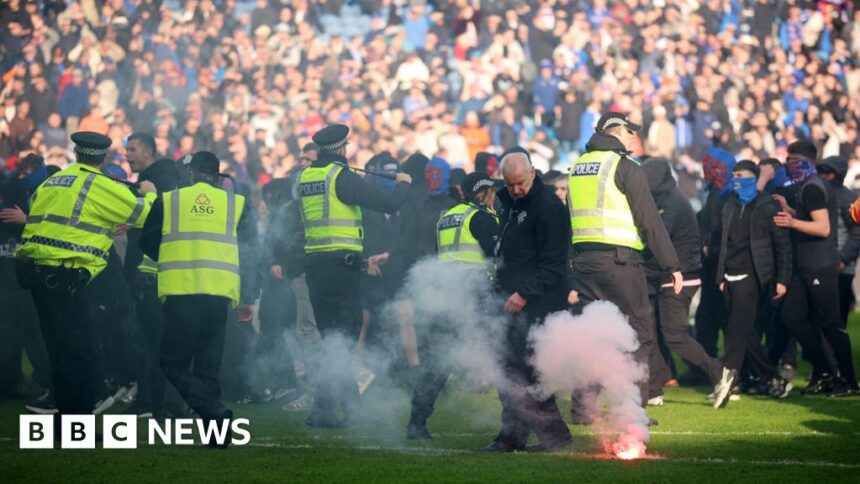
The Old Firm derby, Scottish football’s most storied and volatile fixture, descended into chaos and condemnation on Sunday as a pitch invasion by rival fans turned Ibrox Stadium into a battleground. What should have been a dramatic conclusion to a Scottish Cup quarter-final—a 4-2 Celtic victory on penalties—was irrevocably marred by what Police Scotland branded “despicable” and “shameful” scenes. The images of supporters clashing on the hallowed turf, flares illuminating the fray, and police officers forming desperate barricades have sparked a profound reckoning for the game in Scotland.
- A Celebration Turned Confrontation: Unpacking the Ibrox Chaos
- Official Condemnation and the Wider Repercussions
- Expert Analysis: The Tinderbox of Tribalism and Failed Stewardship
- Predictions and the Path Forward for Scottish Football
- Conclusion: A Stain on the Game and a Call for Collective Responsibility
A Celebration Turned Confrontation: Unpacking the Ibrox Chaos
The immediate trigger for the disorder was a surge of Celtic fans onto the pitch following their team’s dramatic win. While initially appearing as jubilant, if illicit, celebration, the dynamic shifted dangerously when Rangers fans also joined the fracas, storming from the opposite end of the stadium. The narrow gap of the Ibrox pitch suddenly became a no-man’s-land. Flares were launched like projectiles, and a violent melee erupted as the two factions met. Police and stewards, caught in the middle, formed a fragile human chain in a bid to separate the groups, an act of bravery that came at a cost with multiple officers and fans injured.
This was not a spontaneous overflow of joy; it was a pre-meditated breach of security and civility. The sequence of events reveals a troubling escalation:
- Celtic’s Penalty Victory: The final whistle prompts an initial, manageable pitch incursion by celebrating away fans.
- Rangers’ Fan Reaction: A subsequent, retaliatory invasion from the home sections transforms the scene into a direct confrontation.
- Weaponized Pyrotechnics: The use of flares thrown as weapons elevated the danger, creating panic and a tangible fire risk.
- Police and Steward Intervention: The thin blue line of officers became both targets and protectors, suffering injuries in the process.
Official Condemnation and the Wider Repercussions
The response from authorities was swift and unequivocal. Police Scotland confirmed a number of arrests and promised a rigorous investigation, with CCTV and body-worn footage likely to lead to further charges. The statement from Chief Superintendent Kate Stephen cut to the heart of the issue, extending blame beyond the usual footballing circles. She asserted that the behaviour “must be condemned by everyone involved in football and wider society,” framing it not as a football problem, but a societal one.
This language is significant. It moves the incident from the sports pages to the front page, inviting scrutiny from government, sponsors, and the public at large. The Scottish Football Association (SFA) and the clubs themselves now face immense pressure. Potential repercussions could be severe, including:
- Substantial Financial Penalties: Both clubs can expect heavy fines from the SFA for the failure of security and the conduct of their supporters.
- Stadium Closures or Capacity Restrictions: Ibrox could be forced to host matches behind closed doors or with a reduced capacity, a punishment that hits clubs financially and spiritually.
- Deductions of Points or Cup Disqualification: While a nuclear option, governing bodies have historically considered sporting sanctions for extreme disorder.
- Reputational Damage: The global broadcast of these scenes undermines the SPFL’s commercial appeal and tarnishes Scotland’s footballing image.
- A Security Overhaul: Mandatory enhanced perimeter barriers, increased stewarding numbers, and stricter enforcement of bans for pitch incursions at all grounds.
- Joint Club and Police Initiatives: Celtic and Rangers will be pressured into a unprecedented collaborative campaign to curb fan violence, however reluctantly.
- Government Intervention: The Scottish government may feel compelled to introduce legislation akin to stricter liability, holding clubs more directly accountable for fan behaviour.
- A Cultural Reckoning: The most challenging prediction is whether this event serves as a true watershed. It must spark a conversation within fan groups about the line between passion and criminality.
Expert Analysis: The Tinderbox of Tribalism and Failed Stewardship
To view Sunday’s events as an isolated incident is to misunderstand the deep-seated nature of the Old Firm rivalry. This clash exists at the intersection of sport, politics, and identity. The powder keg was always primed; the penalty shootout merely provided the spark. Experts point to a confluence of factors: the high-stakes, winner-takes-all nature of a cup tie, the historical weight of the fixture, and a perceived erosion of respect between the clubs in recent years, both on and off the pitch.
However, context is not an excuse. Analysis must also focus on stewarding and policing failures. How were hundreds of fans able to access the playing surface from multiple sections? Were intelligence and resource deployments sufficient for a fixture of such known risk? The rapid escalation from celebration to combat suggests a security plan that was quickly overwhelmed, raising serious questions for the safety certificate holders and Police Scotland’s operational planning.
Furthermore, the role of social media in inciting and coordinating such actions cannot be ignored. The digital realm often fuels the tribal hatred that manifests physically in the stands and, on this day, on the pitch itself.
Predictions and the Path Forward for Scottish Football
The immediate future is likely to be dominated by disciplinary hearings and legal proceedings. Beyond the sanctions, a fundamental change in approach is required. Predictions for the coming months include:
Conclusion: A Stain on the Game and a Call for Collective Responsibility
The pitch invasion at Ibrox was more than a public order breach; it was a betrayal of football itself. The sacred space where athletes compete was violated, not by outsiders, but by the game’s own most passionate followers. Police officers were injured doing their duty, and the spectacle of hatred overshadowed a moment of sporting excellence.
Chief Superintendent Stephen’s call for condemnation from “wider society” is the crucial takeaway. This is not a problem for police and football authorities alone to solve. It requires fans to self-police, clubs to show genuine leadership beyond statements of regret, media to report responsibly, and politicians to provide a legislative framework that protects the game. The shame of Ibrox must become the catalyst for a lasting change, or Scottish football risks being defined not by its skill and passion, but by its capacity for self-destruction. The final whistle on Sunday marked the end of a match, but the real work to salvage the sport’s soul has only just begun.
Source: Based on news from BBC Sport.