‘Wrong Reason, Right Decision’: The Whistle That Denied Fulham and Sparked a Refereeing Debate
In the high-stakes theatre of the FA Cup, where dreams are forged and shattered in a single moment, a referee’s whistle can echo longer than any roar from the crowd. Such was the case at Craven Cottage, where Fulham’s quest for quarter-final glory was halted not just by a solitary Southampton goal, but by a controversial, split-second decision from official Jarred Gillett. The incident, a disallowed Fulham equalizer, has ignited a fierce debate: was it a catastrophic error or, paradoxically, the correct outcome arrived at via a flawed process? Match of the Day pundits Ellen White and Glenn Murray cut through the noise, presenting a compelling case for the latter—a decision born of the wrong reason, yet ultimately right.
The Incident: A Cascade of Chaos at Craven Cottage
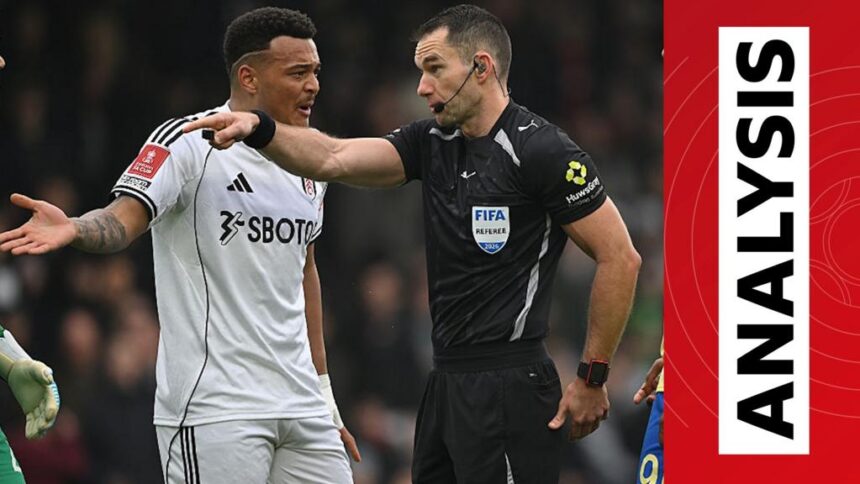
The match hung in the balance. Southampton led 1-0, and Fulham, pressing for a lifeline, saw the ball break to Bobby De Cordova-Reid in the box. His shot, deflected, looped agonizingly over Saints goalkeeper Gavin Bazunu and seemed destined for the net. Yet, before the ball crossed the line, the sharp blast of referee Gillett’s whistle pierced the air. Play was dead. The goal was chalked off. Immediate fury erupted from the Fulham players and bench, a sentiment shared by a bewildered crowd. The initial assumption was a mistaken offside call against the lurking Raúl Jiménez. However, as replays poured in, a more complex, nuanced picture emerged—one that experts would later dissect to reveal a rare refereeing paradox.
Expert Analysis: Dissecting the “Why” with White and Murray
Former England striker Ellen White and ex-Premier League forward Glenn Murray provided crucial clarity on the Match of the Day analysis segment. They pinpointed that Gillett did not whistle for offside against Jimenez, who was in fact onside. The real culprit was an earlier infringement that the referee had identified.
Ellen White’s Take: White focused on the sequence just before the shot. “The referee is blowing because he sees a foul by Rodrigo Muniz on Kyle Walker-Peters,” she explained. From Gillett’s vantage point, Muniz’s challenge as the ball was played into the box appeared to be a push or a clip on the Southampton defender. In that moment, the referee’s duty is to call what he perceives. He believed he saw a foul, and his protocol is to stop play immediately. White acknowledged the harsh outcome but emphasized the referee’s mandate to act on his real-time judgement.
Glenn Murray’s Insight: Murray, bringing a striker’s agony to the analysis, agreed with the technical assessment but added a critical layer. “It’s the wrong reason because, when you see the replay, it’s minimal contact—probably not enough for a foul in today’s game. But it’s the right decision because if you follow that sequence through, if the foul isn’t given, the goal doesn’t happen.” Murray’s point was profound: the chain of events leading to the shot was directly initiated by the contested challenge. Therefore, disallowing the goal upheld the principle that a team should not profit from an infringement, even if the severity of that infringement was debatable.
The Core Refereeing Principles at Play
This incident is a textbook case of the philosophical and practical tensions within modern officiating. It hinges on several key protocols:
- Immediate Whistle Protocol: Referees are trained to blow when they see a clear foul, especially in defensive areas. Hesitation can lead to greater confusion. Gillett saw what he believed was a clear foul and acted.
- Benefit of the Doubt: This usually applies to attackers in offside calls. Here, the “doubt” was about the foul’s severity. Gillett had no doubt in his mind in real-time.
- VAR’s Limitations: Crucially, VAR could not intervene. As the whistle went before the ball entered the net, the phase of play was deemed dead. VAR cannot review a decision to stop play for a foul; it can only review potential penalties or red-card incidents in the build-up to a goal. This technicality left Fulham without recourse.
The fallout highlights a growing conversation about the advantage rule in the box. Could Gillett have delayed his whistle a half-second, seen the goal, and then allowed VAR to check the entire sequence? While tempting, this undermines the referee’s authority and creates a dangerous precedent of “wait-and-see” officiating that could lead to increased injury risk and chaos.
Predictions: Ripple Effects on Fulham and Refereeing Culture
The implications of this single call extend beyond one FA Cup exit. For Fulham, the psychological blow is immense. Manager Marco Silva’s post-match fury is understandable; his team was denied a dramatic, momentum-shifting moment. The challenge now is to ensure this perceived injustice fuels their Premier League campaign rather than deflating it. They must channel the frustration into a determined push for a top-half finish.
For the broader world of officiating, the incident serves as a high-profile teaching moment. It will be dissected in referee training rooms, emphasizing two lessons:
- The critical importance of positioning and angle to avoid being deceived by minimal contact.
- The ongoing debate about tolerance levels for contact in the penalty area. Pundits like White and Murray arguing the contact was “minimal” reflects a desire for more consistency in what constitutes a foul worthy of stopping a promising attack.
We may see increased dialogue between PGMOL and clubs to better explain these marginal, game-defining decisions. Furthermore, it adds fuel to the speculative discussion about potentially expanding VAR’s remit, though such a move remains fraught with complexity.
Conclusion: A Sobering Lesson in Football’s Grey Areas
The disallowed Fulham goal against Southampton will be filed under “cruel luck” for the Cottagers and “great escape” for the Saints. Yet, as the expert analysis from Ellen White and Glenn Murray confirms, it transcends simple blame. Jarred Gillett made a proactive decision based on what he saw, following his training to the letter. The replay suggested his reason—a clear foul—was arguably wrong. But the consequence of that action, perhaps fortuitously, aligned with the game’s laws by negating a goal stemming from that very incident.
This is the human element of football, raw and unfiltered by slow-motion replays. It is a stark reminder that the game is not officiated by omnipotent cameras but by individuals making real-time judgments under immense pressure. The phrase “wrong reason, right decision” will sting for Fulham, but it encapsulates the intricate, often infuriating, and ultimately human drama that makes football, and the FA Cup in particular, a perpetual crucible of emotion and debate.
Source: Based on news from BBC Sport.