Scholes Clarifies Carrick Comments: A Tale of Banter, Brotherhood, and United’s Turbulence
The unique, often unspoken language of a football dressing room is a dialect forged in shared triumph and adversity. It’s a world where brutal honesty is a currency of respect, and where banter can walk a fine line. This week, that private world collided with the public glare, as Manchester United legend Paul Scholes found himself explaining a social media quip aimed at his former midfield partner and the club’s then-interim boss, Michael Carrick. What seemed a cutting public critique was, according to Scholes, simply a case of insider humour lost in translation.
A Partnership Forged in Glory: The Scholes-Carrick Axis
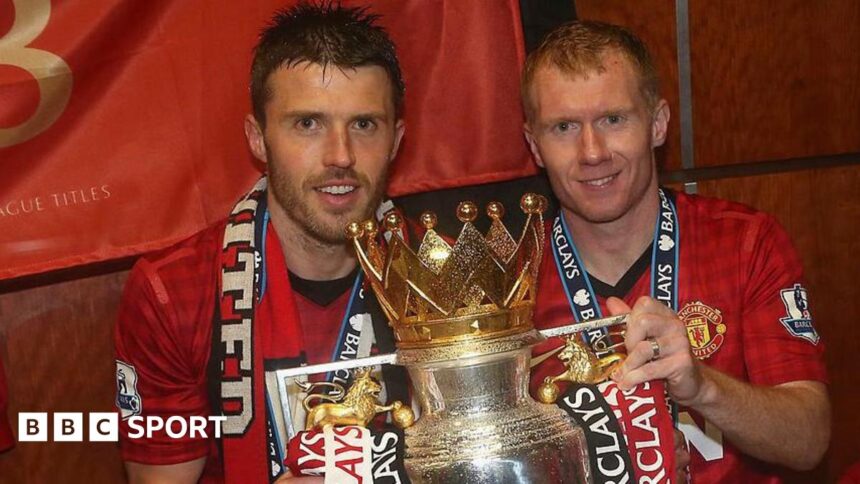
To understand the nuance of this exchange, one must first appreciate the foundation upon which it was built. For seven seasons, Paul Scholes and Michael Carrick formed the cerebral heartbeat of Sir Alex Ferguson’s greatest Manchester United teams. Their understanding was telepathic; Scholes the metronome, Carrick the regulator. Together, they were instrumental in securing:
- Five Premier League titles, dominating English football’s landscape.
- The pinnacle: the 2008 UEFA Champions League crown in Moscow.
- Multiple domestic cups, cementing an era of relentless success.
This wasn’t just a professional relationship; it was a brotherhood forged in the heat of battle. They shared a wavelength on the pitch, a bond that typically extends to a shorthand in communication off it—a context crucial to the recent controversy.
The Instagram Storm: Banter or Betrayal?
The incident erupted following Manchester United’s 2-1 defeat to Newcastle United last Wednesday—the first loss of Carrick’s brief interim tenure. Scholes took to his Instagram story with a comment that immediately went viral: “Michael has definitely got something special about him…cos Utd have been [expletive] last four games.”
The public and pundit reaction was swift and critical. The remark was perceived as a shocking lack of support from a revered former player for a rookie manager and old friend navigating a crisis. Former teammate Patrice Evra encapsulated the disbelief, stating, “I hope he was hacked.” The narrative was set: Scholes had thrown Carrick under the bus.
However, in the cold light of day and on the The Good, The Bad & The Football podcast, Scholes moved to clarify. He stated the post was “in no way intended to be offensive” and revealed he had personally spoken to Carrick to smooth things over. This wasn’t a pundit’s hot take, he implied, but a mate’s failed attempt at ironic humour.
Expert Analysis: The Unbridgeable Gap Between Dressing Room and Pundit’s Chair
This episode highlights a modern footballing tension. Legends like Scholes, Gary Neville, and Roy Keane now occupy the pundit’s chair, a role demanding critical, often harsh, analysis of the very institutions and people they love. The line between their enduring personal relationships and their professional duty to critique is perpetually blurred.
Scholes’s intent likely resided in that private dressing room lexicon—a sarcastic jab meant to be understood as a commentary on the impossible situation Carrick inherited, not his performance. The joke was that the “something special” was merely the luck of having marginally less awful results than what preceded him. To an outsider, without the vocal tone and shared history, it read as pure scorn.
Furthermore, Carrick’s own dignified and undramatic stint in charge, securing a vital Champions League win against Villarreal and a draw at Chelsea before the Newcastle loss, arguably made Scholes’s comment seem even more unwarranted. It amplified the noise around a club desperately seeking stability.
Predictions: Legacy Intact, But a Lesson Learned
So, what does this mean moving forward? The Scholes-Carrick relationship, built over decades, will undoubtedly survive. Their private conversation will have been far more meaningful than any public explanation. However, this serves as a stark lesson for the new breed of ex-player pundits.
- Context is King: Humour and nuance die in 280-character tweets or Instagram story text. What plays in a private WhatsApp group fails on a global stage.
- The Analyst’s Mask: When offering public critique, former teammates must almost fully dissociate from their personal bonds or risk these exact misunderstandings. The “matey” tone can confuse the audience and undermine the analysis.
- United’s Culture: This minor storm is a microcosm of the larger issue at Old Trafford: everything is amplified, every word parsed. The club’s current volatility creates a pressure cooker where even a joke between brothers becomes a back-page story.
Conclusion: More Than a Social Media Misstep
The Scholes-Carrick saga is more than a simple social media misstep. It is a window into the complex transition football legends make after retirement, the collision of private bonds with public roles, and the hyper-scrutiny surrounding Manchester United. While Scholes has clarified his comments were not offensive in intent, the episode underscores that in the digital age, perception often overrules intention.
Their shared legacy—those five Premier League titles and that Champions League night in Moscow—remains untarnished. This is a footnote, not a chapter. But it reminds us that the understanding that once orchestrated dominance on the pitch can sometimes get lost in translation off it. For United, the hope will be that the focus returns to rebuilding that same level of seamless understanding on the field, where it matters most.
Source: Based on news from BBC Sport.