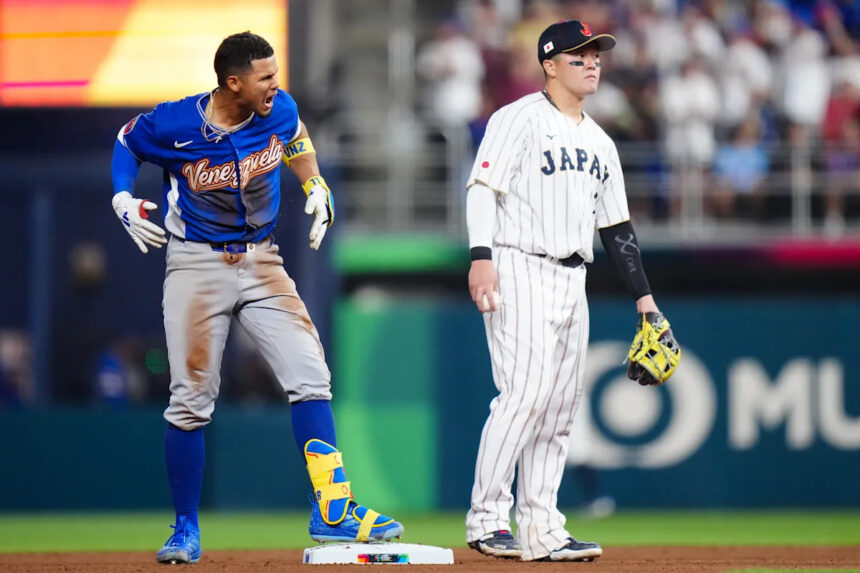
Venezuela’s Historic Offensive Barrage Ends Japan’s WBC Dynasty in Miami Thriller
For over a decade, the World Baseball Classic semifinals have been a given for Samurai Japan. A national expectation. On a humid Saturday night in Miami, that era of invincibility came to a stunning, thunderous end. In a quarterfinal game that felt more like a heavyweight title fight, Venezuela out-slugged Japan 8-5 at loanDepot Park, authoring a historic upset and simultaneously writing a new chapter for their own baseball legacy. The loss marks the first time Japan has failed to reach the WBC’s final four, a seismic shift in the tournament’s power structure fueled by Venezuelan power and relentless pressure.
A Marquee Matchup Delivers Instant Legend
The stage was set for a classic from the very first pitch. Japan’s ace, Yoshinobu Yamamoto, a two-time Sawamura Award winner, faced the explosive top of Venezuela’s order. On the second pitch of the game, Ronald Acuña Jr. unleashed a violent swing, sending a leadoff home run screaming into the Miami night. The Venezuelan faithful erupted, but the response was swift and iconic. In the bottom of the first, Shohei Ohtani, the global face of the sport, stepped in. He worked the count, and on a 2-1 fastball, he connected. The ball soared into the right-field seats, a deafening answer-back that tied the game and sent a wave of red and white through the crowd.
This exchange wasn’t just thrilling; it was historic. As noted by MLB.com’s Sarah Langs, this marked the first time in a professional game—major leagues or WBC—that two former league MVPs had hit leadoff home runs for their respective teams. The rarity of the moment underscored the caliber of this elimination game. It was a symbolic passing of the torch within the game, a showcase of its present and future stars on the grandest international stage.
Venezuela’s Relentless Attack Breaks the Dam
While the star power shone early, the story of the game became Venezuela’s deep and unforgiving lineup. Yamamoto, uncharacteristically vulnerable, labored from the start. He needed 57 pitches to navigate the first three innings, constantly working from behind. Venezuela’s approach was clear: attack early and punish mistakes.
- Ezequiel Tovar’s Dominance: The Colorado Rockies shortstop continued his personal mastery over Yamamoto, lacing an RBI double in the second inning. Tovar’s career numbers against the Japanese ace are video-game-like: 8-for-12 with two homers and two doubles.
- Maikel Garcia’s Clutch Swing: After Japan took a brief 3-2 lead, Kansas City’s Maikel Garcia stepped up in the fifth. With a man on, he turned on a pitch and launched a two-run homer to left-center, reclaiming the lead and momentum for Venezuela.
- Wilyer Abreu’s Decisive Blow: The knockout punch came in the sixth. With two on and two out, relative unknown Wilyer Abreu (Boston Red Sox system) connected for a towering three-run home run to right field. That shot, giving Venezuela an 8-3 lead, was the go-ahead three-run shot that ultimately sealed Japan’s fate.
The Venezuelan offense was a machine, racking up 10 of their 13 hits for extra bases. Five of those were home runs, a testament to their raw power and aggressive approach against a Japanese pitching staff renowned for its precision.
Analyzing the End of a Samurai Japan Era
Japan’s elimination sends shockwaves through the baseball world. This is a program that won the first two WBC titles (2006, 2009) and had medaled in every subsequent tournament. Their preparation is legendary, their fundamentals textbook. So what happened?
Pitching Uncharacteristically Faltered: Beyond Yamamoto’s struggle, the normally reliable Japanese bullpen could not stem the tide. Relievers like Hiroto Takahashi and Taisei Ota were unable to execute the shutdown innings Japan needed, leaving pitches over the heart of the plate to a lineup that does not miss.
Venezuela’s Lineup Depth: Japan’s strategy often revolves around neutralizing the heart of the order. Venezuela, however, presents no soft landings. From Acuña at the top to role players like Abreu and Garcia at the bottom, every hitter posed a legitimate power threat. This game was a masterclass in lineup construction and execution under pressure.
The Weight of History: For Venezuela, this was a chance to make history. For Japan, it was about upholding it. Sometimes, the hunger of the hunter overcomes the poise of the champion. Venezuela played with a palpable, fiery desperation, clinching not only a berth into the 2028 Summer Olympics but also their first WBC semifinal since 2009.
What This Means for the WBC and Beyond
The fallout from this result will resonate far beyond Miami.
Venezuela as a True Title Contender: With this win, Venezuela announces itself not as a dark horse, but as a legitimate favorite to win the whole tournament. Their combination of elite star power (Acuña, Altuve, Salvy Perez) and explosive role players makes them a nightmare matchup for any remaining pitching staff.
A New WBC World Order: Japan’s exit, coupled with the Dominican Republic’s earlier elimination, proves the WBC has achieved its goal of global parity. Baseball’s titans can be toppled on any given night. This elevates the tournament’s prestige and unpredictability, making every pitch must-see television.
Olympic Implications: By reaching the semifinal, Venezuela secured a spot in the 2028 Los Angeles Olympics, a massive prize for the federation. It allows for long-term planning and provides another platform for their golden generation of talent.
Shohei Ohtani’s International Future: In a bittersweet performance, Ohtani homered and pitched a scoreless inning in relief, leaving everything on the field. At 28, his next WBC appearance is not guaranteed. This potential ending adds a layer of poignancy to Japan’s loss, closing a chapter for perhaps the greatest player to ever wear the Samurai blue.
Conclusion: A Night of Thunder and Change
The crack of the bat echoed with meaning in Miami. Each Venezuelan home run wasn’t just scoring a run; it was chiseling away at a dynasty. When the final out was recorded—a fly ball off the bat of, fittingly, Shohei Ohtani—a celebration 14 years in the making erupted in teal and yellow. Venezuela, long a cradle of baseball talent, finally has a team performance to match its passion, advancing on the strength of pure, unadulterated offense.
For Japan, the journey ends earlier than anyone anticipated. They fought valiantly, led by their transcendent star, but on this night, they were simply outgunned by a team possessed. The World Baseball Classic has its first true Cinderella story of the 2023 tournament, but Venezuela is no fluke. They are a powerhouse, and their 8-5 victory over Japan is a landmark result that reshapes the international baseball landscape. The semifinals will go on, but the tournament will forever remember the night in Miami when the samurai were finally, unexpectedly, silenced.
Source: Based on news from Yahoo Sports.