The Five Frantic Minutes That Could Shape Leeds United’s Season
In the frantic, unforgiving theatre of a Premier League relegation battle, seasons are not defined over 38 games. They are forged in moments. A split-second decision, a referee’s whistle, the trajectory of a ball from twelve yards. For Leeds United at Selhurst Park, their entire campaign may well have been compressed into a dizzying, five-minute spell of pure chaos that laid bare the razor-thin margins between triumph and disaster.
A Descent Into Chaos: From Penalty Hope to Red Card Despair
The clock ticked towards half-time in a tense, tactical stalemate. Then, the eruption. A clumsy challenge from Crystal Palace’s Sam Johnstone on Patrick Bamford. The referee pointed to the spot. For Leeds, a golden chance to seize control, to land a crucial blow in their fight for survival. The away end roared. This was the moment.
But the Premier League script is rarely so straightforward. Bamford, the designated taker, saw his powerful effort magnificently saved by Johnstone, who redeemed his error in an instant. The emotional whiplash for Leeds was immediate and severe. From the precipice of a lead, they were plunged into disbelief.
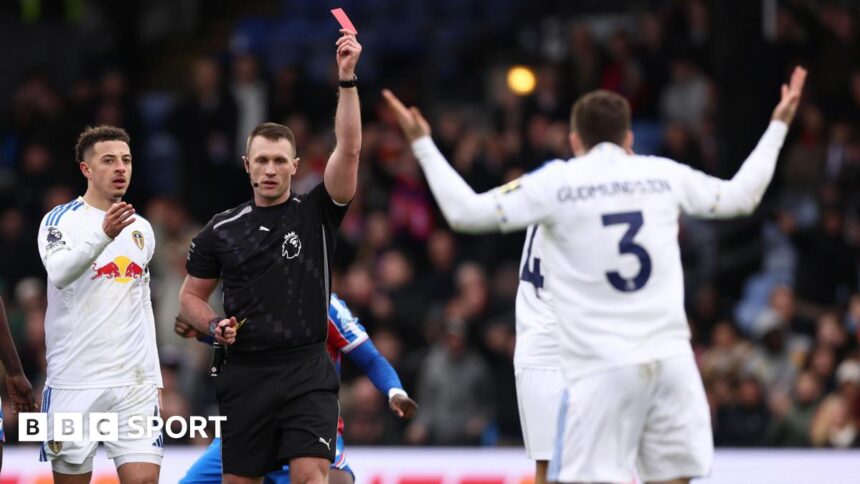
The chaos was only beginning. Gabriel Gudmundsson, already on a yellow card, lunged into a needless, reckless challenge on Jordan Ayew moments later. The second yellow was inevitable. The red card was shown. In the blink of an eye, Leeds had gone from a potential 1-0 lead to a 0-0 scoreline with only ten men for the entire second half. The statistics underscored the historic nature of the collapse: Gabriel Gudmundsson became the first Leeds player to be sent off for two first-half bookings in the Premier League since Mark Viduka in May 2004—a grim piece of history no one at Elland Road wanted.
Perspective is Everything: Point Gained or Two Points Lost?
In the aftermath, the narrative fractured. There was no single truth, only perspective. Was this a point heroically earned, or a victory carelessly thrown away? The answer you get depends entirely on who you ask.
Daniel Farke, the Leeds manager, was unequivocal. He saw resilience, character, and a defiant rearguard action. “To come here, to have a penalty saved, to go down to ten men in the manner we did, and then to show the discipline, the heart, and the tactical intelligence to get a clean sheet… this is a hard-fought point,” he reflected. For Farke, the focus was on the response, not the calamity. His team had absorbed pressure, restructured, and denied a talented Palace side at home. In the context of a long season, such grit is priceless.
Yet, the dissenting voice is just as compelling. Leeds had Palace on the ropes. A goal there changes everything. It forces the hosts to open up, it energizes Leeds, and it likely secures three vital points. For the critics, this was a huge chance blown. The penalty miss was a setback; the immediate red card that followed was an act of self-sabotage. In a relegation battle where every point is a prisoner, failing to capitalize on such a dominant moment could be the difference between survival and the Championship.
Consider the key moments that defined this schism:
- The Penalty Save: Johnstone’s stop shifted the entire momentum of the match and possibly Leeds’ season.
- Gudmundsson’s Moment of Madness: A veteran lapse that put his team in peril for 45 minutes.
- The Defensive Reorganization: Leeds’ impressive second-half shape, a testament to Farke’s coaching.
- Missed Opportunity: With rivals dropping points, a win would have been a monumental step towards safety.
The Historical Echo and the Psychological Test
The ghost of Mark Viduka’s 2004 dismissal is more than a trivia footnote. It’s a reminder of how a single moment of indiscipline can encapsulate a season’s struggle. The real question now is psychological: how does Leeds move forward from this emotional rollercoaster?
Farke will use the defiance of the second half as the blueprint. He will hammer home the unity, the work rate, the tactical obedience. The message is clear: “We can suffer together and succeed together.” This can forge a powerful siege mentality, a “us against the world” spirit that often defines great escapes.
Conversely, the danger is that doubt creeps in. The “what if?” can be a corrosive force. Can Patrick Bamford step up for the next crucial penalty? Can the squad trust each other to keep their heads in high-pressure moments? The management of this psychological fallout is Daniel Farke’s next big challenge. The response in their next home game will be telling—will they play with a fearful handbrake on, or with the furious energy of a team wronged?
The Final Verdict: A Story Awaiting Its Ending
The truth of how this match is defined is not likely to become clear until the end of the campaign. This is the crux of the matter. Football narratives are written in May, not March.
If Leeds United survive by a single point, the draw at Palace will be canonized as the foundation. The day they showed they could fight, scrap, and survive with their backs against the wall. Gudmundsson’s red card will be a forgotten footnote, a moment of madness overcome.
If, however, they fall short by a point or two, those five minutes at Selhurst Park will be revisited with agony. They will be seen as the costly, self-inflicted wound that doomed their Premier League status. The penalty miss and the red card will be forever intertwined as the “what might have been” that sealed their fate.
For now, Leeds walk a tightrope. They have shown both a concerning fragility and an admirable resilience within the same half of football. The five frantic minutes in South London have set the stage for the final act. They have given Leeds a story—one of either heroic resilience or tragic profligacy. The players, under Farke’s guidance, now hold the pen. Their actions in the coming weeks will write the conclusion, and finally reveal whether this chaotic episode was a stumble on the path to safety, or the moment the ground began to crumble beneath their feet.
Source: Based on news from BBC Sport.