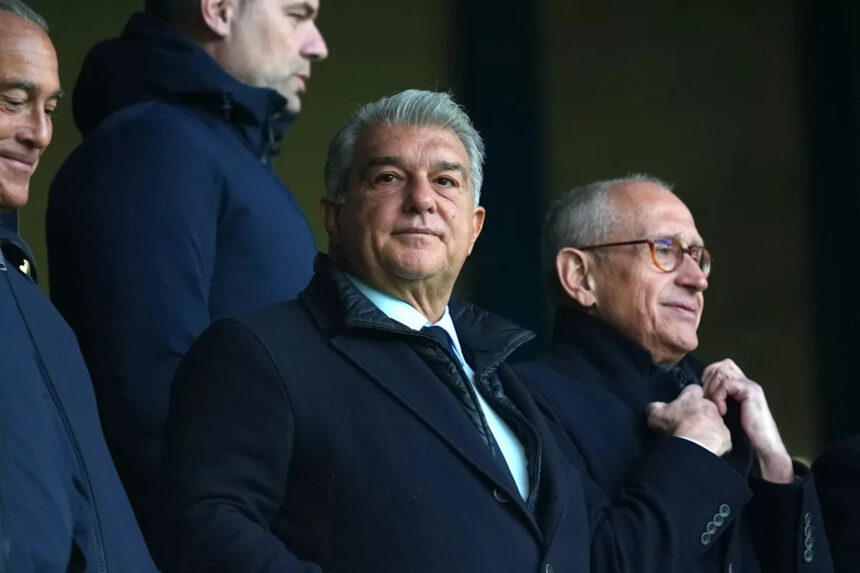
Laporta’s Landslide: A Mandate for Continuity as Barça President Secures Decisive Re-Election
The echoes of “Visca el Barça!” still hung in the crisp Catalan air, a sentiment forged in a 5-2 victory over Sevilla and solidified in a democratic landslide. On a historic Sunday, Joan Laporta didn’t just win an election; he secured a powerful mandate. With a staggering 66% of the vote, the charismatic leader has been entrusted with the future of FC Barcelona until 2031, a verdict that underscores a membership craving stability over seismic change. This wasn’t merely a political victory; it was a resounding endorsement of a project still in progress, a vote of confidence in a president steering the club out of its most treacherous financial waters.
A Sunday of Destiny: Votes, Goals, and a Pre-Booked Celebration
The day was a microcosm of the modern Barça experience: footballing brilliance intertwined with institutional drama. As tens of thousands of socis streamed into polling stations across Catalunya, the first team delivered a masterclass at Montjuïc. The final whistle blew on the pitch, and moments later, stars like Frenkie de Jong and Robert Lewandowski were casting their ballots. This seamless transition from sporting triumph to civic duty highlighted the deep, personal connection at the heart of the club’s democracy.
Laporta’s confidence was palpable. Reports from SPORT revealed that, with over an hour of voting remaining, the 63-year-old had already booked a celebratory dinner at a local Barcelona restaurant. This wasn’t arrogance, but the assuredness of a man who had read the room—the local members, the Culers whose daily lives are woven into the club’s fabric. His subsequent celebration, surrounded by beaming first-team players, wasn’t just a victory lap; it was a symbolic unification of the squad behind his leadership, a powerful image beamed across the globe.
Font’s Failed Gambit and the Messi Shadow
Victor Font, Laporta’s main challenger, ran a campaign anchored in a critique of the past and a promise of a more technocratic future. His central, piercing attack line focused on Laporta’s fractured relationship with Lionel Messi. He positioned the traumatic, financially-driven departure of the club’s greatest ever player as the ultimate failure of Laporta’s previous tenure, a wound that still bleeds for many supporters. Font argued for a new model, one less reliant on the president’s personal magnetism and more on a structured, corporate vision.
Yet, the electorate delivered a stark verdict. The 66% to 28% margin suggests that while the Messi chapter is a source of enduring pain, the majority of voting members prioritized the present and future roadmap over revisiting past heartbreak. Laporta successfully framed Font’s proposals as a risk, a leap into the unknown. His campaign warnings that a Font presidency would jeopardize the club’s fragile financial recovery and on-pitch progression clearly resonated. In the end, the promise of continued, steady navigation through the storm outweighed the appeal of a radically new captain.
Key Factors in Laporta’s Decisive Victory:
- The Economic Rescue Narrative: Despite ongoing leverage, members credit Laporta with pulling the club back from the brink of bankruptcy.
- Sporting Momentum: A La Liga title win in 2022/23 and a vibrant, young team under Xavi Hernández (until recently) provided tangible on-pield hope.
- The Power of Incumbency & Personality: Laporta is a known entity, a fighter with deep emotional ties to the club’s identity.
- Rejection of Perceived Risk: Font’s vision was ultimately viewed as an unproven and potentially destabilizing alternative.
The Laporta Legacy Project: Navigating the 2031 Horizon
This victory is no ordinary re-election. It grants Laporta an unprecedented runway, a near-decade to cement his legacy as the architect of Barcelona’s second modern golden age. The challenges, however, remain Herculean. The Espai Barça project, including the monumental renovation of Camp Nou, is in its most critical and expensive phase. The club’s financial levers, while providing short-term relief, have created long-term revenue obligations that demand sustained sporting success. The search for a new head coach following Xavi’s departure adds another layer of immediate pressure.
Laporta’s triumph suggests members believe he is the only figure with the political capital, connections, and sheer force of will to see these ventures through. His presidency will now be judged on a new set of criteria: sustainable economic health, the delivery of a world-class stadium, and consistent European competitiveness. The shadow of Messi may have faded in the polling booth, but the shadow of Laporta’s own immense promises now looms larger than ever.
Analysis: What This Means for Barcelona’s Future
Expert analysis suggests this election result signals a clear strategic direction. First, it reinforces a president-centric model. Laporta’s personal diplomacy with UEFA, his relationships with super-agents, and his bold decision-making are now enshrined as the preferred method of governance for the foreseeable future. Second, it prioritizes continuity in the club’s sporting project. The core of young talent—Pedri, Gavi, Araújo, Lamine Yamal—is now unequivocally “Laporta’s project,” and their development will be the benchmark of his success.
Furthermore, the result insulates the board from short-term turbulence. A close race would have meant governing while looking over one’s shoulder. A landslide of this magnitude provides political cover to make tough, potentially unpopular decisions necessary for the long-term vision, whether in the transfer market or further financial restructuring.
Predictions for the Next Term:
Expect Laporta to move swiftly to appoint a high-profile coach who aligns with the club’s philosophy and can command the dressing room. The summer transfer window will be a tightrope walk of creative financing. Most significantly, the focus will relentlessly shift from survival to resurgence, with the Champions League inevitably becoming the ultimate measure of this era’s success. The message is clear: the emergency phase is over; the construction phase has the full backing of the socis.
Conclusion: A Vote for Faith Over Fear
Joan Laporta did not just defeat Victor Font; he defeated a narrative of doubt. In choosing Laporta by a colossal margin, the Barcelona membership chose the devil they know over the angel they didn’t. They chose emotional resonance over corporate restructuring. They bet on the president who, for all his flaws and the painful farewells he has overseen, embodies the fighting spirit of the club. This was a vote for faith in a work-in-progress, a belief that the man who helped build one dream team can now forge another, not just on the pitch, but in the balance sheets and the very foundations of the stadium. The journey to 2031 starts now, and Laporta has the keys, the map, and an overwhelming mandate to drive.
Source: Based on news from Yahoo Sports.