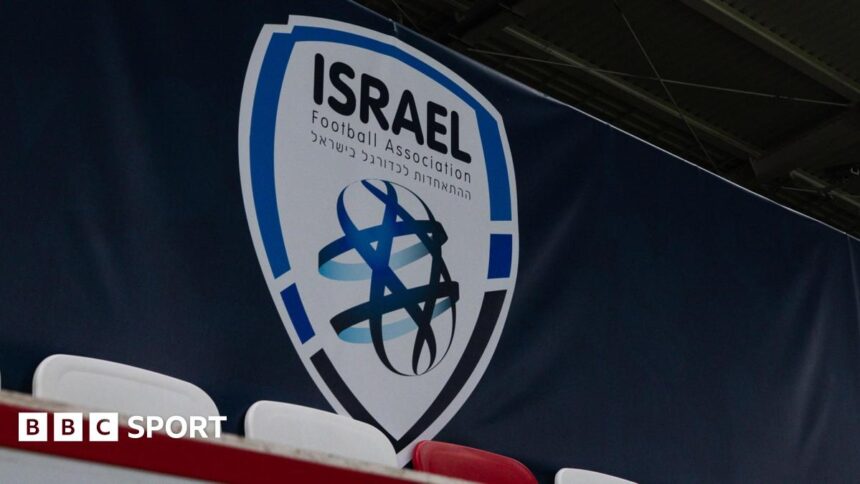
FIFA Sanctions Israel FA: A Watershed Moment in Football’s Fight Against Discrimination
The beautiful game, long celebrated as a universal language of unity, has once again found itself at the complex intersection of sport, politics, and human rights. In a decisive ruling that reverberates far beyond the pitch, FIFA has levied a significant fine and a stark warning against the Israel Football Association (IFA) for breaches related to discrimination and racist abuse. This sanction, stemming from a formal complaint by the Palestine Football Association (PFA), marks a critical chapter in an ongoing saga and forces a global conversation about accountability, neutrality, and the very principles upon which international football stands.
The Complaint and the Condemnation: Unpacking FIFA’s Verdict
The road to this sanction began at the 74th FIFA Congress in May 2024, where the PFA presented a compelling case calling for Israel’s suspension from world football. While the call for suspension was not heeded, it triggered a formal FIFA disciplinary investigation. The probe focused not on geopolitical conflicts, but squarely on the IFA’s domestic handling of racism and discrimination within Israeli football—a key pillar of the PFA’s complaint.
The findings were unequivocal. FIFA’s disciplinary committee found the IFA guilty of violating articles 13 and 15 of the FIFA Disciplinary Code. Article 13 covers “offensive behaviour and violations of the principles of fair play,” while Article 15 deals explicitly with “discrimination and racist abuse.” The specific incidents underpinning these breaches, though not detailed publicly in the ruling, point to systemic failures in addressing such misconduct within the Israeli football landscape.
The resulting punishment is multifaceted:
- A financial penalty of 150,000 Swiss Francs (approximately £141,700), a substantial sum by FIFA’s disciplinary standards.
- A formal warning regarding the IFA’s future conduct, placing the association under heightened scrutiny.
- A unique and symbolic corrective measure: the IFA must display a “significant and highly visible banner” with the words ‘Football Unites the World – No to Discrimination’ alongside its own logo at its next three home matches.
This final point is particularly potent. It transforms the sanction from a private financial transaction into a public, performative act of contrition and education, forcing the federation to visibly align itself with the anti-discrimination message it was found to have inadequately upheld.
Expert Analysis: Between Symbolism and Systemic Change
From a sporting governance perspective, this ruling is a nuanced tightrope walk. FIFA, by focusing on disciplinary code violations rather than political grievances, has attempted to navigate a deeply polarized issue within a legalistic framework. “This is FIFA playing the long game,” notes Dr. Anya Bergman, a sports law professor. “By fining and warning the IFA for its internal disciplinary failures, they address a tangible, codified issue without wading directly into the political morass of suspension. It’s a verdict designed to be defensible within their own statutes, but its symbolic weight is immense.”
The ruling can be seen as a partial victory for the PFA. While their ultimate demand—suspension—was not met, they successfully internationalized their complaint and secured a formal condemnation of the IFA’s practices from the world’s highest football authority. It validates their claims and sets a precedent for holding federations accountable for the environment they foster.
For the IFA, the sanction is a serious reputational blow. The fine is one matter, but the mandated banner display is a public relations challenge. It will be a constant, visible reminder of the ruling during live broadcasts, potentially fueling domestic debate about racism in Israeli sport and the federation’s role. The key question now is whether this punishment will spur genuine, top-down reform in how the IFA identifies, penalizes, and educates against racist incidents in its leagues.
Predictions: Ripple Effects and the Road to 2026
The implications of this decision will unfold in several layers over the coming months and years.
First, it establishes a powerful reference point. Other member associations and activist groups will likely view this as a blueprint for how to leverage FIFA’s disciplinary mechanisms to address systemic discrimination elsewhere. The bar for what constitutes a federation’s “failure to address” abuse has been subtly lowered.
Second, it places the IFA under a microscope. Their next three home matches will be scrutinized not just for the scoreline, but for the display of that banner and the crowd’s reaction to it. Any further verified incidents of discrimination could lead to exponentially harsher penalties, including potential points deductions or stadium closures in future FIFA competitions.
Third, this adds a new dimension to the already tense football relations in the region. Future fixtures involving Israeli clubs or the national team, especially in European competitions, may see this ruling cited by protesters or opposing fans. It has inadvertently become part of the team’s traveling narrative.
Finally, with the 2026 World Cup on the horizon, FIFA is keenly aware of its global image. This ruling signals, however cautiously, that the governing body is willing to use its disciplinary power to enforce its stated principles of unity and non-discrimination, even in politically charged contexts. It is a warning shot to all 211 member associations.
A Unifying Banner or a Dividing Line? The Conclusion
FIFA’s fine and corrective measures against the Israel Football Association represent more than a routine disciplinary action. They are a landmark moment that underscores a hard truth: football associations cannot be neutral arbiters of the game on the pitch while being passive observers of discrimination within their own stands and structures.
The mandated banner, emblazoned with “Football Unites the World – No to Discrimination,” will be a powerful, ironic, and contested symbol. For some, it will be a token gesture; for others, a humiliating but necessary rebuke. Its true success, however, will not be measured in its visibility, but in whether it catalyzes tangible, lasting change within Israeli football culture.
The beautiful game’s greatest power is its ability to inspire and unite. That power is irrevocably diminished when hatred is allowed to echo in its stadiums. This ruling is FIFA’s attempt to reclaim that narrative. The world will now watch to see if the Israel Football Association heeds the warning, embraces the spirit of the banner it is forced to hold, and proves that football can, indeed, be a force for unity in even the most divided of contexts. The ball, as they say, is now in their court.
Source: Based on news from BBC Sport.