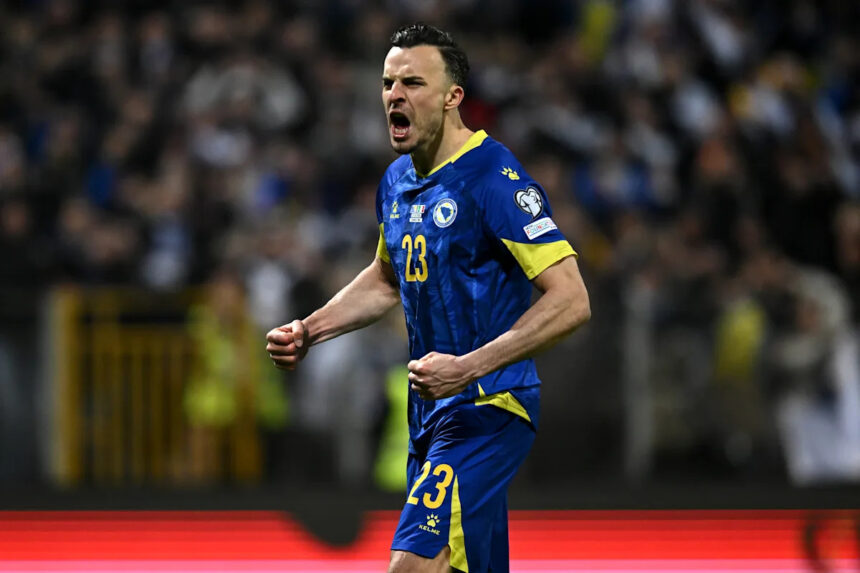
Bosnia’s Balkan Redemption: How the “Milwaukee Messi” and a Nation’s Resolve Sent Italy Crashing Out of World Cup Contention
The air in Zenica is thick with the scent of coal and history, a city forged in steel and resilience. At its heart, Bilino Polje Stadium, a cauldron where dreams are either tempered or shattered. On a night charged with unbearable tension, it was the dreams of a footballing giant, Italy, that were shattered once more. In a staggering playoff qualifier that twisted like a Balkan folk tale, Bosnia and Herzegovina, against all odds and logic, booked their ticket to the FIFA World Cup, condemning the four-time champions to a third consecutive tournament spent watching from home. The final, cruel blow: a calmly converted penalty from an American-born winger dubbed the “Milwaukee Messi.”
A Tale of Two Footballing Psychologies
For Italy, the narrative was one of haunted repetition. The scars from missing the 2018 and 2022 tournaments were fresh, a psychological millstone around the neck of a squad brimming with individual talent but seemingly devoid of collective conviction. Their approach in Zenica was characteristically Italian: organized, patient, seeking to control and suffocate. For large swathes of the match, it worked. They took a lead and seemed to be professionally managing the game, the weight of history slowly lifting.
Bosnia and Herzegovina, however, played with the unburdened fury of a nation with everything to gain. Their qualifying journey has been a rollercoaster, a team capable of breathtaking attacking football and frustrating fragility. But in this single-elimination crucible, they found a unified spirit. Led by veterans like Edin Džeko and Miralem Pjanić, they pressed, harried, and refused to let the Italian narrative stand. The equalizer in the dying embers of regulation time was not luck; it was the inevitable product of a desperate, sustained belief that reverberated from the pitch into the stands and back again.
The Crucible of Penalties: Where Legends Are Forged and Broken
When extra time yielded no winner, the spectacle moved to its most brutal phase: the penalty shootout. This is where tactics fade and mentality is everything. The FIFA Playoff Qualifier was now a pure test of nerve.
- Italian Uncertainty: Italy’s first miss was a portent of doom. The body language spoke of a team remembering past failures, their technique buckling under the existential pressure. A second miss followed, a skied effort that seemed to hang in the Bosnian night forever.
- Bosnian Ice: In stark contrast, Bosnia and Herzegovina’s takers approached the spot with a chilling certainty. Each conversion—firm, decisive—ratcheted up the pressure on the next Italian taker. The Bilino Polje Stadium roar grew with each success, becoming a tangible force.
- The Deciding Moment: With a 3-1 lead in the penalty shootout, Bosnia needed one more to seal history. The man entrusted with the task was not a grizzled veteran, but a 22-year-old born over 4,500 miles away.
Esmir Bajraktarevic: From American Prodigy to Bosnian Folk Hero
The story of Esmir Bajraktarevic is a modern football fable. Born in Appleton, Wisconsin, he honed his skills in the U.S. youth system before his prodigious talent earned him a move to Europe and a crucial choice: represent the nation of his birth or that of his heritage. Choosing Bosnia, he brought a distinct, fearless attacking flair that quickly earned him the nickname “Milwaukee Messi” among fans.
As he placed the ball on the spot, the world seemed to slow. Here was a symbol of the Bosnian diaspora, a child of a war-torn nation’s scattered community, holding its collective destiny on his foot. With a stutter-step run-up and a crisp, low strike, he wrote his name into national lore. The net bulged, and in that instant, Bajraktarevic transformed from promising talent to immortal legend. The eruption that followed was more than celebration; it was a national catharsis.
Italy’s World Cup hopes evaporated, not with a bang, but with the soft rustle of a net 4,500 miles from Milwaukee. The irony was exquisite: Italy, the bastion of calcio, felled by a product of the American heartland choosing a Balkan heart.
Analysis and Implications: The Road Ahead for Both Nations
The fallout from this result will reverberate for years.
For Italy: This is a systemic crisis. Three consecutive World Cup absences for a nation of Italy’s resources and pedigree is an unmitigated disaster. Questions will rage about the domestic league’s development of talent, tactical approaches in the modern game, and the profound psychological block that seems to afflict the Azzurri in these decisive moments. A deep, painful introspection and likely a wholesale rebuild from the federation down is inevitable.
For Bosnia and Herzegovina: The opposite emotion: unbridled euphoria and validation. Qualifying for Group B of this summer’s FIFA World Cup places them on the globe’s biggest stage. Their path will be brutally difficult, but that is a concern for tomorrow. Today, they have achieved the improbable. This victory transcends sport; it is a moment of immense national pride and unity for a country often defined by its divisions. It proves that with belief and sheer force of will, footballing miracles are possible.
Expert predictions for their World Cup run will be cautious, but in Džeko, Pjanić, and now Bajraktarevic, they possess the individual quality to shock any opponent on a given day. Their greatest strength, however, will be the intangible spirit forged in the fire of Zenica.
Conclusion: A Night That Redefined Destiny
November 20th will be remembered as the night the footballing world order was upended, not by a financial superpower, but by passion, perseverance, and a penalty from Wisconsin. Bosnia and Herzegovina’s victory is a testament to football’s beautiful, cruel, and democratic nature. On the pitch, history and pedigree are just words; only performance matters.
For Italy, the long, dark winter of reflection begins anew. For Bosnia, a summer of unimaginable promise awaits. As the smoke from flares and fireworks clears over the Dinaric Alps, one truth remains: in the theatre of football, sometimes the most compelling stories are written not by the expected protagonists, but by those who dare to rewrite the script entirely. The World Cup will be richer for their presence, and Italy’s haunting absence will serve as the starkest reminder of the fine line between glory and oblivion.
Source: Based on news from Yahoo Sports.