Forget Forest & Spurs: Barrow AFC Are the Unquestioned Kings of Chaos
In a season of unprecedented managerial merry-go-rounds, where Premier League titans and Old Firm giants have lurched from one dugout drama to the next, a single, glorious truth has emerged from the footballing maelstrom. The undisputed, heavyweight champions of chaos do not reside in the neon-lit corridors of the Premier League or the goldfish bowls of Glasgow. They are found on the windswept shores of Morecambe Bay, in the humble, passionate home of Barrow AFC. While Nottingham Forest and Tottenham Hotspur make the headlines, the Bluebirds have authored a masterclass in beautiful, unadulterated bedlam that puts every other club’s crisis to shame.
The Bluebird Rollercoaster: A Timeline of Turmoil
The 2025-26 campaign will be remembered for its instability, but Barrow’s story is in a league of its own. Their saga isn’t just a managerial change; it’s a triptych of contrasting philosophies, a three-act play of panic, promise, and pure pandemonium. Let’s chart the course of a club that has redefined “transitional season.”
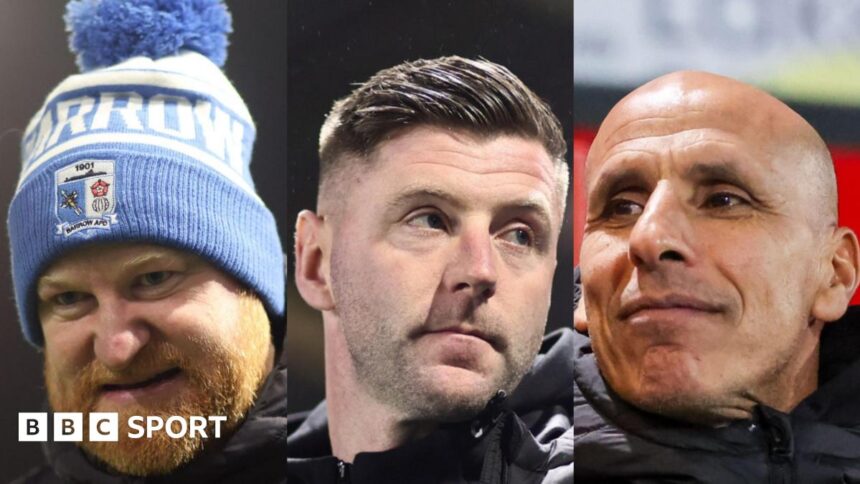
- Act I: The Whing Experiment. The season began with Andy Whing, a young coach with a burgeoning reputation from his time at Brackley Town. The appointment signaled a modern, project-based approach. It lasted just 12 league games. A rocky start saw the club hovering nervously above the League Two drop zone, and the board decided the project needed a premature conclusion.
- Act II: The Gallagher Gambit. In strode Paul Gallagher, the former Preston North End coach known for his developmental acumen. A shift in style, a new voice. Yet, results remained stubbornly inconsistent. The specter of relegation grew larger, and patience, in the hyper-competitive world of the EFL, is a rare commodity. Gallagher’s reign was over by February.
- Act III: Maamria’s Mission. Enter the firefighter: Dino Maamria. The seasoned, charismatic Tunisian, a man with a history of steering ships away from rocky shores. His task: simple survival. His methods: passionate, direct, and utterly different from his predecessors. In the space of one season, Barrow players have been asked to adapt to three distinct footballing ideologies.
This isn’t just a club searching for the right fit; this is a club trying on entire identities for size, discarding them at the first sign of a wrinkle. While Forest’s four bosses or Spurs’ three make for shocking statistics, Barrow’s chaos is more concentrated, more profound. It represents the razor-thin margins and existential fear that defines life in the lower leagues, where one wrong turn can have catastrophic consequences.
Contextual Chaos: Why Barrow’s Bedlam Beats the Big Boys
To understand why Barrow’s turmoil trumps all, you must look beyond the raw numbers. Yes, Celtic performing the “hokey-cokey” with a 74-year-old Martin O’Neill is surreal. Yes, Rangers breaking a historic streak of mid-season stability is significant. And yes, Watford being on their third boss is, well, Watford.
But the scale of the operation matters. At a mega-club, a managerial change is seismic, but the infrastructure—the sporting directors, the elite training grounds, the squads packed with internationals—provides a cushion. The chaos is often at the top, filtered down. At Barrow, the chaos is total and all-consuming.
Every new boss at Holker Street isn’t just changing tactics; he’s likely overhauling a minuscule backroom staff, reassessing a squad built by someone else with limited resources, and trying to implant a new culture in a matter of days, not months. The ripple effect touches every single employee and player. When Tottenham moved from one elite coach to another, they remained a global superpower. When Barrow moved from Whing to Gallagher to Maamria, they swung between a long-term vision, a coaching-centric approach, and a pure survival scrap. The club’s very soul was being rewritten every few weeks.
Furthermore, the spotlight on Barrow is different. Forest’s drama plays out on Sky Sports News; Barrow’s unfolds in passionate, worried discussions in local pubs and on fan forums. The stakes, relative to the club’s existence, are arguably higher. Relegation from the Football League for Barrow would be a far greater catastrophe than Tottenham’s unthinkable drop from the Premier League. The pressure, therefore, breeds a unique, desperate kind of chaos.
The Anatomy of a Crisis: What Drives the Carousel?
Barrow’s season is a perfect case study in the modern football disease: short-termism amplified by digital-age panic. The factors are clear:
- The Relegation Ghost: The fear of dropping out of the EFL is a powerful motivator for boardroom impulsivity. A few bad results trigger an existential crisis.
- The “Available Saviour” Myth: The quick-fix appointment of a known firefighter like Maamria is a classic lower-league trope, often at odds with a previous appointment of a “project” manager.
- Resource Scarcity: With budgets stretched, squads are less adaptable. A manager’s “system” is harder to implement when you can’t buy the specific players for it, leading to faster breakdowns.
- The Social Media Echo Chamber: While not exclusive to Barrow, the intensity of feeling in a one-club town can accelerate boardroom decisions, creating a feedback loop of urgency.
In this environment, a long-term plan is the first casualty. Barrow’s journey from Whing to Maamria is the physical manifestation of a plan being ripped up, not once, but twice. It’s chaos by committee, a desperate series of reactions rather than a proactive strategy.
Final Whistle and Future Forecast
As the season reaches its climax, Dino Maamria is battling to secure Barrow’s League Two status. Should he succeed, he will be hailed a hero. But what then? Does the club stick with the firefighter, or does it, once again, gaze longingly at a new project manager, hoping for a steadier future? The great irony is that the quest for stability creates the most instability.
Prediction for Barrow: Survival, but at a cost. The summer of 2026 will see another significant squad overhaul, the third in a year, as Maamria (or yet another new manager) seeks to imprint their style. The “Kings of Chaos” crown will be hard to relinquish; such intense turbulence leaves a club directionless, requiring years, not months, of calm to recover.
Prediction for the Trend: The Barrow blueprint—extreme volatility in the face of relegation fear—will continue to be replicated across the EFL. However, their 2025-26 campaign should stand as a stark warning. While Forest, Spurs, Celtic, and Rangers have dabbled in disorder, their resources offer redemption. For clubs like Barrow, this level of chaos is a high-wire act over an abyss. They have become the ultimate symbol of a season where no one seemed to have a steering wheel, proving that in the beautiful game’s theatre of the absurd, the most compelling drama isn’t always on the biggest stage. Sometimes, it’s roaring in the wind on the coast of Cumbria.
Source: Based on news from BBC Sport.