Turning Football Into Rubble: The VAR Ruling That Sparked Continental Fury
The beautiful game is built on moments of unadulterated joy and heartbreak, emotions that flow from the spontaneous, irrevocable decisions made in real-time. But what happens when that spontaneity is not just reviewed, but retroactively rewritten minutes after the fact? The result was a scene of pure chaos in the Asian Champions League semi-finals, a night where a controversial VAR decision didn’t just decide a match—it threatened the very fabric of competitive spirit, ending with police escorts and a referee’s safety in jeopardy.
A Dream Equalizer, A Nightmare Review
The stage was set for a classic continental drama. Japan’s Machida Zelvia, leading 1-0 deep into stoppage time against Dubai’s Shabab Al-Ahli, were seconds from a historic victory. In a final, desperate surge, Shabab Al-Ahli’s Brazilian forward, Guilherme Bala, embarked on a superb solo effort, weaving through defenders before slotting the ball home. The eruption from the team and their supporters was primal, a belief they had snatched a lifeline from the jaws of defeat.
On the pitch, the referee initially allowed the goal to stand. The celebration was in full flow. Yet, an ominous silence fell as the official pressed his finger to his earpiece. VAR was checking. Minutes ticked by in a state of suspended agony. The eventual verdict was not about offside, not about a foul in the buildup, but about a procedural technicality almost unheard of at this level: it was deemed that Shabab Al-Ahli had taken the throw-in restart while Machida Zelvia were still in the process of making a substitution.
The goal was chalked off. The final whistle blew immediately. In an instant, elation turned to utter fury.
From Pitch to Pandemonium: The Aftermath of Chaos
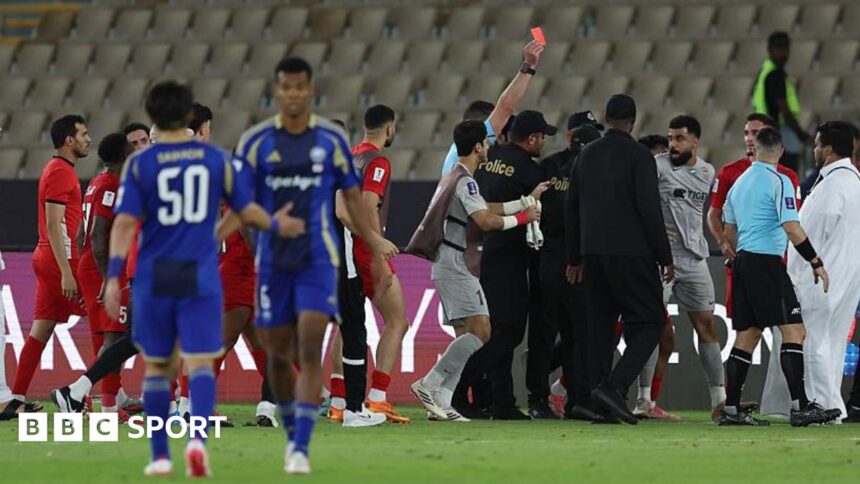
The fallout was immediate and volatile. The Shabab Al-Ahli players surrounding the referee was a predictable, if regrettable, scene. But the disorder escalated rapidly.
- Manager Paulo Sousa, in a act of sheer protest, stormed down the tunnel before the match had officially concluded, a powerful visual indictment of the process.
- After the whistle, goalkeeper Hamad Al-Meqbaali was sent off for his continued protests, adding insult to injury.
- Most alarmingly, the situation grew so hostile that police had to escort the referee and his officiating team off the pitch for their own safety.
This final image—law enforcement shielding officials from the players of a top-tier professional club—is the damning snapshot of this affair. It transcends debate over a single call and exposes a raw nerve about authority, respect, and the soul of the sport.
Expert Analysis: Lawful, But Is It Right?
By the strictest, most pedantic letter of the law, the decision might be defensible. Law 3 of the game states a substitution is completed when the player leaves the field, and the replacement enters. If the throw was taken before this process was finalized, the restart was illegal. VAR, permitted to check “game-changing situations,” intervened.
However, football is not played in a laboratory. The critical questions here are about consistency, expectation, and the spirit of the game.
Where was the referee’s game management? The on-field official is the conductor. It is his duty to manage the substitution process, to signal when play may resume. If the throw was taken illegally, why wasn’t it stopped in real-time? The use of VAR to police administrative timing, rather than clear and obvious errors in game-changing moments, represents a dangerous overreach. It turns the technology into a hyper-vigilant timekeeper, searching for infractions that had zero impact on the glorious, athletic moment that followed.
This incident highlights a growing chasm between protocol and passion. The rule, while it exists, is rarely enforced with such catastrophic consequences. The “offense” did not create an unfair advantage for the scoring team; Bala’s goal came from individual brilliance after a sustained passage of play. By punishing it retroactively, VAR didn’t correct an injustice—it created one.
Predictions: The Reckoning and the Road Ahead
The reverberations from this night will be felt far beyond this semi-final tie. This is a watershed moment for VAR implementation globally, particularly in high-stakes knockout football.
First, expect a fierce internal review by the AFC (Asian Football Confederation). The focus will be less on the technical accuracy and more on the catastrophic failure of match control and the dangerous precedent set. Refereeing guidelines may be clarified to limit VAR’s scope to “active footballing offenses,” not procedural timing checks.
Second, this fuels the global debate about VAR’s mission creep. The technology was sold as a tool to eliminate “clear and obvious” howlers. It is increasingly being used to forensic, joy-killing standards. This incident may empower critics and push governing bodies to tighten its operational framework.
Finally, for Shabab Al-Ahli and their passionate supporters, this will forever be the “stolen dream.” The psychological blow could affect their domestic campaign, while Machida Zelvia’s historic achievement is now shadowed by an asterisk of controversy. The trust between teams, officials, and the sport’s governing structures has suffered significant damage.
Conclusion: More Than a Game Lost
The fury in Dubai was not just about a disallowed goal. It was about the theft of a narrative. Football’s greatest currency is its moments of pure, uncontestable drama. Guilherme Bala created one, only to have it annulled by a bureaucratic footnote discovered minutes later.
When the final memory of a continental semi-final is not a stunning goal, but police escorting the referee off the pitch, the sport has lost its way. VAR, intended to remove controversy, has instead birthed a new, more toxic breed of it. It has moved from judging actions to policing technicalities, turning moments of footballing brilliance into administrative rubble. The beautiful game must find a balance before this erosion of trust becomes irreversible. The alternative is a future where the final whistle brings not relief or celebration, but the fear of what the replay booth might yet undo.
Source: Based on news from BBC Sport.