IPL 2026: Why concussion sub for a shoulder injury? Mahela Jayawardene explains
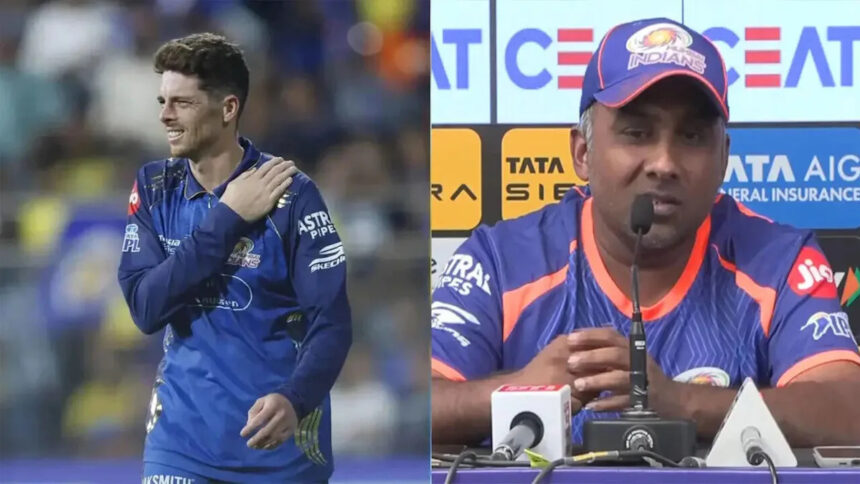
Mumbai Indians’ head coach Mahela Jayawardene has offered a detailed explanation behind the controversial concussion substitute decision that overshadowed a one-sided clash at the Wankhede Stadium. During their 103-run defeat to Chennai Super Kings in IPL 2026, MI introduced Shardul Thakur as a concussion replacement for Mitchell Santner—a move that sparked heated debate across the cricketing world.
While Sanju Samson’s unbeaten century and Akeal Hosein’s four-wicket haul powered CSK to a commanding win, the spotlight shifted to the unusual substitution. Santner suffered an injury in the 17th over while completing a low catch, appearing to hurt his shoulder. However, replays later suggested his head also made contact with the ground. He was subsequently taken for scans and did not return to the field.
The Incident: What happened on the field?
With Chennai Super Kings cruising at 189 for 4 in the 17th over, Mitchell Santner sprinted in from deep midwicket to attempt a sharp catch off Tilak Varma’s bowling. He completed the catch successfully, dismissing Shivam Dube, but immediately fell awkwardly. The New Zealander clutched his right shoulder and was attended to by the MI medical team. After a brief delay, he walked off the field, his arm hanging limply.
Replays from multiple angles showed Santner’s head striking the turf as he rolled over after the catch. Though the primary visible injury was to his shoulder, the impact to his head was undeniable. Santner was taken for a precautionary scan and did not return. Shortly after, the Mumbai Indians dugout requested a concussion substitute, and the match referee approved the replacement of Santner with Shardul Thakur.
This decision raised immediate eyebrows. Shardul Thakur, a pace-bowling all-rounder, is not a like-for-like replacement for Santner, a left-arm spinner. The optics of the situation—especially with Santner later seen wearing a shoulder sling—fueled widespread discussion on social media and among cricket pundits.
Mahela Jayawardene’s explanation: “He felt unstable”
Addressing the controversy, MI head coach Mahela Jayawardene defended the decision during the post-match press conference. He provided a step-by-step account of what transpired in the dressing room.
“Santner hit his head first, the neck and obviously, the shoulder as well. He then went for a scan. Once he got back, he was lying down. Yes, the ice was there for the shoulder, but he felt that he wasn’t stable, so we took him for a scan in that situation,” Jayawardene said.
“We requested a concussion sub. It’s at the match referee and the umpires’ discretion. They allowed Shardul Thakur. It is what it is. But hopefully, Santner’s injury isn’t too bad. Once he’s back, we’ll have a look at it,” he added.
The explanation, however, did little to silence debate. Many questioned whether a visible shoulder injury justified a concussion replacement, especially when the substitute was a bowler of a completely different skill set.
Key points from Jayawardene’s statement:
- Santner’s head made contact with the ground first, followed by the neck and shoulder.
- The player reported feeling “unstable” after returning from the scan.
- The match referee and umpires approved the concussion substitution after reviewing medical reports.
- Shardul Thakur was the nominated concussion substitute because he was listed as an all-rounder in the pre-match squad.
IPL 2026 Rules vs reality: Why the decision raises eyebrows
As per IPL rules, teams must nominate potential concussion substitutes before the match, covering roles such as batter, bowler and all-rounder. The final call rests with the match referee, who ensures a like-for-like replacement. In this case, Mumbai Indians had listed Shardul Thakur as a like-for-like option for Santner under the “all-rounder” category.
But the reality on the ground was starkly different. Santner bowls left-arm orthodox spin and bats in the lower middle order. Shardul Thakur bowls right-arm medium pace and is a batting all-rounder who often bats higher up. The mismatch in bowling styles and roles made the substitution appear opportunistic, especially given the match context—MI were already 103 runs behind and needed a miracle to win.
Why this matters:
- Concussion substitutes are meant to protect player safety, not to gain tactical advantage.
- The rule requires a “like-for-like” replacement, but interpretation varies widely.
- Previous IPL instances, such as the 2020 final where Shardul Thakur replaced Ravindra Jadeja, have set controversial precedents.
- The match referee’s discretion is final, but it often lacks transparency.
Critics argue that the system is being exploited. “If a player has a shoulder injury, you can’t just call it a concussion to bring in a different type of bowler,” former India opener Aakash Chopra tweeted. Others pointed out that Santner’s shoulder sling contradicted the concussion claim, though medical experts note that head impacts can cause delayed symptoms and secondary injuries.
Expert analysis: Was the sub justified?
From a medical perspective, the decision may be defensible. Dr. Rohan Kapoor, a sports physician consulted by multiple IPL teams, explained that head impacts can cause delayed concussion symptoms. “A player might feel fine initially but later experience dizziness, nausea, or instability. The fact that Santner reported feeling unstable after the scan is a red flag. In such cases, removing the player is the right call,” he said.
However, the tactical timing of the substitution cannot be ignored. MI were already in a losing position, and bringing in a pace-bowling all-rounder like Thakur could have been seen as a desperate move to salvage something. Thakur ended up bowling just one over, conceding 14 runs, and scored 12 off 8 balls with the bat—hardly a game-changing impact.
What the numbers say:
- Santner had bowled 3 overs for 24 runs and taken 1 wicket before his injury.
- Thakur’s introduction did not alter the course of the match; CSK won by 103 runs.
- The substitution was approved in the 18th over, with MI needing an impossible 104 runs off 12 balls.
“It’s a gray area,” said former England captain Nasser Hussain in a column. “The rule is there for player safety, but when the substitute is so different in style, it invites scrutiny. The match referee needs to be more stringent in ensuring a true like-for-like replacement.”
Predictions: What this means for IPL 2026 and beyond
This controversy is likely to trigger a review of concussion substitute protocols in the IPL. The governing council may tighten the definition of “like-for-like” to prevent future exploitation. Possible changes include requiring the substitute to have a similar bowling style or batting position, or mandating an independent medical assessment before approval.
For Mumbai Indians, the fallout could be significant. If Santner’s injury proves serious, they will miss a key spinner in upcoming matches. But the reputational damage may be worse. The franchise has been accused of bending rules in the past, and this incident adds fuel to that narrative.
What to watch for:
- IPL governing council’s official statement on the incident.
- Potential rule amendments before the next season.
- Santner’s recovery timeline and whether he plays again in IPL 2026.
- How other teams approach concussion substitution requests going forward.
The incident also highlights the growing tension between player safety and competitive advantage. While no team would risk a player’s long-term health for a short-term gain, the perception of gamesmanship can damage the league’s credibility.
Conclusion: A win for CSK, a debate for the ages
Chennai Super Kings’ 103-run victory was comprehensive, powered by Sanju Samson’s brilliant century and Akeal Hosein’s four-wicket haul. But the post-match narrative was dominated by the concussion substitute controversy. Mahela Jayawardene’s explanation—that Santner hit his head first and felt unstable—provides medical justification, but it does not erase the awkward optics of replacing a spinner with a pace-bowling all-rounder.
In the end, the decision was legal, approved by the match referee, and based on player welfare. Yet, in a sport where margins are thin and perceptions matter, the IPL must ensure that its concussion substitute rule is applied with absolute clarity. Otherwise, every future substitution will be met with suspicion, undermining the very purpose of the rule—to protect players, not to win matches.
For now, the Wankhede crowd witnessed a CSK masterclass and a rulebook debate that will echo through the remainder of IPL 2026. Whether the league learns from this or repeats the same mistakes remains to be seen.
Source: Based on news from Yahoo Sports.