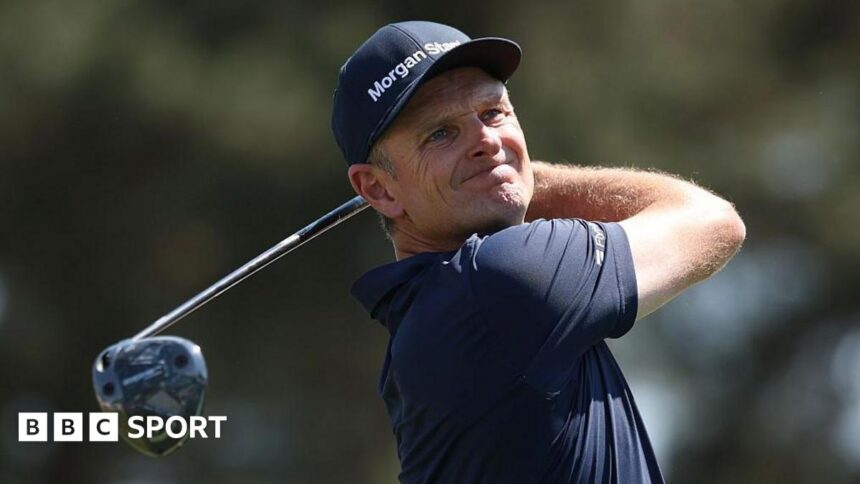
Will Rose’s McLaren Club Gamble Pay Off? The High-Stakes Experiment at Doral
MIAMI — The sun was already baking the tarmac at Doral’s Blue Monster Course, but the real heat was reserved for Justin Rose. The 45-year-old Englishman is no stranger to pressure. He has a US Open title, an Olympic gold medal, and a Ryder Cup legacy to his name. Yet as he steps onto the first tee for the Cadillac Championship this week, he carries a weight that has nothing to do with his luggage. It is the weight of expectation—and a brand-new set of McLaren Golf clubs.
Rose, currently ranked fifth in the PGA Tour rankings, has become the first professional golfer to represent the legendary Formula 1 team as they pivot into the golf equipment market. It is a move that has sent shockwaves through the sport. But here is the rub: Rose was already playing some of the best golf of his career with his old sticks. He won at Torrey Pines in February. He has been preparing assiduously for the Masters in an attempt to go one better than his heartbreaking 2025 play-off defeat to Rory McIlroy. So why, on the eve of a signature event, would he risk it all for a set of clubs that have never been tested in PGA Tour combat?
Welcome to the most intriguing subplot of the 2026 season. This is not just a sponsorship deal. This is a gamble. And the payoff—or the failure—could define the rest of Rose’s career.
The McLaren Gamble: Why Now?
Let us start with the obvious question: Why would a player of Justin Rose’s caliber, at the peak of his form, change equipment just weeks before the Masters? The answer lies in the intersection of technology, timing, and a very large checkbook. McLaren is not just dipping a toe into golf; they are diving headfirst. Known for their engineering prowess in Formula 1, the team has spent years developing a golf club that promises to marry aerodynamics with precision. The result is a set of irons and woods that, according to early leaks, feature a revolutionary face technology designed to increase ball speed while maintaining control.
But here is the reality: Tour players are creatures of habit. They are superstitious. They trust the feel of a 5-iron the way a surgeon trusts a scalpel. Rose, however, has always been a student of the game. He is known for his meticulous preparation and his willingness to embrace innovation. In a press conference earlier this week, he explained the switch with characteristic calm: “I felt that the performance data was undeniable. The consistency of the spin rates, the launch angles—it was better than what I was playing. When you have a chance to partner with a brand like McLaren, you take it. But I also know that data doesn’t win tournaments. Execution does.”
The risk is real. Rose has been playing well this year—winning at Torrey Pines in February and consistently finishing inside the top ten. His game is built on a foundation of trust. He knows exactly how his old driver will react when he steps on the gas. With the McLaren clubs, there is an element of the unknown. Will the new irons hold up under the pressure of a Sunday back nine? Will the driver produce the same penetrating ball flight that has made him one of the most accurate players on tour? These are questions that cannot be answered in a simulator. They must be answered on the Blue Monster, a course that punishes indecision with water hazards and winds that can turn a 5-iron into a lottery ticket.
Expert Analysis: The Technical and Psychological Hurdles
To understand the magnitude of this gamble, we spoke with a veteran equipment analyst who has worked with multiple major champions. He asked to remain anonymous due to ongoing contractual relationships, but his insights were sharp. “Changing clubs at this stage is like a Formula 1 driver asking for a new engine in the middle of a race. Yes, the new engine might be faster. But if the driver doesn’t trust the braking points or the throttle response, they will crash. Rose is essentially learning a new language while standing on the tee box.”
The technical challenges are immense. Rose’s swing is a masterpiece of timing. He generates power from his lower body and releases the club with a precision that has allowed him to compete with players a decade younger. The new McLaren clubs feature a different center of gravity and a slightly stiffer shaft profile. This means that the ball flight will be different. The spin rates will be different. Even the sound of impact will be different—and for a player like Rose, sound is data. A click that is too loud can signal a loss of feel. A thud that is too soft can indicate a mishit.
Let us break down the specific areas of concern:
- Driver Consistency: Rose’s driving accuracy has been a cornerstone of his success. The McLaren driver is designed to be more forgiving on off-center hits, but the question is whether it will produce the same predictable fade that Rose relies on to attack pins. If the new driver introduces a draw bias, he could find himself in the rough more often than he would like.
- Iron Distance Control: This is the biggest worry. Rose is famous for his ability to hit a 7-iron exactly 175 yards, regardless of conditions. The new irons have a different loft and a hotter face. He may gain 5 yards of distance, but if he loses the ability to dial in his yardages, the consequences on a course like Doral could be catastrophic. Water is everywhere. A 5-yard misjudgment can turn a birdie opportunity into a double bogey.
- Short Game Feel: The wedges are the most sensitive clubs in the bag. Rose’s short game is not flashy, but it is brutally effective. He relies on a soft, repeatable feel around the greens. If the new wedges have a different bounce or grind, he may struggle to execute the delicate pitch shots that save par.
Psychologically, the pressure is even greater. Every time Rose hits a bad shot this week, the narrative will be: “It’s the clubs.” That is a heavy burden to carry. He will have to block out the noise and trust the process. But as any sports psychologist will tell you, confidence is fragile. If he starts spraying shots early, the doubt can spiral. On the flip side, if he hits a few pure shots, the confidence will skyrocket. The mental game is a pendulum, and Rose is swinging it himself.
Predictions: What to Expect at Doral
So, what will happen when Rose tees it up on the Blue Monster? Let us look at the variables. The Cadillac Championship is a stacked field. Players like Scottie Scheffler, Jon Rahm, and Rory McIlroy are all in attendance. The course is playing firm and fast, with the Florida wind expected to gust up to 20 miles per hour on the weekend. These are not ideal conditions for testing new equipment. In fact, they are the worst possible conditions. Wind amplifies every mistake. A club that feels great in a calm practice round can feel like a foreign object when the wind is howling and the pressure is on.
My prediction is cautious but optimistic. I believe Rose will make the cut comfortably. He is too good a player to let a club change completely derail his week. However, I do not expect him to contend for the title. The learning curve is simply too steep. He will likely have a solid Thursday round, a shaky Friday, and then settle into a middle-of-the-pack finish. The real test will come in the weeks that follow. If he can use Doral as a learning experience and refine his setup, he could be dangerous at the Masters. But if the struggles persist, the gamble will look like a costly mistake.
Let us look at the potential outcomes:
- Best Case: Rose finishes inside the top 10, proving that the clubs are Tour-ready. He gains confidence and becomes a legitimate Masters favorite. McLaren’s stock skyrockets, and other pros line up to test the equipment.
- Worst Case: Rose misses the cut or finishes near the bottom of the leaderboard. The narrative turns toxic. Questions arise about his judgment. He spends the next month in damage control, trying to rebuild his swing around the new clubs.
- Most Likely: Rose finishes around 20th to 30th place. He shows flashes of brilliance but also has a few costly errors. He takes the positive data and works with his team to make adjustments. The gamble is not a failure, but it is not an immediate success either.
Conclusion: A Calculated Risk with Historic Implications
Justin Rose is not a gambler by nature. He is a planner. He is the kind of player who maps out his entire season in December, right down to the practice rounds. That is why this move is so fascinating. It suggests that he sees something in the McLaren clubs that the rest of us cannot see. It suggests that he is willing to sacrifice short-term comfort for long-term gain. And let us be honest: at 45 years old, the long-term is not what it used to be. He is running out of time to add a second major championship to his resume. The play-off loss to McIlroy in 2025 still stings. He knows that he needs an edge.
Whether the McLaren clubs provide that edge remains to be seen. But one thing is certain: this week at Doral will be a spectacle. Every shot will be analyzed. Every swing will be dissected. And if Rose walks off the 18th green on Sunday with a smile on his face, the entire golf world will take notice. McLaren will have pulled off the greatest marketing coup in recent golf history. If he walks off with a grimace, the question will linger: Was it worth it?
For now, the answer is blowing in the Miami wind. Justin Rose has rolled the dice. The Blue Monster is waiting. And we, the audience, are holding our breath.
Source: Based on news from BBC Sport.