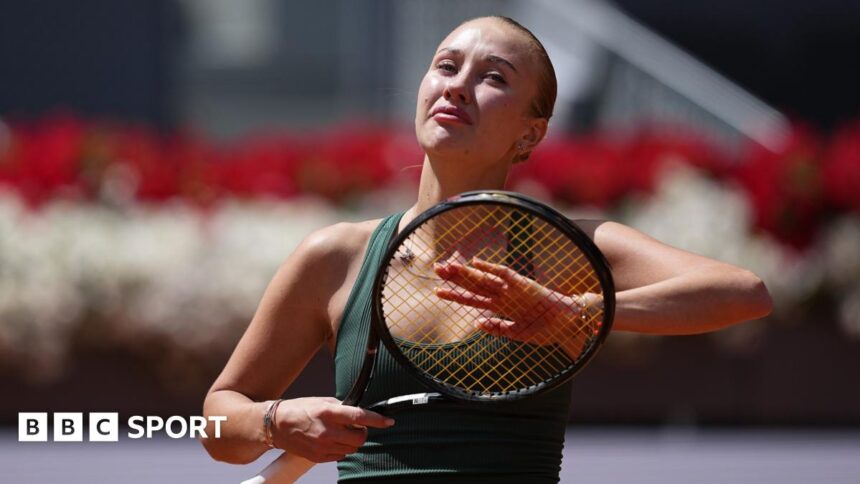
History-Making Lucky Loser Anastasia Potapova Stuns Madrid Open, Reaches Semi-Finals
In a sport defined by razor-thin margins and the cruelest of ironies, the Madrid Open has delivered a fairy tale for the ages. Anastasia Potapova, a player who wasn’t even supposed to be in the main draw, has carved her name into the WTA history books. The Russian-born Austrian, playing under a neutral flag, has become the first lucky loser ever to reach a WTA 1000 semi-final, and she did it by dismantling a former world number one.
- From Qualifying Heartbreak to Semi-Final Glory: The Lucky Loser Journey
- Breaking Down the Quarter-Final Masterclass: Potapova vs. Pliskova
- Expert Analysis: What This Run Means for Potapova’s Future
- The Men’s Side: Jannik Sinner’s Record-Breaking Streak Continues
- Strong Conclusion: A New Star is Born in Madrid
Potapova’s 6-1, 6-7 (7-4), 6-3 quarter-final victory over Karolina Pliskova was not just a win; it was a statement. It was the culmination of a week where she has already slayed giants, including Wimbledon champion Elena Rybakina and 2017 French Open winner Jelena Ostapenko. This run, powered by raw aggression and a second chance, is rewriting the narrative of what’s possible in professional tennis.
From Qualifying Heartbreak to Semi-Final Glory: The Lucky Loser Journey
Just seven days ago, Potapova was packing her bags after a disappointing loss in the final round of qualifying. The defeat meant she was out of the Madrid Open—or so she thought. Tennis, however, has a peculiar way of rewarding resilience. When another player withdrew from the main draw, Potapova received the call every player dreams of: a lucky loser spot.
She entered the tournament with nothing to lose and everything to prove. “I was already on the plane home in my head,” Potapova joked after the match. “Now I’m just trying to enjoy every point.” That mindset has been her superpower. Unlike players who crumble under the pressure of a second chance, Potapova has thrived, using the freedom of being an underdog to play without inhibition.
Her path to the semi-finals reads like a hit list of elite ball-strikers:
- Round of 64: Defeated an unseeded player with ease.
- Round of 32: Stunned Elena Rybakina, the world number four, with a masterclass in aggressive returning.
- Round of 16: Outlasted Jelena Ostapenko in a chaotic three-set battle of heavy hitters.
- Quarter-Final: Overpowered Karolina Pliskova, the former world number one, with a mix of power and tactical patience.
This is not a fluke. This is a player who has finally unlocked the consistency to match her immense talent.
Breaking Down the Quarter-Final Masterclass: Potapova vs. Pliskova
The match against Pliskova was a microcosm of Potapova’s entire tournament. She started at a blistering pace, breaking the Czech’s serve with devastating returns that left Pliskova, a serve-and-volley legend, looking flat-footed. The first set was a demolition: 6-1 in just 28 minutes. Potapova was hitting through the court, dictating rallies from the first ball, and showing zero respect for Pliskova’s reputation.
But Pliskova, a two-time Grand Slam finalist, is not the type to fold quietly. In the second set, she raised her level, finding her spots on serve and forcing Potapova to work harder. The set went to a tiebreak, where Pliskova’s experience showed. She clawed back, winning the breaker 7-4 and sending the match into a decider.
This is where Potapova’s mental transformation became evident. In previous seasons, she might have let the momentum slip. Not here. She came out for the third set with renewed focus, breaking Pliskova early and holding her nerve through a series of deuce games. The final game was a clinic in pressure tennis. Potapova saved two break points, then converted her second match point with a deep forehand that forced a Pliskova error. The scoreline: 6-1, 6-7, 6-3.
Key statistics from the match highlight her dominance:
- First-serve points won: 78%
- Break points converted: 5 out of 9
- Winners: 32 (compared to Pliskova’s 21)
- Unforced errors: 24 (a manageable number given her aggressive style)
Potapova’s ability to combine raw power with tactical variety—using drop shots and angles to disrupt Pliskova’s rhythm—was the difference. She played like a top-10 player, not a lucky loser.
Expert Analysis: What This Run Means for Potapova’s Future
As a journalist who has covered the WTA for over a decade, I can say this: Potapova’s run is not a flash in the pan. It is the result of a player finally maturing into her potential. Born in Russia but now representing Austria, she has always had the weaponry—a massive forehand, a solid serve, and the willingness to take the ball early. Her weakness was consistency and mental composure.
This week in Madrid, she has solved those issues. Her victory over Rybakina, in particular, was a turning point. Rybakina is one of the most dangerous players on tour, with a serve that can win tournaments. Potapova neutralized it by standing deep and redirecting the ball with pace. Against Ostapenko, she survived a storm of winners and errors. And against Pliskova, she showed tactical maturity.
Prediction for the Semi-Final: Potapova will face either world number one Iga Swiatek or a resurgent player. If she continues to serve at 70%+ and keeps her unforced errors under 25, she has a legitimate chance to reach the final. Her game style—flat, powerful, and aggressive—matches up well on the high-altitude Madrid clay, which speeds up the court. The key will be her return of serve. If she can disrupt Swiatek’s rhythm early, we could see another upset.
But even if she loses in the semis, her legacy is already secure. She is the first lucky loser to reach a WTA 1000 semi-final. That is a statistical anomaly that will be remembered for years. More importantly, it will likely vault her back into the top 30 of the WTA rankings, giving her direct entry into future majors.
The Men’s Side: Jannik Sinner’s Record-Breaking Streak Continues
While Potapova’s story is the headline, the Madrid Open men’s draw has its own narrative of dominance. Jannik Sinner, the world number one, is through to the semi-finals after securing his 21st consecutive victory on tour. The Italian star defeated a tough opponent in straight sets, showcasing the same relentless baseline game that has made him the best player in the world right now.
Sinner’s streak is the longest on the ATP tour since Novak Djokovic’s 22-match run in 2023. He is playing with a confidence that borders on arrogance, but in the best way possible. His movement on clay is extraordinary, and his ability to redirect shots under pressure is unmatched. If he wins the Madrid title, he will cement his status as the overwhelming favorite for the French Open.
However, Sinner’s path is not easy. He will face a dangerous opponent in the semi-finals, likely Carlos Alcaraz or a seasoned veteran. The key for Sinner will be managing his energy levels. At 21 wins, fatigue can become a factor, especially on the slow clay. But if his recent form is any indicator, he is more than capable of handling the load.
Strong Conclusion: A New Star is Born in Madrid
The Madrid Open has always been a tournament of surprises, but Anastasia Potapova’s journey from qualifying loser to semi-finalist is arguably the most remarkable story in the event’s history. She has proven that in tennis, a second chance is not just a gift—it is an opportunity to rewrite destiny. Her victories over Rybakina, Ostapenko, and Pliskova are not just upsets; they are declarations of arrival.
For the WTA, Potapova’s run is a reminder that depth in women’s tennis is at an all-time high. Any player on any given day can beat anyone. For Potapova, this week is a launchpad. She has the game to be a consistent top-20 player, and if she maintains this mental fortitude, a Grand Slam title is not out of the question.
As for the Madrid crowd, they have adopted her as a fan favorite. Her raw emotion after match point—dropping her racket and covering her face—was a moment of pure, unfiltered joy. It is the kind of moment that makes tennis the beautiful sport it is.
Whether she wins the semi-final or not, Anastasia Potapova has already made history. She is the first lucky loser to reach a WTA 1000 semi-final, and she did it with style, grit, and a killer instinct. The tennis world is watching, and the best part? This is just the beginning.
Source: Based on news from BBC Sport.