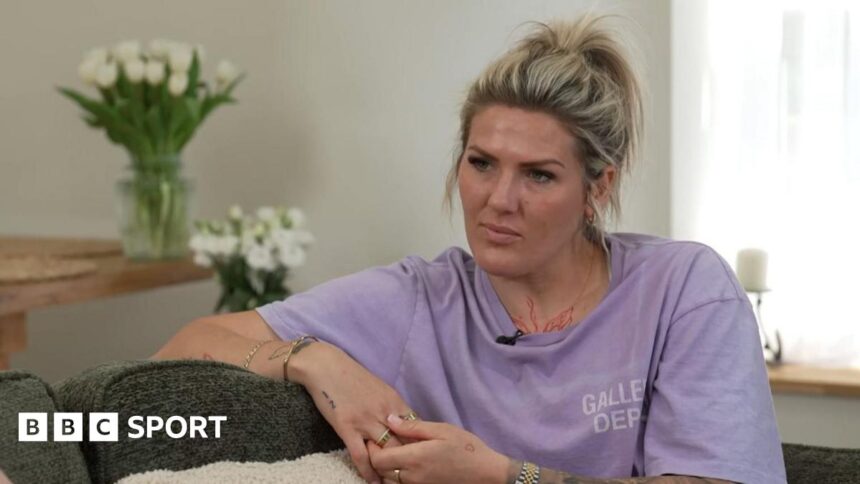
‘I lost myself’ – Millie Bright on retirement, abuse, and the future she never thought she’d have
There is a letter sitting on Millie Bright’s kitchen table in Sheffield. It is handwritten, from her mother, and it was handed to the former Chelsea captain on the very day she announced her retirement from professional football. But nearly a week later, Bright still hasn’t read it all the way through. “I can’t get past the first few lines without breaking down,” she admits, her voice thick with emotion. “It’s not that I don’t want to read it. It’s that I’m not ready for what comes next.”
This is the paradox of Millie Bright in 2025. A warrior on the pitch, a leader of a dynasty, and a woman who has now walked away from the game at just 32 years old. In an exclusive, deeply personal reflection, Bright opens up about the abuse she endured, the moment she “lost herself” in the pursuit of perfection, and the quiet, rural future she is finally allowing herself to imagine.
The weight of the armband: When leadership became a burden
When Bright was named Chelsea captain in 2023, succeeding the legendary Magdalena Eriksson, it was seen as a natural progression. She was the heart of the defence, a Euros winner in 2022, and a player whose intensity could lift an entire stadium. But behind the scenes, the captaincy was exacting a heavy toll. “I lost myself,” Bright says bluntly. “I was so focused on being the leader everyone needed, on carrying the team, on managing the dressing room, that I forgot to check in with Millie.”
The pressure was compounded by an unforgiving public spotlight. Bright reveals that online abuse became a constant, draining presence in her life. “People think because you wear a captain’s armband, you have a thick skin. But I was getting messages that targeted my family, my ability, my very worth as a person. It wasn’t just criticism; it was venom. There were nights I would sit in my car after training and just stare at the steering wheel, wondering why I was doing this to myself.”
The abuse, she explains, wasn’t limited to anonymous trolls. “You see it at games, too. The shouts from the stands. The ‘overrated’ chants. You tell yourself it’s part of the job, but it chips away at you. I wasn’t playing for joy anymore. I was playing to survive the next 90 minutes without making a mistake that would get me torn apart.”
294 appearances, 8 titles, and a farm in Sheffield
Statistically, Bright’s career is a monument. She leaves Chelsea after 294 appearances, eight Women’s Super League titles, six FA Cups, and four League Cups. She was the bedrock of a team that dominated English football for a decade. But numbers don’t tell the story of the sacrifice.
Bright retired from England duty last year, a decision she says was “the hardest but the clearest.” Now, her full retirement from club football has brought her back to her roots: the family farm in Sheffield. “I’m sitting here, in the kitchen, looking out at the fields. My dad’s 60th birthday is this weekend. In the past, I would have been at a training camp, or flying to a Champions League game, sending a text message apology. Now, I’m going to bake him a cake. I’m going to help with the sheep. That’s the future.”
She laughs—a genuine, unguarded laugh—when asked if she misses the roar of the Stamford Bridge crowd. “I miss the girls. I miss the bus banter. I don’t miss the anxiety. I don’t miss the feeling that your entire identity is tied to whether you win a game on a Tuesday night. Football is a beautiful game, but it’s also a beast. And I needed to get off the ride before it consumed me completely.”
Expert analysis: The changing landscape of player welfare
Bright’s candid confession about abuse and burnout is not an isolated incident. As the women’s game has professionalised at breakneck speed, the psychological demands on players have skyrocketed. The days of playing for “love of the game” in front of a few hundred fans are long gone. Today’s stars face the same level of scrutiny, media pressure, and online vitriol as their male counterparts—often without the same support infrastructure.
Key factors contributing to early retirement in women’s football:
- Accelerated professionalisation: Players are now full-time athletes with 24/7 media obligations, leaving little room for mental recovery.
- Lack of psychological safety nets: While clubs have improved, many players still report feeling isolated when dealing with abuse or performance anxiety.
- Physical toll vs. mental toll: Bright suffered multiple knee injuries, but she insists the mental injuries were harder to rehab.
- The ‘captain’s curse’: Leaders like Bright often absorb disproportionate emotional responsibility for the team, leading to faster burnout.
Bright’s decision to walk away at 32, while still at the top of her game, is a watershed moment. It signals a shift in priorities. “I want to be remembered as a winner,” she says. “But more than that, I want to be remembered as someone who was brave enough to say ‘enough’.”
Predictions: What comes next for Millie Bright and the Chelsea legacy
So what does the future hold for a player who has defined an era? Bright is characteristically pragmatic. “I’m not going to be a pundit who just shouts at a screen. I’m not going to be a coach who lives in a tracksuit. I want to work with people. I want to use my experience to help the next generation navigate the mental side of the game—the stuff nobody talks about.”
Expect Bright to move into player welfare and advocacy. She has already had informal conversations with the PFA and several WSL clubs about developing mental health mentorship programs. “If I can save one player from sitting in her car crying after training, then my retirement has meaning beyond the trophies.”
As for Chelsea, the club loses more than a captain. They lose a symbol of resilience. The Blues are currently in a transition phase, with a young, hungry squad. Bright’s absence will be felt most in the big moments—the Champions League knockout ties, the derby matches—where her leadership was worth an extra goal. “The next captain has to be someone who doesn’t just wear the armband, but breathes it,” Bright advises. “It’s a heavy burden. But it’s also the greatest honour.”
Strong conclusion: The letter, the farm, and the peace
Before we end the conversation, I ask Bright if she plans to finish reading her mother’s letter. She pauses. “I will. Maybe this weekend, after Dad’s party. When the house is quiet. When I’m not ‘Millie Bright, footballer’ anymore. When I’m just Millie.”
She looks out the window again. The Yorkshire sky is grey, but her face is calm. “I used to think retirement was an ending. But it’s not. It’s the first day of a life I never let myself have.”
Millie Bright leaves football with 294 appearances, 8 league titles, and a legacy of dominance. But more importantly, she leaves with something she almost lost entirely: herself. And that, perhaps, is the greatest victory of all.
Source: Based on news from BBC Sport.