Legacy Carried Forward: Duece Jones-Drew Commits to UCLA, Following in Father Maurice’s Footsteps
The name Jones-Drew is synonymous with UCLA football greatness. For a generation of Bruins fans, Maurice Jones-Drew—better known as “MJD”—was the heart and soul of the offense, a compact, explosive running back who ran with a ferocity that belied his 5-foot-7 frame. On Sunday, the next chapter of that legacy was officially written. Rising senior Duece Jones-Drew, the son of the UCLA legend, announced his commitment to the Bruins, choosing Westwood over a host of Pac-12 and Mountain West suitors.
The commitment is more than just a feel-good story. It’s a significant recruiting win for first-year head coach Bob Chesney and a signal that the Bruins’ program—despite a turbulent coaching transition—can still attract high-end talent from one of the most fertile high school football regions in the country. Duece Jones-Drew, a three-star running back out of De La Salle High School (Concord, Calif.), will join the 2027 recruiting class, bringing with him a blend of pedigree, power, and a chip on his shoulder that feels remarkably familiar.
The Recruiting Battle: Why UCLA Won the Day
For months, the recruitment of Duece Jones-Drew was a tightly contested affair. Programs like Arizona, Cal, SMU, and Utah all made strong pushes, each selling their own vision for the 5-foot-11, 205-pound back. But in the end, the pull of legacy—combined with a stable coaching relationship—proved decisive.
“UCLA felt like home,” Jones-Drew said in his commitment announcement. “Coach Chesney and Coach Steward made it clear that I’m not just ‘Maurice’s son.’ They see me as my own player, and they have a clear plan for how I fit.”
A key factor in the decision was the retention of running backs coach A.J. Steward. Steward, who had served in the same role under former head coach DeShaun Foster, was kept on by Chesney during the transition. This continuity was critical. Steward had already built a strong relationship with Jones-Drew, and his presence provided a layer of stability that many recruits crave during times of coaching upheaval.
- Key Suitors: Arizona, Cal, SMU, Utah
- Deciding Factor: Relationship with RB coach A.J. Steward and the legacy factor
- 247 Ranking: Composite three-star, one of the top running backs in California for the 2027 class
The fact that Chesney—who took James Madison to the College Football Playoff in 2025—was able to keep a recruit of this caliber in the fold speaks volumes. Many analysts expected the coaching change to create an opening for other programs, but the “Chesney Effect” appears to be real. His playoff pedigree and offensive creativity were major selling points.
Scouting Report: More Than Just a Name
Let’s be clear: Duece Jones-Drew is not just a legacy recruit. He is a legitimate Power Four talent who plays with a style that will immediately remind UCLA fans of his father—but with some modern twists.
At De La Salle, a program renowned for producing NFL talent (including his father), Jones-Drew has shown he can be a workhorse back. He runs with low pad level, exceptional balance, and a violent finish. He is not a dancer; he is a one-cut runner who gets north-south quickly. His vision between the tackles is advanced for a high school junior, and he has the contact balance to break arm tackles at the second level.
However, the younger Jones-Drew is also showing improved speed and receiving ability that his father didn’t fully display until later in his college career. Duece has been working on his route tree and has soft hands out of the backfield—a skill that will make him a three-down weapon in Chesney’s offense.
Strengths:
- Elite contact balance and pad level
- One-cut, downhill running style
- Proven production in a top-tier high school program
- High football IQ and work ethic (genetic advantage)
- Underrated receiving ability
Areas for Growth:
- Top-end long speed (needs to consistently run in the 4.5 range)
- Pass protection technique at the college level
- Consistency as a perimeter runner
“He’s a different back than his dad in some ways,” said one Pac-12 area scout who has evaluated Duece. “MJD was a bowling ball with jets. Duece is a bit taller, a bit more of a traditional build, but he has that same violent intent. He’s a tough, tough runner who will wear down a defense. He’s a steal as a three-star.”
What This Means for UCLA’s 2027 Class and Offensive Future
The commitment of Duece Jones-Drew is a foundational piece for the 2027 recruiting cycle. While the class is still in its early stages, landing a legacy player with his profile sends a message to other top California prospects: UCLA is still a destination for elite running backs.
Under Bob Chesney, the Bruins are expected to run a pro-style, run-heavy offense that features multiple tight ends and a physical offensive line. This scheme is tailor-made for a back like Jones-Drew. He will be asked to be the “hammer”—the guy who gets 20-plus carries a game and controls the clock. His style pairs perfectly with a potential change-of-pace back that UCLA will likely target later in the cycle.
Furthermore, Jones-Drew’s commitment helps stabilize a program that has seen significant roster turnover. The retention of A.J. Steward was vital, and now Chesney can point to this commitment as proof that his staff can recruit and develop talent. Expect Jones-Drew to be a vocal recruiter for the Bruins, using his name and connections to help lure other top prospects to Westwood.
Projected Impact Timeline:
- 2027 (Freshman): Likely redshirt or special teams role. Depth chart behind veteran backs.
- 2028 (Sophomore): Contention for RB2 role. Primary short-yardage and goal-line back.
- 2029 (Junior): Potential breakout year as lead back.
Expert Analysis: The Legacy of a Name
It’s impossible to discuss this commitment without addressing the elephant in the room: the shadow of Maurice Jones-Drew. No one understands that pressure better than Duece himself. But from everything I’ve gathered, he embraces it rather than shies away from it.
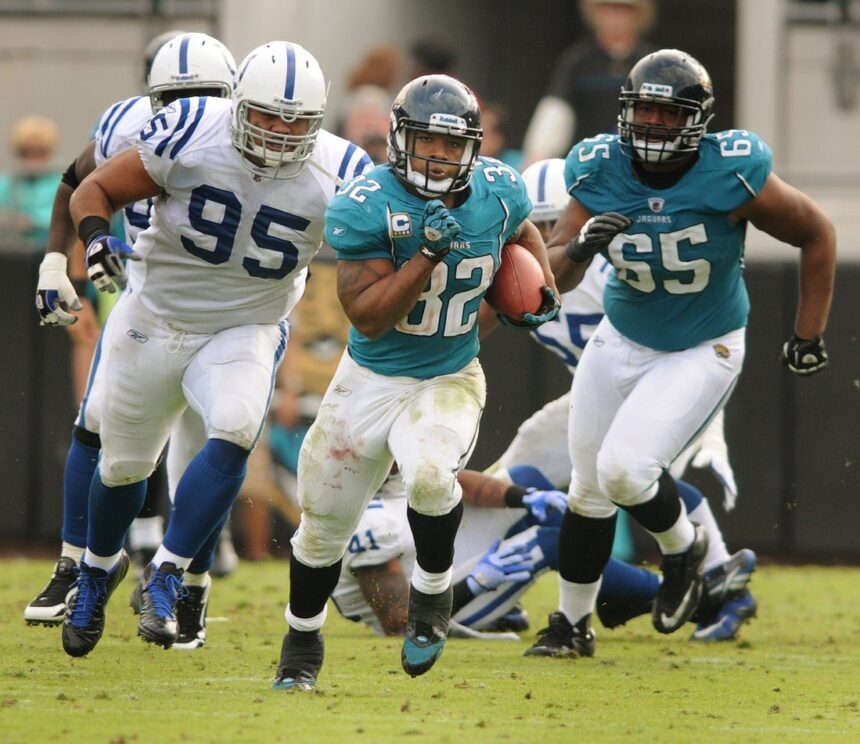
Maurice Jones-Drew’s UCLA career was legendary. He rushed for over 2,000 yards in two seasons, was a unanimous All-American, and left as one of the most decorated backs in school history. His NFL career with the Jacksonville Jaguars was equally dominant—three Pro Bowls, a rushing title, and a reputation as one of the toughest runners of his era.
Duece has grown up around that legacy. He has trained with his father, studied his film, and learned what it takes to succeed at the highest level. But he is also his own man. He wears a different number. He has a different running style. He is building his own story.
“My dad never pressured me to go to UCLA,” Duece said in a recent interview. “He wanted me to make my own decision. But when I visited, I just felt it. I saw the Rose Bowl, I saw the weight room, I saw the guys. I knew that’s where I wanted to be.”
The pressure will be real. Every carry will be compared. Every touchdown will be weighed against his father’s. But if his high school tape is any indication, Duece Jones-Drew has the tools—and the mental makeup—to carve out his own legacy.
Conclusion: A New Era Begins in Westwood
The commitment of Duece Jones-Drew is a perfect blend of emotion and strategy. For UCLA fans, it’s a chance to relive the glory days through the next generation. For Bob Chesney and his staff, it’s a tangible recruiting victory that proves the program is on the rise.
Don’t be surprised if Duece Jones-Drew becomes a fan favorite long before he takes a snap. His work ethic, his family name, and his punishing running style will endear him to a fanbase that loves hard-nosed football. And if he can develop into even a fraction of the player his father was, UCLA will have found a gem in the 2027 class.
The legacy is alive. The name is back. And Duece Jones-Drew is ready to write his own chapter in the storied history of UCLA football. The Bruins just got a whole lot tougher.
Source: Based on news from Deadspin.