Champions League Cash: How Man Utd’s Top-Four Finish Reshapes Transfer Plans and the Carrick Question
For Manchester United, the final whistle at Wembley was not just the end of an FA Cup final; it was the sound of a financial jackpot. Qualification for the UEFA Champions League is a transformative event for any club, but for a Manchester United side navigating a new football structure, it is a lifeline. The numbers are staggering. With reports suggesting United are likely to generate around £200m next season—half of which is expected to be pumped directly into the summer transfer window—the return to Europe’s elite competition adds a potential £100m windfall to the coffers. This isn’t just about signing a star striker; it is about the future of the squad and the legacy of a club legend, Ruud van Nistelrooy? No. We are talking about Michael Carrick, the midfield architect who now stands at a career crossroads.
Let’s break down what this seismic financial injection means for the Red Devils’ recruitment strategy and the burning question of Carrick’s future at the club.
The £100m Ripple Effect: How UCL Money Unlocks the Market
The immediate impact of Champions League qualification is a direct line to a higher tier of player. In the modern game, the difference between the Europa League and the Champions League is not just prestige; it is the ability to attract the elite-level talent that rejects mid-table European football. For Manchester United, the extra £100m in revenue—stemming from broadcast rights, matchday income, and prize money—allows the club to operate without the fear of Financial Fair Play (FFP) restrictions that have hamstrung other giants.
This cash injection does three critical things for the transfer plan:
- Removes the “Sell-to-Buy” Pressure: Instead of being forced to offload players like Jadon Sancho or Harry Maguire at a discount to fund a move for a striker, United can now be patient. They can wait for the right offer, or simply keep the depth.
- Activates Release Clauses: The club can now comfortably trigger release clauses for top targets. Rumors of a £60m move for a top-tier centre-forward become realistic, not aspirational.
- Wages as a Weapon: The extra revenue allows United to offer competitive wages to free agents or players in the final year of their contracts, a market where they have struggled against clubs like Real Madrid and Bayern Munich.
The narrative has shifted from “how do we afford a rebuild?” to “who do we want to build around?” The Champions League badge is the ultimate salesman, and United now have the cash to close the deal.
Priority One: The Number Nine and the Creative Engine
With the financial runway cleared, the transfer strategy becomes laser-focused. The glaring hole is at centre-forward. While Rasmus Højlund has shown flashes, he is not a 30-goal-a-season striker yet. The Champions League demands a proven finisher. Expect United to target a prolific goalscorer—names like Victor Osimhen or a resurgent Harry Kane (if a move is ever possible) will be linked, but the reality is a player who can guarantee 20+ goals across all competitions.
However, the midfield cannot be ignored. The second priority is a creative, ball-progressing midfielder. The current engine room, while physical, lacks the incisive passing to unlock low-block defences in the Premier League and the tactical discipline needed in Europe. The £200m budget allows for a dual attack: one marquee striker and one high-end midfielder.
Prediction: United will spend approximately £150m of that budget on two players. Expect a move for a dynamic, box-to-box midfielder who can play alongside Kobbie Mainoo, and a centre-forward who can lead the line in the Champions League group stages. The remaining £50m will be used for squad depth—a right-back and a wide forward.
The Carrick Conundrum: A Legend’s Future in the Balance
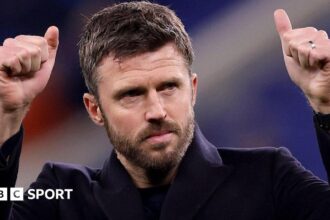
While the transfer talk dominates headlines, a quieter but equally significant question looms: What does this mean for Michael Carrick? The former United midfielder is currently the head coach of Middlesbrough, but his name is increasingly whispered as a potential future manager at Old Trafford. The Champions League qualification changes the timeline.
Carrick has proven himself at the Riverside, implementing a possession-based style that mirrors the philosophy of his mentor, Erik ten Hag. However, the financial reality is that a Champions League club demands an immediate return on investment. Ten Hag is under pressure to deliver results in Europe. If he succeeds, Carrick remains a distant prospect. If Ten Hag falters, the Carrick narrative explodes.
Expert Analysis: Carrick is not ready for the United job *this summer*. The pressure of managing a £200m budget and a squad of superstars in the Champions League is a different beast to managing in the Championship. However, the £100m UCL windfall gives United the stability to keep Carrick on their radar. He should stay at Middlesbrough for at least another season, aiming for Premier League promotion. That is the true proving ground.
If Carrick gets Boro promoted, he becomes the perfect successor. If he doesn’t, he remains a cult hero with a bright future. The Champions League money buys United the luxury of patience with their former player, rather than rushing him into the hot seat.
Risks and Rewards: The High-Stakes Gamble of the Summer
Having £200m to spend is a blessing, but it is also a curse. History is littered with clubs who spent big after a UCL qualification and crashed back to earth. The “Grealish effect” at Aston Villa or the “Chelsea scattergun” approach are cautionary tales. United must avoid the temptation to overpay for “name” players simply because they have the cash.
The key is data-driven recruitment. The new football leadership under Sir Jim Ratcliffe must ensure the money is spent on players who fit a specific tactical profile, not just players who are available. The Champions League groups are unforgiving. A poor start can lead to a Europa League drop-off and a loss of that £100m revenue.
Strong Conclusion: Manchester United’s return to the Champions League is the single most important financial event of their season. It unlocks a £200m war chest that can accelerate a rebuild by two years. It allows them to target world-class talent and gives them the financial muscle to say “no” to bad deals. For Michael Carrick, it means a slower, more deliberate path to the Old Trafford dugout—one that requires him to prove his mettle in the Premier League first. The money is in the bank. The plan is on the table. Now, it is down to execution. If United get this summer right, the Champions League anthem will be a regular soundtrack at Old Trafford for years to come. If they get it wrong, that £100m will feel like a burden, not a blessing.
Source: Based on news from Sky Sports.
Image: CC licensed via www.flickr.com