Carolina Holds Off Philadelphia: Hurricanes 3, Flyers 2 OT – A Gritty Test of Championship Mettle
For the first time in the 2025 Stanley Cup Playoffs, the Carolina Hurricanes felt the sting of a deficit. For the first time, they faced a moment of genuine adversity. And for the first time, they proved that their championship DNA runs deeper than just a perfect record. On Monday night at a raucous Lenovo Center, the Hurricanes did not just win; they survived, adapted, and ultimately dominated in the clutch, edging the Philadelphia Flyers 3-2 in overtime to take a commanding 2-0 series lead.
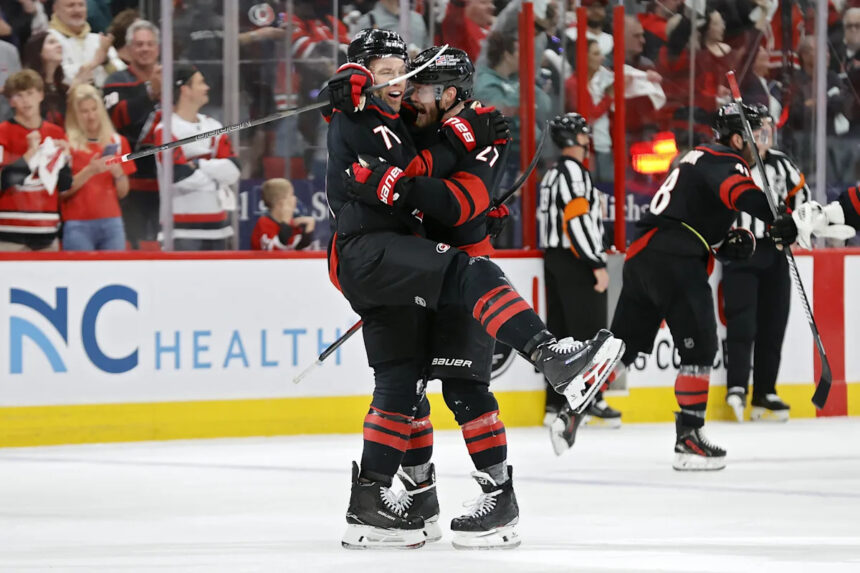
Taylor Hall, a veteran acquisition who has been searching for his first deep playoff run, delivered the dagger with just 1:06 remaining in the extra frame. The goal wasn’t pretty. It was a gritty, greasy, playoff-style finish that perfectly encapsulated the night. Sean Walker started the rush, feeding Hall as he drove the net. Hall was initially stopped and driven to his knees, but rookie Jackson Blake kept the puck alive with relentless stick work. From his knees, Hall swatted at the loose rubber, banking it past a sprawling Samuel Ersson to send the home crowd into a frenzy.
The win improves Carolina to a perfect 6-0 this postseason and gives them a stranglehold on the series. But this game was a far cry from the dominant, systematic dismantling of the New York Rangers in Round 1. This was a war of attrition, a penalty-filled, chaotic slugfest that tested the Hurricanes’ resolve like never before.
The First Crack in the Armor: Philadelphia Strikes First
Coming into Monday night, the Hurricanes had not trailed in a playoff game since Game 3 of the second round last year. The Flyers, desperate after a lopsided Game 1 loss, came out with a clear mandate: get physical, get dirty, and get the first goal. They succeeded on all fronts.
Philadelphia’s forecheck was relentless in the opening period. They forced turnovers, and for the first time, Carolina’s vaunted transition game looked disjointed. The Flyers struck first at the 12:47 mark of the first period. A miscommunication in the neutral zone led to a 2-on-1 rush, and Travis Konecny buried a sharp-angle shot past Frederik Andersen, who had been perfect through the first five games of the postseason.
- Key Moment: The goal ended Andersen’s shutout streak at 142 minutes and 31 seconds.
- Momentum Shift: The Lenovo Center went quiet, a rare sound for a building that has become a fortress.
But here is the mark of a champion: they did not panic. Head coach Rod Brind’Amour kept his bench calm, and the Hurricanes slowly began to tilt the ice back in their favor. The Flyers had their moment, but they could not build on it. Carolina’s response was measured, not frantic. They weathered the storm and waited for their chance.
Special Teams Chaos: A Penalty-Filled Grind
If you love flow, this game was not for you. If you love raw, unfiltered playoff intensity and special teams chess matches, this was a masterpiece. A total of 15 penalties were called—eight against Carolina, seven against Philadelphia. The game was a disjointed mess of 4-on-4, 5-on-4, and 4-on-3 situations that tested the discipline and depth of both rosters.
The Hurricanes’ power play, which had been lethal in Round 1, finally broke through in the second period. After killing off a Flyers power play, Carolina struck on the man-advantage when Sebastian Aho found a seam in the Flyers’ zone. Aho’s one-timer from the faceoff circle tied the game at 1-1, and the building erupted. It was a classic Hurricanes goal: puck movement, patience, and a lethal release.
Philadelphia responded with a power-play goal of their own later in the period. A point shot from Cam York deflected off a skate and past Andersen, restoring the Flyers’ lead. The goal was controversial—replays showed a potential high-stick—but it stood, and the Flyers took a 2-1 lead into the second intermission.
The third period was a tense, tight-checking affair. The Hurricanes dominated possession, outshooting the Flyers 14-5 in the frame, but Samuel Ersson was sensational. He made sprawling saves, including a robbery on Andrei Svechnikov from the slot. Finally, with just under seven minutes remaining in regulation, the Hurricanes’ persistence paid off. A forecheck by Jordan Martinook created a loose puck in the slot, and Jesper Fast swept it home to tie the game at 2-2.
Expert Analysis: Why Carolina’s Grit Matters More Than Style
Let’s be clear: this was not the Hurricanes’ best game. Their breakout was sloppy. They took too many penalties, including two offensive-zone stick infractions that are uncharacteristic of Brind’Amour’s system. Against a more clinical team—say, the Florida Panthers or the Dallas Stars—those mistakes might have been fatal.
But the Flyers, for all their heart and grit, lack the finishing touch to make Carolina pay. They had the Hurricanes on the ropes twice, and twice they let them off the hook. That is the difference between a team built to win a Cup and a team still learning how to win playoff games.
Key Takeaways:
- Depth Scoring: The Hurricanes got goals from Aho, Fast, and Hall. That is three different lines contributing. When your stars (Svechnikov, Necas) are quiet, your depth must step up. It did.
- Goaltending Battle: Frederik Andersen was not tested often, but he was steady. He stopped 23 of 25 shots. Ersson was the star for Philadelphia with 38 saves, but he could not get the big stop in OT.
- Jackson Blake Factor: The rookie’s work on the game-winner was a masterclass in net-front presence. He is playing with a veteran’s poise, and his ability to keep pucks alive is becoming a weapon.
The Hurricanes now hold a 2-0 series lead, but this game proved they are not invincible. The Flyers have found a blueprint: get physical, take away time and space, and hope for penalties. The question is whether they can sustain that level for four games.
Predictions: Where Does This Series Go?
History is not on Philadelphia’s side. Teams that go down 2-0 in a best-of-seven series win the series only about 13% of the time. But the Flyers have reason for belief. They outplayed Carolina for long stretches of Game 2. They had the better scoring chances at 5-on-5 in the first two periods. If they can clean up their neutral-zone turnovers and get a bounce or two, this series could shift dramatically when it moves to Philadelphia for Game 3.
However, the Hurricanes have a psychological edge. They have now won six straight playoff games. They have proven they can win in different ways—blowouts, tight defensive battles, and now a chaotic overtime thriller. That versatility is the hallmark of a champion.
Prediction for Game 3: The Flyers will come out desperate and win a tight, low-scoring game at home. Expect a 3-1 final. But the Hurricanes will adjust, and they will close out the series in five games. The depth and system of Carolina is simply too much for a Flyers team that is overachieving just to be here.
The path to the Eastern Conference Final still runs through Raleigh, and the Hurricanes have shown they can handle the heat. They are not just a regular-season juggernaut; they are a team that finds a way in the ugly moments. And in the playoffs, ugly wins count just as much as the pretty ones.
Strong Conclusion: A Statement of Resilience
When the final horn sounded, Taylor Hall was mobbed by his teammates. The veteran, who has been traded multiple times and has never won a Stanley Cup, looked like a man who finally found a home. His goal was not a highlight-reel snipe. It was a rebound, a scramble, a battle. It was the kind of goal that defines a championship run.
The Carolina Hurricanes are not perfect. They showed cracks on Monday night. They showed they can bleed. But more importantly, they showed they can heal in real-time. They can fall behind, take penalties, and still find a way to win. That is the mark of a team that believes in its system and its culture.
The Flyers are not done. They are too proud, too well-coached by John Tortorella, to roll over. But the Hurricanes have taken their best punch and are still standing. With a 2-0 series lead and a 6-0 postseason record, the question is no longer if Carolina can win the series. The question is: can anyone stop them?
For one night at the Lenovo Center, the answer was a resounding no. Taylor Hall made sure of it.
Source: Based on news from Yahoo Sports.