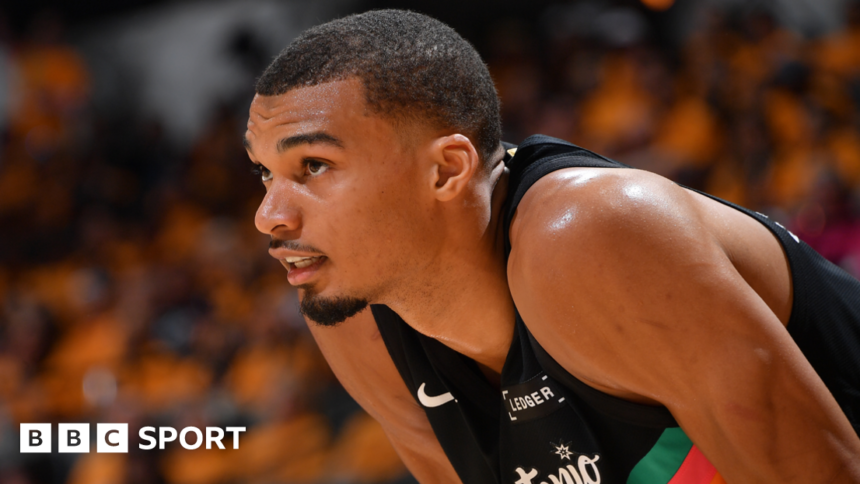
Timberwolves Draw First Blood Despite Wembanyama Record-Breaking Night
The San Antonio Spurs had history on their side. They had the newly minted, unanimous Defensive Player of the Year. They had the home crowd. And for 48 minutes, they had Victor Wembanyama rewriting the NBA record books.
None of it was enough.
In a stunning upset that sent shockwaves through the Western Conference, the Minnesota Timberwolves stole Game 1 of the Conference Semi-Finals on Monday night, defeating the second-seeded Spurs 104-102 in San Antonio. The sixth-seeded Timberwolves, fueled by the return of Anthony Edwards and a gritty defensive stand in the final seconds, have drawn first blood in this best-of-seven series.
But the story of the night—the one that will be replayed for decades—belongs to Wembanyama. The 20-year-old phenom delivered a defensive performance unlike anything the playoffs have ever seen. His 12 blocks shattered the previous NBA playoff record, a mark that had stood for decades. Yet, in a cruel twist of fate, his individual brilliance was overshadowed by a team loss.
Wembanyama’s Historic Night: A Triple-Double for the Ages
Let’s put this into perspective. Since the NBA began tracking blocks in the 1973-74 season, only two other players had recorded a triple-double in the playoffs that included blocks. Wembanyama is now the third. His final line: 11 points, 15 rebounds, and 12 blocks. It was a masterclass in rim protection, a performance that validated his unanimous selection as Defensive Player of the Year.
- 12 blocks – A new NBA playoff record, surpassing previous marks held by legends like Hakeem Olajuwon and Mark Eaton.
- 15 rebounds – Dominated the glass on both ends.
- Unanimous DPOY – Became the first player in NBA history to win the award with a perfect vote.
The French sensation was a one-man wrecking crew in the paint. He altered countless other shots, forced the Timberwolves to think twice before driving, and single-handedly kept the Spurs in a game where their offense sputtered. Every time Minnesota looked to build a lead, Wembanyama swatted away their hopes. His timing, his wingspan, his instincts—all on full display.
Yet, the box score also reveals a glaring weakness: offense. Wembanyama shot just 4-of-14 from the field. The Timberwolves’ defensive scheme, led by the physicality of Rudy Gobert and the relentless pressure of Jaden McDaniels, made him work for every inch. They forced him into tough, contested looks and dared other Spurs to beat them. On this night, no one else stepped up.
Anthony Edwards Returns, Timberwolves’ Bench Delivers
The Timberwolves entered the game with a cloud of uncertainty. Star guard Anthony Edwards had been listed as questionable with a nagging knee injury. Would he play? Could he be effective?
The answer was a resounding yes. Edwards came off the bench—a move that surprised many—and dropped 18 points in 28 minutes. He was not the explosive, highlight-reel Ant we saw in the first round, but he was efficient. He hit timely mid-range jumpers, drew fouls, and provided the emotional spark the Timberwolves needed.
“He’s our engine,” said Timberwolves head coach Chris Finch after the game. “Even at 80 percent, he changes the game. We managed his minutes, and he delivered when it mattered most.”
Edwards’ return allowed Minnesota to deploy a deep, versatile rotation. The Timberwolves’ bench outscored San Antonio’s reserves 42-26. Key contributions came from:
- Naz Reid – 14 points and 6 rebounds, including a crucial three-pointer in the fourth quarter.
- Kyle Anderson – 10 points, 5 assists, and steady veteran leadership.
- Mike Conley – 16 points and 8 assists, orchestrating the offense with poise.
The game’s defining sequence came in the final 90 seconds. With the Spurs trailing by two, Wembanyama blocked a layup by Karl-Anthony Towns—his 12th rejection—and San Antonio had a chance to tie or take the lead. But the Timberwolves’ defense stiffened. They forced a tough, contested three-pointer from Devin Vassell that clanked off the rim. Rudy Gobert secured the rebound, was fouled, and calmly sank two free throws to seal the 104-102 victory.
Expert Analysis: Why the Spurs Lost and What Must Change
From a tactical standpoint, the Spurs lost this game in two critical areas: three-point shooting and turnovers. San Antonio shot a dismal 9-of-34 (26.5%) from beyond the arc. Meanwhile, they committed 16 turnovers, many of which were unforced errors in the half-court.
Wembanyama’s brilliance on defense masked the fact that the Spurs’ offense was disjointed. Without a consistent secondary scorer, the Timberwolves were able to load up on the French star and force others to beat them. De’Aaron Fox, acquired mid-season to be the primary playmaker, had a quiet 17 points but was inefficient (6-of-17 shooting).
“We have to be better offensively,” Spurs coach Gregg Popovich admitted. “Victor gave us everything he had, but basketball is a team game. We didn’t make the extra pass. We didn’t move without the ball. That’s on me.”
For the Timberwolves, the blueprint is clear: survive Wembanyama’s defensive impact and attack the Spurs’ perimeter defense. Minnesota shot 38% from three-point range, with Edwards, Conley, and Reid all hitting clutch shots. They also won the rebounding battle 48-44, a testament to their physicality.
Key adjustments for Game 2:
- Spurs: Need Keldon Johnson and Jeremy Sochan to provide more scoring punch. Johnson had just 8 points in 22 minutes.
- Timberwolves: Continue to use Anthony Edwards as a sixth man if his knee is not 100%. His energy off the bench disrupts San Antonio’s rhythm.
- Spurs: Involve Wembanyama in more pick-and-roll sets to get him easier looks at the rim, rather than forcing post-ups against Gobert.
Predictions: Can the Timberwolves Pull Off the Upset?
This series is far from over. The Spurs are the second seed for a reason. They have the best player on the floor in Wembanyama, and they have a Hall of Fame coach in Popovich. History tells us that champions adjust. But Minnesota has something special brewing.
The Timberwolves have elite defensive versatility. They can switch 1 through 5, they have length on the wings, and they have a legitimate Defensive Player of the Year candidate of their own in Rudy Gobert. When your defense can neutralize a generational talent—even for one game—you have a puncher’s chance.
My prediction: The Spurs will win Game 2. Wembanyama will not let his team go down 0-2 at home. He’ll adjust, his teammates will shoot better, and San Antonio will even the series. However, the Timberwolves have proven they can win in this building. If Edwards gets healthier and the bench continues to produce, this series goes six or seven games.
But for one magical night, the Timberwolves drew first blood. They silenced a record-breaking performance and reminded the basketball world that in the playoffs, defense wins championships—but it takes a team to win a game.
Strong Conclusion: A Series Defined by Giants
Victor Wembanyama did everything humanly possible to win Game 1. He rewrote the record books. He blocked shots that seemed impossible. He gave the Spurs a chance.
And yet, the Timberwolves walked out of San Antonio with a victory.
This is the beauty of playoff basketball. Individual greatness can dominate a stat sheet, but it cannot guarantee a win. The Timberwolves, a gritty sixth seed with a chip on their shoulder, proved that teamwork, depth, and resilience can overcome even the most historic individual performance.
As the series shifts to Game 2, the pressure is now on the Spurs. They cannot afford to fall into an 0-2 hole. But the Timberwolves have served notice: they are not here to be a footnote in Wembanyama’s legend. They are here to win.
First blood is theirs. The question now is: can they finish the job?
Stay tuned. This series is just getting started.
Source: Based on news from BBC Sport.