French Broadcaster Hits Back at Bath’s TMO Criticism: “The Video Referee is the Master”
The fallout from Bath Rugby’s heartbreaking 24-21 defeat to Bordeaux-Begles in the Investec Champions Cup semi-final has taken a sharp new twist. After a week of simmering frustration from the West Country, the French broadcaster responsible for the match’s television match official (TMO) footage has delivered a pointed and definitive rebuttal. France Télévisions, the host broadcaster for the fixture at the Stade Chaban-Delmas, has directly addressed the criticism leveled by Bath’s head coach, Johann van Graan, stating unequivocally that the video official had full access to every angle and made his own judgments.
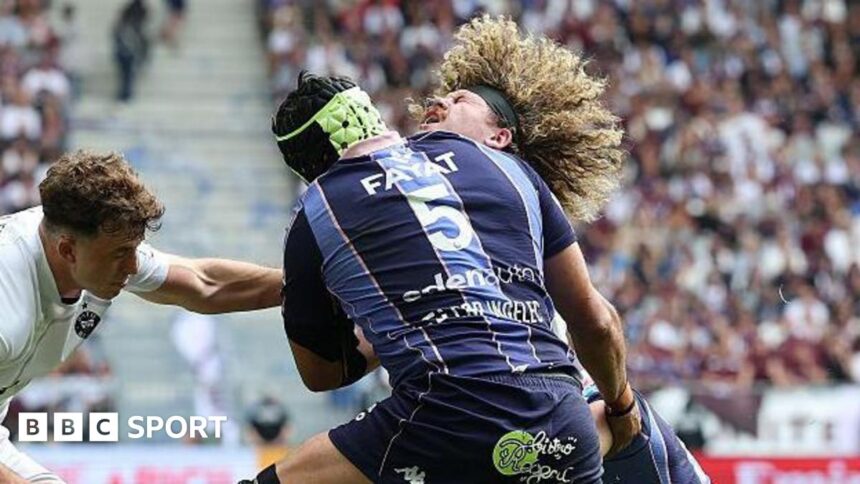
The controversy centers on a series of collisions involving Bath’s powerful No. 8, Alfie Barbeary. Van Graan, visibly agitated after the match, claimed that three separate carries by Barbeary involved direct head contact from Bordeaux defenders, incidents he believes were either missed or ignored by the match officials. However, the broadcaster’s response suggests that the issue is not one of missing footage, but of interpretation.
“The video referee is the master of what he wants to see, and nowadays he has access to every camera, every angle,” France Télévisions’ rugby editor, Cedric Beaudou, told AFP. This statement throws a stark light on the growing tension between clubs and broadcasters over the role of technology in rugby’s most pivotal moments. This article delivers a complete, expert breakdown of the row, the underlying issues of officiating consistency, and what this means for the future of the Champions Cup.
The Core of the Controversy: Van Graan’s Call for Consistency
Johann van Graan’s post-match press conference was not the typical lament of a losing coach. It was a carefully worded, data-driven plea for systemic change. The South African tactician did not simply blame the referee; he targeted the process. His central argument was that the TMO, operating under the direction of the broadcast feed, failed to review three specific instances where Barbeary’s head was contacted during carries in the second half.
“We need consistency,” van Graan stated, his voice carrying the weight of a season’s work undone. “I counted three carries from Alfie Barbeary where there was direct contact to the head. The officials have to see them. If they see them, they have to act. If they don’t see them, why not?” The Bath boss was particularly frustrated that similar incidents in other matches—often involving smaller players—are routinely escalated for review, while a player of Barbeary’s physical stature might be perceived as being able to “ride” the contact.
The specific incidents in question occurred during a frantic period of the second half when Bath was chasing the game. Barbeary, who had been a destructive force with ball in hand, was met with high, aggressive tackles that van Graan argued were “reckless and dangerous.” The coach pointed to a lack of a clear, standardized protocol for what constitutes a “clear and obvious” head contact review in the semi-final environment.
- Incident 1: A shoulder-to-head contact after a pick-and-go near the Bordeaux 22.
- Incident 2: A swinging arm that caught Barbeary’s jawline as he broke a tackle.
- Incident 3: A high, upright tackle that drove the head back.
Van Graan’s frustration is shared by many in the English Premiership, where the standard of TMO intervention has been a hot topic. The feeling is that the “big moments” of a semi-final deserve the highest level of scrutiny, and that scrutiny was lacking.
France Télévisions’ Defence: “Every Camera, Every Angle”
Enter Cedric Beaudou of France Télévisions. His response to AFP was not merely a defensive statement; it was a declaration of the broadcaster’s role and the TMO’s autonomy. By stating that “the video referee is the master of what he wants to see,” Beaudou is shifting the responsibility away from the production team and squarely onto the officiating crew.
This is a crucial distinction. Broadcasters like France Télévisions are responsible for producing the live feed, which includes multiple camera angles—sideline, high-behind, in-goal, and isolated slow-motion replays. They are not, however, responsible for deciding which angles the TMO studies or how long he takes to deliberate. Beaudou’s argument is that the TMO, who sits in a separate truck or booth, has the ability to request any angle at any time. If he missed a head contact, it was because he chose not to look at the specific replay, or he deemed the contact legal.
“All footage was shared correctly,” Beaudou insisted. “The production team provided the standard match feed. The TMO has the same access as the referee’s headset. He can pause, rewind, and zoom on any frame he wishes. We do not hide angles. We do not edit the feed for the officials.” This statement directly refutes the implication from Bath that the broadcaster somehow “limited” what the TMO could see. In the world of elite broadcasting, the director’s job is to show the action to the viewers, not to coach the officials.
This defence raises a deeper question: Is the TMO system too passive? In many cases, the TMO only intervenes when a specific incident is flagged by the referee or by a producer in the booth. The expectation from van Graan and many coaches is that the TMO should be proactively scanning for foul play, regardless of whether the on-field referee has seen it. Beaudou’s comments suggest that France Télévisions believes they have provided the tools; the TMO simply chose not to use them to review the Barbeary incidents.
Expert Analysis: The Gap Between Expectation and Reality
As a seasoned observer of the Champions Cup, this row exposes a fundamental fracture in modern rugby officiating. The technology is now incredibly sophisticated. High-frame-rate cameras, super slow-motion, and spider-cams provide an almost omniscient view of the pitch. Yet, the human element—the TMO’s judgment—remains the most inconsistent variable.
Let’s analyze the specific tactical context. Bordeaux’s defensive strategy was to target Bath’s primary ball-carriers, namely Barbeary and Ben Spencer. When a team targets a player of Barbeary’s size (6’3”, 115kg), defenders often commit with high intensity. The line between a legal, dominant tackle and a high shot becomes incredibly fine. In the heat of a semi-final, with 30,000 fans roaring, the on-field referee, Andrew Brace, is focused on the breakdown and the offside line. He relies on the TMO to catch the high-speed collisions.
The problem is the “threshold of intervention.” World Rugby’s protocols dictate that a TMO should only stop play for a “clear and obvious” act of foul play that has been missed. If a head contact is deemed to be indirect, or if the tackler’s shoulder dips slightly, the TMO may decide it does not meet the threshold. Van Graan’s argument is that three separate incidents, all involving the same player and the same type of contact, should have triggered a review. The TMO, presumably, saw them and judged them as legal, or did not see them at all.
Beaudou’s comment that the TMO is “the master of what he wants to see” is a double-edged sword. It empowers the official but also absolves the broadcaster of any blame. It suggests a system where the TMO can pick and choose what to review, which is exactly the inconsistency that van Graan is railing against. If a TMO in one match reviews a similar incident and awards a yellow card, but in another match ignores it, the system fails.
My prediction: This incident will not be the last. The Champions Cup knockout rounds are becoming a pressure cooker for officiating. Expect EPCR (European Professional Club Rugby) to issue a statement in the coming days, likely supporting the TMO’s decision-making process but also reminding broadcasters and teams of the existing protocols. However, the underlying issue—the subjective nature of the TMO’s “mastery”—will remain unresolved until a more rigid, automated system is introduced, such as a mandatory review for any head contact above a certain force threshold.
What This Means for Bath and the Future of the Champions Cup
For Bath, this is a bitter pill to swallow. They came within a single score of reaching their first Champions Cup final since 2014. The defeat to Bordeaux was a classic “what if?” narrative. Finn Russell’s missed conversion, a late handling error, and now the officiating controversy will haunt the squad through the off-season. Van Graan’s public criticism was a calculated risk—a way to protect his players and to put pressure on the governing bodies before next season.
But the reality is that Bath lost the game in other areas. They conceded 14 points in a ten-minute spell of ill-discipline in the first half. Their lineout malfunctioned at crucial moments. While the Barbeary incidents are a legitimate talking point, they are not the sole reason for the loss. However, the psychological impact is significant. Players need to feel protected. If Barbeary feels that his safety is not being prioritized by the TMO, it changes how he carries the ball—and that diminishes his effectiveness.
For the Champions Cup as a product, this controversy is a stain. The tournament prides itself on being the pinnacle of club rugby. When the host broadcaster and a semi-finalist are trading barbs over the quality of the TMO footage, it undermines the integrity of the result. France Télévisions’ defence, while technically accurate, feels tone-deaf. Telling a losing coach that the TMO is “the master” does not soothe the wound; it widens it.
Key takeaways for the sport:
- Transparency is key: Broadcasters should be required to release a full log of which angles were sent to the TMO during the match.
- Standardized thresholds: EPCR must define a clear, universal standard for what constitutes a mandatory TMO review for head contact.
- Coach-Broadcaster relations: This public spat is unhealthy. A private debrief between van Graan, the match officials, and the broadcast producer would have been more productive.
Conclusion: A Clash of Cultures and a Call for Clarity
The row between Johann van Graan and France Télévisions is more than just a post-match squabble. It is a collision between the old-school, on-field culture of rugby and the modern, high-definition, forensic dissection of the game. Van Graan represents the coach who wants every tool available to ensure fairness. Beaudou represents the broadcaster who provides the tools but refuses to be the referee.
The truth lies somewhere in the middle. The TMO had the footage. The TMO had the power. But did he have the will? Cedric Beaudou’s statement that “the video referee is the master of what he wants to see” is a powerful, almost arrogant, declaration of the status quo. It tells us that the system is not broken—it is simply human. And humans, even with 20 cameras, make mistakes or prioritize different things.
For Bath, the season is over. The what-ifs will linger. For the Champions Cup, the work is just beginning. The tournament needs to ensure that in future semi-finals, the “master” of the video feed is not just powerful, but also consistent, accountable, and willing to see everything. Otherwise, the credibility of the biggest prize in club rugby will continue to be questioned. The ball is now in EPCR’s court. They must decide if they want a system of masters or a system of machines.
Source: Based on news from BBC Sport.