I Was Never Rated as a T20 Player: KL Rahul Glad to Silence IPL Strike-Rate Chatter
For years, the narrative surrounding KL Rahul in Indian cricket was a frustrating paradox. Here was a batsman of immense classical elegance, a man who could anchor a Test match with the poise of a modern-day great, yet whose name was often whispered with a question mark in the context of T20 cricket. The whispers, and often the shouts, centered on one thing: his strike rate. The criticism was relentless. He was too slow, too cautious, too “Test-like” for the slam-bang world of the Indian Premier League (IPL).
But as the 2025 IPL season unfolds, those whispers have been replaced by a deafening silence. Rahul is not just playing T20 cricket; he is dominating it. In a candid, revealing interview on JioStar’s show ‘Superstars’, the Delhi Capitals wicketkeeper-batter laid bare the struggles of his early career, admitting that he was never rated as a T20 player and that silencing that chatter has become one of his proudest achievements.
The Perception Trap: From Test Specialist to T20 Enigma
KL Rahul’s journey in international cricket began with a bang—a Test debut in Australia where he looked every bit the part of a future batting mainstay. His technique was watertight, his temperament unflappable. It was the perfect recipe for red-ball success. However, this very identity became a cage when he stepped into the whites of the IPL.
“I was never seen as a strong T20 player in the early years,” Rahul admitted on the show. “People looked at my technique and automatically assumed I was only a Test specialist. It was difficult to break away from that image. Every time I played a slow innings, it was magnified because of that perception.”
The data from his early IPL seasons tells a story of evolution. In his first few years with Sunrisers Hyderabad and then Kings XI Punjab, Rahul was often the anchor. He would accumulate runs, but the strike rate—often hovering in the low 130s—became a lightning rod for criticism. Analysts questioned whether his game was suited to the modern T2O era, where 200+ totals are the new normal. He was labeled a “selfish” player, a “dot-ball eater,” and a “run accumulator” rather than a match-winner.
The 152* Knock That Changed Everything
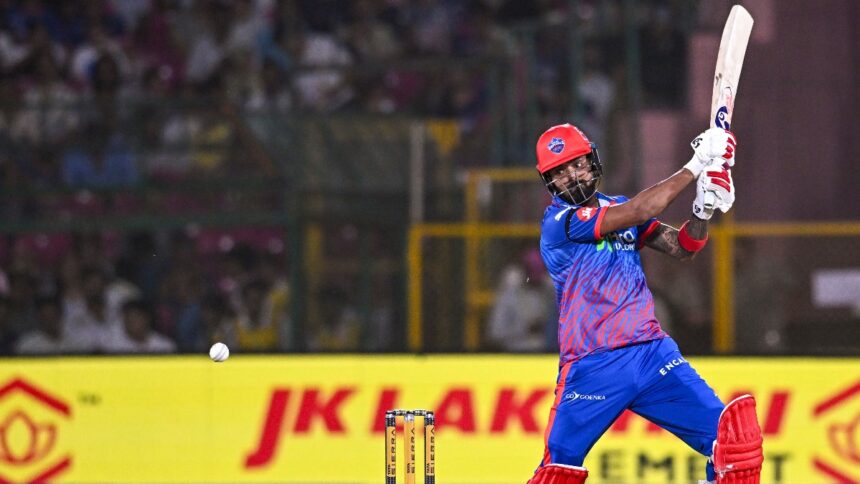
Then came the night that redefined the narrative. Last month, playing for the Delhi Capitals against the Punjab Kings, Rahul played what is arguably the greatest innings of his IPL career. He smashed an unbeaten 152 off just 64 balls. The innings was a masterclass in controlled aggression: 16 fours and 10 sixes, a strike rate of 237.50. It was a statement, a thunderous declaration that the old perception was dead.
Yes, the innings came in a losing cause—a cruel twist of fate that has often followed Rahul’s greatest knocks—but the impact was seismic. It was not just the volume of runs; it was the manner in which they were scored. He dismantled the bowling attack with a fury that had previously seemed dormant.
“That innings against Punjab was special, not just because of the runs, but because of what it represented,” Rahul reflected. “It was a release. For years, I had been told I couldn’t do that. I had been told I was too slow. That knock was for everyone who doubted my T20 ability.”
The knock serves as a powerful data point. It proves that Rahul possesses the full toolkit of T20 shots: the lofted drives over extra cover, the brutal pull shots, and the innovative scoops. The question was never about ability; it was about permission. Rahul has now given himself permission to be the aggressor.
Expert Analysis: The Evolution of a Modern T20 Batsman
From an expert’s perspective, Rahul’s transformation is a case study in mental fortitude and tactical adjustment. The criticism he faced was not entirely unfounded in his early years. He did have a tendency to go into a shell if wickets fell early. His approach was often risk-averse, prioritizing preservation over acceleration.
However, the KL Rahul of 2025 is a different beast. Here are the key shifts in his game:
- Powerplay Aggression: Rahul is now taking the fight to the bowlers in the first six overs. He is no longer content to just “see off” the new ball. His strike rate in the powerplay this season is significantly higher than his career average.
- Gap Exploitation: He has improved his ability to find the boundary against spin in the middle overs. Previously a weakness, he now uses his feet and the sweep shot more effectively to rotate strike and punish loose deliveries.
- Mental Reset: The biggest change is internal. He has stopped playing for the “image” of a Test batsman. He is playing for the situation, without the fear of failure that comes from being judged on strike rate alone.
KL Rahul has not played a T20 International for India since 2022. That is a staggering fact for a player of his calibre, especially given his current form. While he remains a vital cog in India’s ODI and Test setups, the T20I door has been closed, seemingly in favor of younger, more explosive talents. But his recent IPL form is a loud, persistent knock on that door.
“I am proud to have broken the perception,” Rahul said. “It wasn’t easy. There were times when I doubted myself. But I kept working on my game, kept believing that I could be a match-winner in this format too.”
Predictions: What the Future Holds for Rahul in T20 Cricket
So, what does the future hold for KL Rahul in the shortest format? The answer is complex. The Indian T20I team is currently a crowded space. The management has invested heavily in players like Shubman Gill, Yashasvi Jaiswal, and Ruturaj Gaikwad. However, form and experience cannot be ignored for long.
Here are three predictions based on his current trajectory:
- A T20I Return is Inevitable: If Rahul continues this vein of form—striking at over 150 while maintaining his class—the selectors will have no choice but to bring him back. His ability to keep wickets and open the batting is a massive asset. He offers a stability that the current top order sometimes lacks. Expect him to be in the conversation for the next T20 World Cup.
- He Will Become Delhi’s X-Factor: For the Delhi Capitals, Rahul is no longer just the sheet anchor. He is the primary aggressor. If he can maintain this high-strike rate approach throughout the season, he will single-handedly drag Delhi into the playoffs. He has the potential to win the Orange Cap this year.
- The Narrative is Dead: The “slow starter” label is gone. The “Test specialist” tag is gone. Rahul has successfully rebranded himself as a complete T20 player. The next phase of his career will be about consistency in this new aggressive avatar.
Strong Conclusion: The Silence is Golden
The chatter about KL Rahul’s strike rate has finally been silenced. It took years of relentless work, a mountain of criticism, and one unforgettable 152-run blitzkrieg to do it. But Rahul has done more than just answer his critics; he has evolved. He has proven that a player can be both technically sound and explosively aggressive.
In a sport obsessed with instant gratification and viral moments, Rahul’s journey is a testament to the power of perseverance. He was never rated as a T20 player, but he refused to accept that label. Today, he stands as one of the most dangerous batsmen in the IPL, a player who can dismantle any bowling attack on his day.
As he sits in the Delhi Capitals dugout, the silence around his game is deafening—and for KL Rahul, that is the sweetest sound of all. The Test specialist is gone. In his place stands a T20 gladiator, ready to conquer the format he was once told he could not master. The IPL is watching, and the world is taking note.
Source: Based on news from India Today Sport.