3 Biggest Takeaways for Sixers Following Game 1 Loss to Knicks
NEW YORK — The Philadelphia 76ers arrived at Madison Square Garden riding the high of an emotional Game 7 victory over the Boston Celtics on the road. But by the time the final buzzer sounded on Monday night, that euphoria had evaporated. The Sixers looked exhausted, disjointed, and completely overmatched as the New York Knicks steamrolled them 137-98 in Game 1 of this second-round series. Trailing by as many as 40 points, Philadelphia’s performance was a stark reminder of the gap between surviving a series and dominating one. While one game does not define a series, the warning signs were flashing bright neon. Here are the three biggest takeaways from a brutal night in the Big Apple.
1. The Knicks Exposed Philadelphia’s Defensive Exhaustion
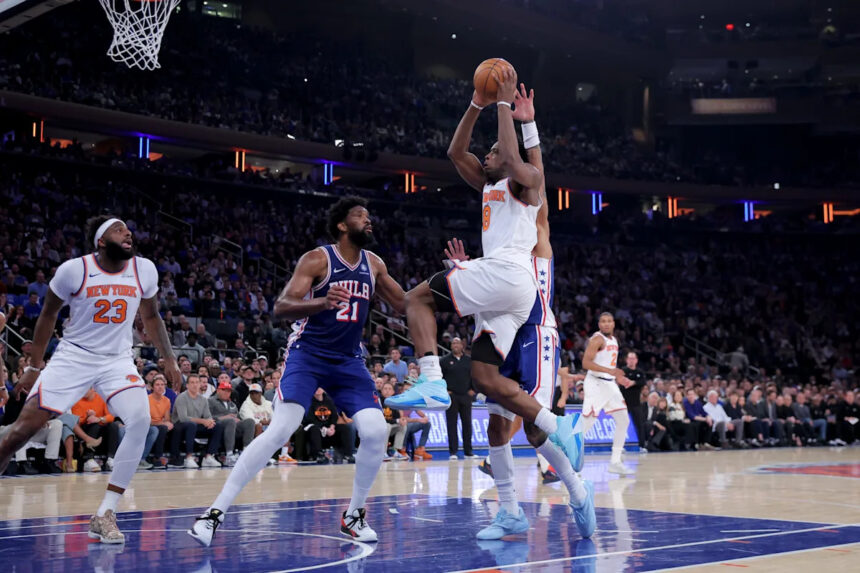
The first and most glaring issue was the Sixers’ defensive performance. It was, by any standard, a disaster. The Knicks lived in the paint, finished at the rim with ease, and when the Sixers collapsed, New York kicked the ball out to open shooters. When Philadelphia did manage to close out, the Knicks simply put the ball on the floor and dribbled into mid-range jumpers with impunity. Jalen Brunson, in particular, feasted. He found creases in the defense that simply should not exist at this level. It didn’t matter if the Sixers threw Tyrese Maxey, Kelly Oubre Jr., or even Joel Embiid at him—Brunson got to his spots.
“Well, I thought we got off to a decent start defensively, and then we had, I think, five or six mid pick-and-rolls in a row where they scored in pretty much every way they could,” a visibly frustrated Sixers coach said postgame. “Came off, hit a 3, we didn’t get through the screen, they got a lob, a couple floaters down the lane. I think they scored six straight times off that.”
That sequence was the game. The Sixers were full step slow on every rotation. They were chasing, not leading. The Knicks moved the ball with crisp precision, and Philadelphia’s legs simply weren’t there. This is a direct consequence of the emotional and physical toll of that Game 7 win in Boston. The Sixers expended so much energy to get here that they had nothing left in the tank for Game 1. The rest disparity was obvious: New York had been off since Saturday, while Philadelphia played a grueling seven-game series that ended just 48 hours prior.
Key Defensive Failures in Game 1:
- Pick-and-roll coverage: The Sixers were consistently beaten on the ball screen, allowing Brunson and Josh Hart to turn the corner.
- Transition defense: The Knicks scored 22 fast-break points, many coming off live-ball turnovers that the Sixers couldn’t recover from.
- Three-point line: New York shot 42% from deep, often finding wide-open looks when the Sixers over-helped in the paint.
- Second-chance points: The Knicks grabbed 14 offensive rebounds, turning misses into easy putbacks.
2. The Offensive Flow Was Completely Stagnant
It wasn’t just the defense. The Sixers’ offense, which had been clicking against Boston, looked clunky and predictable. Paul George led the team with 17 points, but he needed 15 shots to get there. Joel Embiid managed just 14 points and four rebounds—a far cry from his MVP-level production. Tyrese Maxey, the hero of Game 7, was held to 13 points and three rebounds, unable to find any rhythm against New York’s aggressive perimeter defense. Kelly Oubre Jr. chipped in with 12 points and five rebounds, and rookie VJ Edgecombe added 12 points in garbage time, but the starting unit never found a groove.
The issue was isolation-heavy offense. Too often, the Sixers settled for contested jumpers early in the shot clock rather than moving the ball. The Knicks’ defense, led by the tenacious OG Anunoby and Mitchell Robinson, simply dared Philadelphia to beat them one-on-one. And the Sixers couldn’t. Embiid was doubled on every touch, and when he kicked the ball out, the supporting cast failed to make quick decisions. The result was a stagnant offense that produced just 98 points—a number that would be acceptable if the defense held, but not when you’re giving up 137.
“We were just a step slow everywhere,” the coach added. “Didn’t guard the ball well enough, didn’t contest shooters well enough. They were obviously picking us apart. Just moving a lot better than we were.” That lack of movement translated to the offensive end, where the Sixers recorded only 18 assists on 35 made field goals. For comparison, the Knicks had 31 assists on 52 made baskets. That’s the difference between a team that trusts each other and a team that is still searching for its identity.
Offensive Adjustments Needed:
- More ball movement: The Sixers need to force the Knicks to rotate by running Embiid and Maxey through multiple screens.
- Pick up the pace: Philadelphia cannot afford to walk the ball up. They need to push in transition before New York’s defense sets.
- Get Embiid deeper post position: He was catching the ball at the three-point line too often. He needs to be closer to the basket to draw fouls.
- Involve the bench: VJ Edgecombe showed energy, but the second unit needs to provide a scoring spark to take pressure off the starters.
3. The Series Is Far From Over—But Game 2 Is a Must-Win
Let’s be clear: The Sixers losing Game 1 is not a death sentence. The Boston Celtics lost Game 1 to the Miami Heat in the 2023 Eastern Conference Finals and still forced a Game 7. But the margin for error is razor-thin. The Knicks are not a team you want to give a 2-0 lead to. New York is built on physicality, depth, and defensive tenacity. If the Sixers allow them to dictate the pace again, this series could be over in five games.
The good news is that the Sixers have been here before. Embiid, George, and Maxey have all experienced playoff adversity. The bad news is that the Knicks are playing with a swagger that suggests they believe they are the better team. Jalen Brunson’s 34-point performance was a statement. The Knicks’ bench outscored Philadelphia’s 45-28. And the home crowd at Madison Square Garden was a factor from the opening tip.
But the Sixers can take solace in one thing: They know they can play better. The defensive lapses were largely due to fatigue, not scheme. The offensive stagnation was a product of poor decision-making, not talent. If Philadelphia can get a day of rest and a focused practice, they can re-establish their identity in Game 2. The key will be energy and effort. The Sixers cannot afford to be “a step slow” again. They need to be the aggressor, not the reactor.
Predictions for Game 2:
- Joel Embiid will bounce back: Expect a 30-point, 12-rebound performance as he attacks the rim early to establish dominance.
- Tyrese Maxey will find his rhythm: He’s too talented to be held down two games in a row. Look for 25+ points and a more aggressive approach.
- Defensive adjustments: The Sixers will switch more on pick-and-rolls and trap Brunson to get the ball out of his hands.
- The series will be tied 1-1: Philadelphia’s pride and desperation will lead to a hard-fought win on Wednesday night.
Conclusion: A Wake-Up Call, Not a Knockout
The 39-point loss was ugly. There’s no sugarcoating it. The Sixers were outclassed in every phase of the game. But the NBA playoffs are a series of adjustments, and Philadelphia has one of the best coaching staffs in the league to make them. The biggest takeaway from Game 1 is that the Sixers cannot coast on the emotional high of beating Boston. They need to bring their own energy, their own defensive intensity, and their own offensive flow.
“It’s not very easy to evaluate any of that stuff,” the Sixers coach admitted. And he’s right. One game in a hostile environment, after a grueling seven-game series, is not the time to overreact. But the warning signs are there. The Knicks are hungry, well-rested, and confident. The Sixers need to match that hunger in Game 2 or risk watching their season slip away. The good news? The Sixers have been counted out before. And they know exactly how to respond. Game 2 will tell us everything about their championship mettle.
Source: Based on news from Yahoo Sports.