How Did Guehi’s ‘Assist’ Allow Barry to Score From an Offside Position? The Bizarre VAR Drama That Rocked Goodison Park
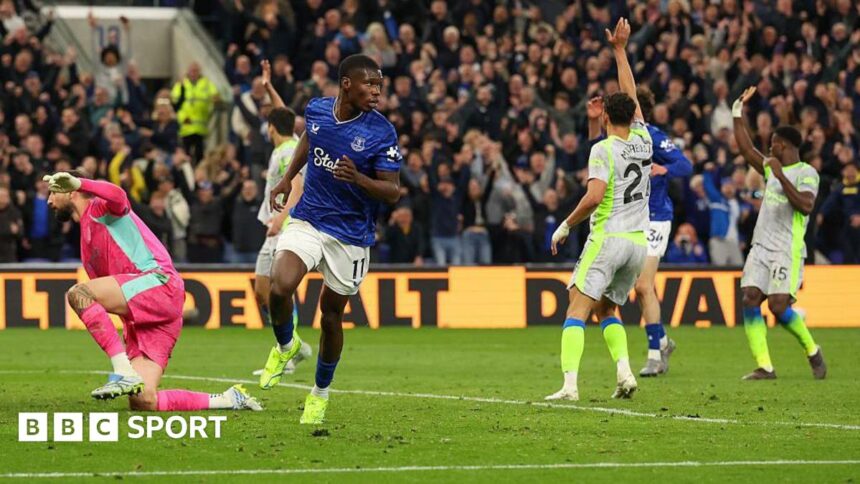
The Premier League served up yet another jaw-dropping chapter of drama, controversy, and sheer unpredictability as Everton and Manchester City played out a pulsating 3-3 draw at Goodison Park. While Jérémy Doku’s late equaliser salvaged a point for the champions, the match will be remembered for one of the most bizarre officiating moments of the season: the “assist” from Manchester City defender Marc Guehi that allowed Everton striker Thierno Barry to score from an offside position.
Toffees boss David Moyes was left “amazed” not only by the goal itself but by the decision to allow it to stand. The incident has sparked a furious debate about the interpretation of the offside law, the role of the VAR, and whether common sense has been completely abandoned in the modern game. Let’s break down exactly what happened, why it was allowed, and what it means for the future of football officiating.
The Incident: A Defensive Nightmare or a Tactical Masterstroke?
The moment of madness arrived in the 74th minute, with the score locked at 2-2. Everton had fought back from a goal down, but City were pressing for a winner. A long ball forward from the Everton midfield looked routine. City defender Marc Guehi, under no immediate pressure, attempted to head the ball back to his goalkeeper, Ederson.
However, Guehi’s header was weak, looping into the air rather than back toward goal. The ball fell perfectly into the path of Everton substitute Thierno Barry, who was standing in an offside position. Barry, alert and opportunistic, controlled the ball, turned, and slotted it past Ederson to put Everton 3-2 up.
Immediately, the Manchester City players surrounded referee Michael Oliver, pointing to the linesman’s flag. The assistant referee had raised his flag, indicating that Barry was offside when Guehi touched the ball. But then came the twist: after a lengthy VAR check, the goal was awarded. The reasoning? Guehi’s header was deemed a deliberate play, not a deflection or a rebound. Under the current laws of the game, a player cannot be offside if the ball is deliberately played by an opponent.
This is where the controversy exploded. How can a defender’s panicked, poor header be considered a “deliberate play”? Was Barry offside when the ball was played? Yes. But because Guehi intentionally touched it, the offside was reset. The football world was left scratching its head.
Expert Analysis: The Law vs. Common Sense
To understand why this goal stood, we need to dive into the IFAB (International Football Association Board) laws. The rule states that a player in an offside position is not penalised if they receive the ball directly from a deliberate play by an opponent. The key word here is deliberate.
Let’s look at the criteria used to determine a deliberate play:
- Intent: Did the player mean to play the ball? Guehi clearly intended to head it back to his keeper.
- Distance: Was the ball close enough for the player to control? The ball was directly above Guehi.
- Direction: Did the ball travel to a predictable area? Guehi’s header went backward, but not directly to Barry.
- Time: Did the player have time to make a controlled action? Guehi had a split second to react.
According to the strict letter of the law, Guehi’s header was a deliberate act. He chose to head the ball. It wasn’t a ricochet or a block. Therefore, Barry was not offside when he received the ball. Former Premier League referee Mark Clattenburg explained on Sky Sports: “It’s a terrible decision from a football perspective, but technically, it’s correct. The law does not account for poor quality. If you deliberately play the ball, the offside is gone. It’s harsh, but the VAR was correct.”
However, critics argue that this interpretation destroys the spirit of the offside rule. Jamie Carragher called it “a loophole that makes a mockery of the game.” The question is: should a defender’s mistake be punished by a rule that was designed to prevent goal-hanging? The answer, for now, is yes.
Why David Moyes Was “Amazed” for a Different Reason
While the Barry goal dominated the headlines, Moyes had another grievance. In the 88th minute, with the score still 3-2 to Everton, substitute Merlin Rohl broke into the City box. He was dragged down by Bernardo Silva as he tried to shoot. The contact was clear: Silva’s arm wrapped around Rohl’s shoulder, pulling him off balance. The referee waved play on, and VAR did not intervene.
This decision was arguably more egregious than the offside call. Penalty kicks are awarded for fouls, not for the quality of the chance. Rohl had possession, was moving toward goal, and was clearly impeded. The lack of a penalty gave City the opportunity to equalise, which they did through Doku in the 95th minute.
Moyes said after the match: “I’m amazed. If that’s not a penalty, then what is? We’ve had a goal given that everyone in the stadium thought was offside, and then we don’t get a stonewall penalty. I don’t understand the game anymore.”
The Fallout: What This Means for Future Matches
The Guehi-Barry incident has immediate and long-term implications. For Everton, it feels like two points dropped. For Manchester City, it masks a shaky defensive performance. But for the Premier League, it’s another crisis of confidence in the officiating system.
Here are three key takeaways for the rest of the season:
- Defenders must be smarter: If you are in a position where an opponent is offside, do not play the ball. Let it run. Guehi would have been better off leaving the ball for Ederson. The offside flag would have gone up. Instead, his “assist” cost his team two points.
- VAR consistency is a myth: The same technology that gave Barry’s goal failed to spot Silva’s foul on Rohl. This inconsistency is the biggest frustration for fans and managers. How can a marginal offside be reviewed for three minutes, yet a clear foul in the box is ignored?
- The law needs rewriting: The IFAB must clarify what constitutes a “deliberate play.” The current definition is too broad. A defender under pressure, making a panicked clearance, should not be treated the same as a midfielder playing a pass. A new sub-clause for “clearance under pressure” could solve this.
Predictions: Will This Happen Again?
Yes. Without a doubt. The Barry goal is not an anomaly; it is the logical conclusion of a poorly worded law. We will see more goals like this, especially as teams press higher. Managers will now instruct their forwards to hover in offside positions, waiting for a defender to make a mistake. It’s a low-risk, high-reward strategy.
Expect Arsenal, Liverpool, and Tottenham to exploit this loophole in the coming weeks. If a defender even glances at the ball, the offside trap is broken. The only solution is for the IFAB to issue an emergency clarification. Until then, defenders will be terrified to touch the ball, and forwards will be licking their lips.
For Thierno Barry, this goal will be remembered as the one that sparked a rule change. For Marc Guehi, it will be a nightmare that haunts his career. The line between genius and disaster in football is often a single, poorly executed header.
Conclusion: The Beautiful Game’s Ugly Loophole
The Everton vs. Manchester City match was a six-goal thriller that had everything: late drama, a stunning equaliser from Jérémy Doku, and a defensive calamity. But the story will always be about the goal that shouldn’t have been. The Guehi “assist” to Barry is a perfect example of how the law can be technically correct but spiritually wrong.
Football is a game of emotion, instinct, and split-second decisions. When a defender makes a mistake, the punishment should not be a goal that contradicts the fundamental principle of offside: preventing attackers from gaining an unfair advantage. Barry was offside. He gained an advantage. The only reason the goal stood is because of a semantic loophole that no one outside a law book could love.
David Moyes and Everton have every right to feel robbed. But they also know that this is the new reality of Premier League football. The VAR era is here, and it is messy, inconsistent, and often infuriating. For now, the only thing we can predict is more controversy. The next time a defender heads the ball in his own box, he should think twice. Because that “assist” might just be the most dangerous pass of the game.
Final score: Everton 3-3 Manchester City. Final verdict: The law wins, but common sense loses.
Source: Based on news from BBC Sport.