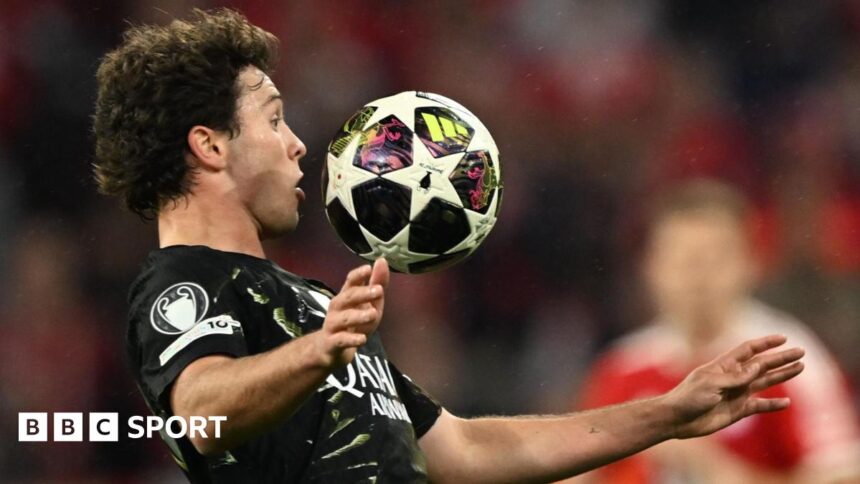
Why Neves Handball Against Bayern Wasn’t a Penalty: The Little-Known Law That Shocked the Allianz
The Allianz Arena was a cauldron of fury. Bayern Munich, trailing 1-0 on the night and 6-4 on aggregate to Paris Saint-Germain in the Champions League semi-final second leg, saw their hopes of a miraculous comeback seemingly extinguished by a single, controversial moment. When Vitinha’s clearance smashed into the arm of his own teammate, Joao Neves, inside the penalty area, the entire stadium—players, coaching staff, and 75,000 fans—erupted in disbelief. Referee Joao Pedro Silva Pinheiro waved play on. VAR did not intervene. Social media exploded. But here’s the truth: the referee was absolutely correct.
This was not a penalty. And the reason is buried deep within the Laws of the Game—a specific, little-known exemption that even seasoned pundits often get wrong. Let’s break down exactly why Bayern’s agony was legally justified, and what this means for the future of handball interpretations in elite football.
The Incident: A Clear Hit, A Clear Refusal
To understand the controversy, we need to replay the moment. It was the 30th minute. Bayern, desperate for a goal to close the aggregate deficit, were pressing high. PSG’s Vitinha, under pressure from Jamal Musiala, attempted a powerful clearance from just outside his own box. The ball rocketed straight into the arm of Neves, who was positioned less than two meters away, his arm in a natural, downward position as he braced for contact.
The Bayern players immediately surrounded Pinheiro. Thomas Tuchel, on the sideline, was apoplectic. The logic seemed simple: the ball hit an arm, the arm was in the box, and the arm belonged to a defender. But football’s handball law has evolved into a labyrinth of nuance. The key here was not where the arm was, but who played the ball.
According to BBC Sport’s football issues correspondent Dale Johnson, the decision hinged on a specific clause within Law 12: “It is not a handball if hit on the hand/arm by the ball which has been played by a team-mate (unless the ball goes directly into the opponents’ goal or the player scores immediately afterwards).”
This is the critical distinction. The ball was played by Vitinha, a PSG player. It then struck Neves, also a PSG player. The law is designed to prevent a team from being punished for accidental contact between two of its own players. Imagine the chaos if a defender’s clearance ricocheting off a teammate’s shin was a penalty—handball would become a lottery. The same logic applies to the arm.
Key takeaway: If the ball had been played by a Bayern player and then hit Neves’ arm, it would have been a penalty. But because the source was a PSG teammate, the law protects the defending team.
Expert Analysis: Why VAR Stayed Silent
The decision not to award a penalty was not just correct—it was textbook. Let’s dissect the three layers of the handball law that played out in real time:
- Source of the ball: As established, the ball came from a teammate (Vitinha). The exemption applies immediately.
- Arm position: Neves’ arm was in a natural, non-unnatural position. He was not making his body “unnaturally bigger.” The arm was close to his torso, not raised or flailing. Even without the teammate exemption, many referees would have deemed this accidental.
- Distance and reaction time: The ball was struck from extremely close range (less than two meters). Players cannot reasonably avoid contact at that distance. The law explicitly considers whether the player had time to react. Neves had zero time.
VAR’s silence was therefore a validation of the on-field decision. The protocol for VAR intervention is “clear and obvious error.” Given the teammate exemption, there was no error. In fact, awarding a penalty would have been the clear and obvious mistake. Social media outrage often overlooks these technicalities because fans see only the contact, not the context.
Expert prediction: This incident will be used in UEFA referee training sessions for years. It perfectly illustrates the difference between a “handball offense” and a “handball incident.” An offense requires intent or unnatural positioning plus a non-teammate source. An incident is just contact. Bayern suffered the latter.
Why Bayern’s Frustration Is Misplaced
Let’s be honest: Bayern Munich’s anger was understandable, but it was also a deflection. Trailing 6-4 on aggregate, the team had already underperformed in the first leg (a 4-2 loss in Paris). The handball incident, while dramatic, did not cost them the tie. At that moment, they still needed two more goals with 60 minutes to play. The real story is not the penalty that wasn’t given, but the tactical failures that put them in that position.
Bayern’s players surrounded the referee for over a minute, losing crucial momentum. Instead of focusing on the next attack, they dwelled on a decision that was never going to change. Tuchel’s side had multiple chances after the incident—including a close-range header from Harry Kane that sailed wide—but they failed to convert. The handball narrative became a convenient excuse.
Moreover, the law is there to protect the game’s integrity. If we punished every accidental ricochet between teammates, football would grind to a halt. Imagine a corner kick where a defender’s header deflects off a teammate’s hand—that would be a penalty every time. The law creates a logical boundary: you cannot penalize a team for a ball played by their own player.
Bold prediction: This incident will spark a renewed debate about simplifying the handball rule. Currently, the law is too complex for fans and even some professionals. Expect UEFA to issue a clarification memo before next season, but do not expect a rule change. The teammate exemption is too sensible to remove.
Conclusion: The Right Call, The Wrong Outcry
In the end, the Allianz Arena was left wondering what might have been. PSG held on to their 1-0 lead (2-0 on aggregate in the second leg, 7-4 overall) and advanced to the final. Bayern’s season ended in anguish, and Joao Neves’ arm became a scapegoat. But the truth is written in black and white in the Laws of the Game.
The referee, Joao Pedro Silva Pinheiro, made a brave and correct decision. VAR backed him because the law was clear. The outrage was a product of emotion, not logic. For Bayern fans, the pain is real. But the next time a similar incident occurs—and it will—remember the rule: a ball played by a teammate cannot be a handball penalty, unless it goes directly into the goal.
Final verdict: Not a penalty. Not even close. And that’s the cold, hard truth of football’s most misunderstood law.
Source: Based on news from BBC Sport.