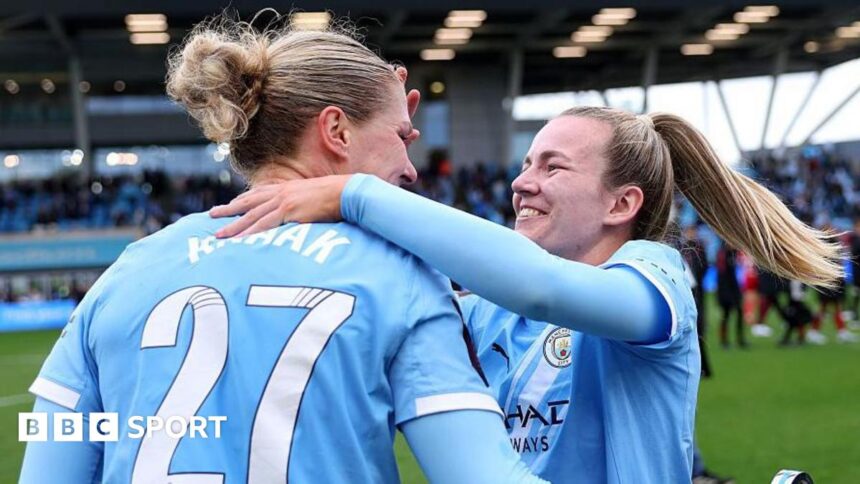
Inside Man City’s WSL Title-Winning Season: The Tactical Masterclass That Ended Chelsea’s Reign
For a decade, the Women’s Super League had a blue hue, but it was the deep royal blue of Chelsea. Since 2017, Emma Hayes’ machine had dominated English football, hoarding titles and rewriting records. Yet, on a damp Wednesday evening in Brighton, the tectonic plates shifted. When the final whistle blew at the Broadfield Stadium, confirming Arsenal’s 1-1 draw was not enough to keep the title race alive, Manchester City were crowned WSL champions for the first time in ten years. It is a seismic moment for the league, a vindication of patience, and a testament to the quiet brilliance of manager Andree Jeglertz.
City’s triumph—clinched with a game to spare and a commanding six-point gap over second-placed Chelsea—is not just a trophy. It is a statement. It signals the end of a dynasty and the birth of a new one. But how did a side that finished fourth last season, and was written off by pundits as a “work in progress,” dismantle the most dominant force in women’s football? The answer lies in a meticulous rebuild, defensive resilience, and a tactical evolution that left rivals scrambling.
The Jeglertz Revolution: From Rebuild to Ruthless Efficiency
When Andree Jeglertz took over at the Academy Stadium, the narrative was clear: City needed a reset. The previous season had been a disappointment, with the team finishing fourth and failing to challenge for the title. The Swedish tactician, however, saw something others missed. He inherited a squad with immense talent but lacking a clear identity. His first task was to strip away the chaos and install a system built on defensive solidity and transitional speed.
Unlike the high-pressing, relentless attacking style that defined Chelsea under Hayes, Jeglertz opted for a more controlled, patient approach. The hallmark of City’s season has been their ability to absorb pressure and strike with devastating precision. They have not always been the prettiest team to watch, but they have been the most effective. Consider the numbers: City conceded just 12 goals in 21 games, the best defensive record in the league. This was not luck; it was a system.
The manager drilled a compact 4-3-3 shape that transformed into a 4-5-1 out of possession. The midfield trio—often featuring the dynamic Laura Coombs and the evergreen Keira Walsh (before her injury)—became the league’s best shield. They choked space, forced turnovers, and launched quick counters. It was a style that frustrated opponents, especially Chelsea, who found themselves unable to break down City’s low block in both league meetings.
- Defensive record: 12 goals conceded in 21 games (best in WSL).
- Clean sheets: 12 in the league, including crucial shutouts against Arsenal and Chelsea.
- Conversion rate: City averaged 2.1 goals per game, but with fewer total shots than Chelsea, proving clinical efficiency.
Jeglertz also showed a ruthless streak in team selection. He benched star players when form dipped and rotated the squad heavily during the congested winter period. This kept the squad fresh and hungry. The message was clear: no one was undroppable. This meritocracy fostered a culture of accountability that previous City sides lacked.
The Spine of Steel: Defenders, Midfielders, and a World-Class Goalkeeper
Every title-winning team needs a spine, and City’s was arguably the strongest in the league. At the back, the partnership of Alex Greenwood and Laia Aleixandri was a fortress. Greenwood, the captain, provided leadership and composure on the ball, while Aleixandri offered pace and aggressive tackling. They were ably supported by full-backs Leila Ouahabi and Eszter Kovacs, who balanced defensive duties with overlapping runs.
But the true difference-maker was between the sticks. Goalkeeper Khiara Keating had a breakout season, earning her first senior England call-up and establishing herself as the league’s best shot-stopper. Her reflexes, particularly in one-on-one situations, saved City crucial points. In the 0-0 draw against Chelsea at the Kingsmeadow, Keating made five saves, including a stunning double-stop that preserved the point. That clean sheet was a psychological blow to the champions.
In midfield, the balance was perfect. Laura Coombs played the deepest role, breaking up play and recycling possession. Jess Park brought energy and dribbling in the final third, while Mary Fowler emerged as the creative hub, drifting into half-spaces and linking play. When Walsh was injured for a spell, the system did not collapse—it adapted. This depth was a luxury Chelsea lacked, as injuries to Sam Kerr and Millie Bright exposed their thin squad.
Up front, Bunny Shaw was the undisputed star. The Jamaican striker scored 18 league goals, winning the Golden Boot and providing a focal point for City’s attack. She was not just a finisher; she held the ball up, brought others into play, and scored headers, volleys, and penalties. Her physicality bullied defenders, and her movement created space for wingers like Lauren Hemp and Chloe Kelly to exploit.
- Bunny Shaw: 18 goals, 5 assists (Golden Boot winner).
- Khiara Keating: 12 clean sheets, 80% save percentage.
- Alex Greenwood: 90% pass completion, 45 interceptions.
The Turning Points: Key Matches That Decided the Title
No title is won in a single game, but a handful of moments defined City’s season. The first came in October at the Academy Stadium, when City hosted Chelsea. It was a tactical chess match, ending in a 1-1 draw. But the narrative shifted: City did not just compete with the champions; they outplayed them for long stretches. That result planted a seed of doubt in Chelsea’s mind.
The real statement came in December. City traveled to the Emirates to face Arsenal, a team many expected to challenge for the title. In a 2-1 victory, City showcased their resilience. They went behind early but responded with two quick goals before half-time. The second half was a masterclass in game management: they sat deep, absorbed pressure, and hit on the counter. Arsenal’s frustration boiled over, and City walked away with three points.
However, the defining moment of the season was the 0-0 draw at Kingsmeadow in February. Chelsea, desperate to close the gap, threw everything at City. But Keating was unbeatable, and the defense stood firm. That point felt like a win for City, and it effectively broke Chelsea’s spirit. From that match onward, City never looked back. They went on a nine-game unbeaten run, while Chelsea stumbled, losing to Liverpool and drawing with Manchester United.
The final nail came on Wednesday, when Arsenal’s draw at Brighton mathematically confirmed City’s coronation. It was an anti-climactic end to a dramatic race, but it was fitting: City had been so consistent that they did not need a final-day thriller. They had earned the right to celebrate early.
Predictions: Can City Sustain Their Dominance?
The immediate question is whether this is a one-off or the start of a new dynasty. The evidence suggests the latter. City have a young squad, with an average age of 24.5. Key players like Keating (20), Park (22), and Fowler (21) are only going to improve. The club’s investment in the women’s team has been substantial, with a state-of-the-art training facility and increased marketing. They have the infrastructure to compete long-term.
However, challenges remain. Chelsea will not fade away quietly. With new manager Sonia Bompastor likely to bring tactical variations, and the return of injured stars like Sam Kerr, they will be hungry for revenge. Arsenal are also rebuilding, and Manchester United are lurking. The WSL is becoming more competitive, and retaining the title will require even greater depth.
For City, the key is keeping their core together. Bunny Shaw has been linked with moves to Lyon and Barcelona, and losing her would be a massive blow. The club must also strengthen the squad for Champions League football, where the physical demands are higher. If Jeglertz can add a top-class midfielder and a backup striker in the summer, City could dominate for years.
My prediction: City will finish in the top two again next season, but winning back-to-back titles will be harder. The league is evolving, and rivals will study Jeglertz’s tactics. However, with this core and this manager, they have the foundation for sustained success. The blue of Manchester is back, and it is here to stay.
Conclusion: A Victory for Patience and Process
Manchester City’s WSL title win is not a fluke. It is the result of a deliberate, long-term plan executed with precision. Andree Jeglertz has built a team that is defensively sound, tactically flexible, and mentally tough. They ended Chelsea’s six-year reign not by out-spending or out-starring them, but by out-thinking them. Every player bought into the system, from the veteran Greenwood to the teenage Keating.
For the fans who waited a decade, this title tastes sweeter. It represents a return to the top after years of near-misses and rebuilding. For the WSL, it is a healthy shift in power—a reminder that no dynasty lasts forever. As the confetti falls and the champagne flows, one thing is certain: Manchester City are not just champions. They are the new standard-bearers of English women’s football.
The reign of blue continues, but the shade has changed. Long live the Cityzens.
Source: Based on news from BBC Sport.