Bruno Fernandes: Trophies, Records, and the Unfinished Business at Manchester United
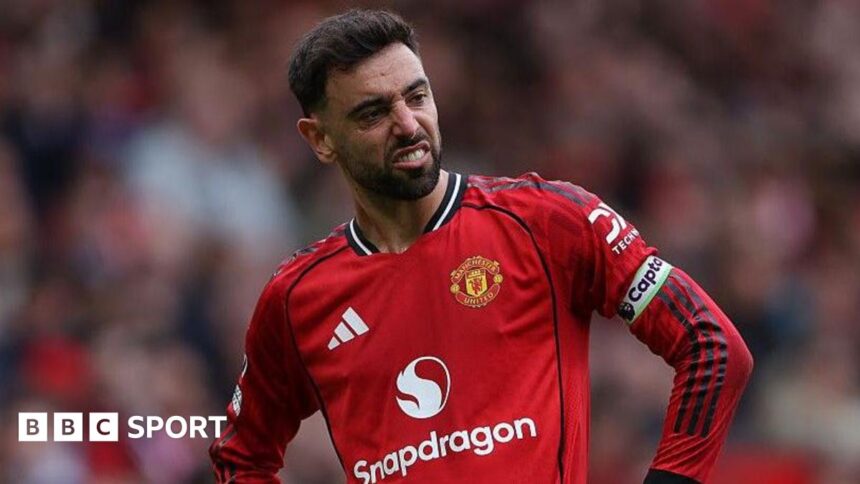
There is a curious paradox at the heart of Bruno Fernandes’s career at Manchester United. On one hand, the Portuguese playmaker is statistically one of the most dominant creative forces the Premier League has seen since he arrived in January 2020. On the other, his trophy cabinet—two domestic cups—feels almost insultingly bare for a player of his ambition and output. This season, as he prepares to collect the prestigious Football Writers’ Association Footballer of the Year award, the question is no longer about his talent. It is about his legacy. Can a player who creates 29 ‘big chances’ in a single season, who breaks assist records, and who wears the captain’s armband, truly be considered a Manchester United great without a league title? That is the conundrum Bruno Fernandes faces as he enters the most critical phase of his career.
- The Assist Machine: Why Fernandes is the Premier League’s Most Prolific Creator
- The Trophy Question: Domestic Cups vs. Elite Ambition
- Individual Accolades vs. Team Glory: The FWA Award and a Captain’s Mindset
- The Future: Stay, Build, or Chase Glory Elsewhere?
- Conclusion: A Legend in the Making, but the Story is Not Over
The Assist Machine: Why Fernandes is the Premier League’s Most Prolific Creator
Let us start with the numbers, because they tell a story that cannot be ignored. With 29 ‘big chances’ created so far this Premier League season, Bruno Fernandes leads the division in this key metric. For context, this is not just a fluke of a hot streak; it is a pattern of sustained excellence. Since his debut, no player in England’s top flight has created more goalscoring opportunities from open play or from set pieces. He is a statistical outlier, a player who consistently finds passes that others simply do not see.
What makes this record even more staggering is the environment in which it is being achieved. Manchester United have not been a fluid, dominant side for most of this season. They have lurched between defensive solidity under Erik ten Hag and periods of chaotic transition. Yet, Fernandes remains the fixed point. He is the player who turns half-chances into clear-cut openings. His assist record this season—nudging double digits in the league—is a testament to his vision, but also to his resilience. He does not go missing in difficult games. He demands the ball, even when the team is under pressure. For a player often criticized for his body language, the raw output is irrefutable proof of his value. He is, without question, the most important creator at Old Trafford since the days of Wayne Rooney in his prime.
The Trophy Question: Domestic Cups vs. Elite Ambition
However, football is not played on a spreadsheet. It is played for silverware. And here lies the uncomfortable truth for Fernandes. Since joining Manchester United, he has won the Carabao Cup and the FA Cup under Erik ten Hag. These are not small achievements. Winning a domestic double in 2023 was a genuine statement of progress. Beating Manchester City in the 2024 FA Cup final was a moment of pure, unadulterated glory. Fernandes lifted those trophies with the passion of a man who understood their weight.
But the elephant in the room is the Premier League and the Champions League. Fernandes has not come close to winning either. United’s best league finish since his arrival was third place—a position they are currently battling to achieve again. If they secure that spot in May, it will be only the second time in five full seasons that they have finished in the top three. For a club of Manchester United’s history, that is a meagre return. For a player many argue is the best signing since Sir Alex Ferguson retired, it is a frustrating reality.
The argument for Fernandes is that he has carried a mediocre squad on his back. He has not had the luxury of a prime Kevin De Bruyne or a peak Mohamed Salah around him. He has had to create chances for forwards who have often been inconsistent. Yet, the elite tier of players—the ones who win league titles—somehow find a way to elevate their entire team. Fernandes has elevated the attack, but he has not been able to drag United over the line in a title race. That missing piece of a Premier League crown is what separates him from the true pantheon of United legends. He is not a winner of the highest order yet, but he is the closest thing to it that this post-Ferguson era has produced.
Individual Accolades vs. Team Glory: The FWA Award and a Captain’s Mindset
On Friday, Fernandes will be named the Football Writers’ Association Footballer of the Year. It is a massive honour, voted for by the journalists who watch the game closest. It places him in the same company as Thierry Henry, Cristiano Ronaldo, and Steven Gerrard. But if you listen to Fernandes speak, you will hear a man who is almost embarrassed by the attention. He is not one for coveting individual awards. He has said repeatedly that he would trade every personal accolade for a team trophy.
This is not false modesty. It is the mindset of a captain. Bruno Fernandes, the Manchester United captain, leads by example in the most difficult moments. He takes penalties under immense pressure. He runs more than almost any other midfielder in the league. He is the first to confront a referee and the last to leave the pitch. His frustration when things go wrong is not a sign of petulance; it is the mark of a player who cares deeply. The FWA award recognizes that relentless drive. It acknowledges that in a season of turbulence, he has been the one constant. But for Fernandes, the award will feel hollow if he cannot add a Premier League medal to his collection in the coming years.
The Future: Stay, Build, or Chase Glory Elsewhere?
This brings us to the most pressing question: what is Bruno Fernandes’s future? At 30 years old, he is entering the peak years of a creative midfielder’s career. He has three or four more seasons at the very highest level. He has a contract at Old Trafford until 2026, with an option for a further year. But the clock is ticking on his chance to win the biggest prizes.
There are three realistic paths ahead:
- Stay and build with INEOS. The new football structure under Sir Jim Ratcliffe and sporting director Dan Ashworth represents the most competent leadership United have had in a decade. If they can sign a world-class striker and a reliable defensive midfielder, Fernandes could be the conductor of a title-winning orchestra. The foundation is there. He is the leader of that project.
- A transition of roles. As he ages, Fernandes could evolve into a deeper playmaker, dictating tempo rather than just creating chances. This would extend his longevity and allow younger, more dynamic runners to play ahead of him. It is a role he has already experimented with for Portugal.
- A shock departure. While there is no indication he wants to leave, the lure of a club like Bayern Munich, Barcelona, or a return to Sporting Lisbon cannot be dismissed if United fail to progress. He deserves to play in the Champions League and compete for the biggest trophies. If United finish fifth or sixth, the temptation to seek a new challenge will grow louder.
My prediction is that Fernandes stays. He is not a player who runs from a challenge. He has invested too much of his soul into Manchester United to walk away now, especially with the club finally showing signs of structural competence. He will win more trophies—perhaps not the Premier League next season, but within the next three years. He is too good, and his hunger is too real, to be denied forever.
Conclusion: A Legend in the Making, but the Story is Not Over
Bruno Fernandes is already a Manchester United icon. His assist record, his relentless creation of big chances, and his leadership are undeniable. He has lifted more trophies than many of his peers in the post-Ferguson era. But he knows the judgment of history is harsh. A player of his calibre is measured by league titles and Champions League triumphs. The FWA award is a beautiful validation of his season, but it is not the final chapter.
The next two years will define his legacy. If he can lead Manchester United to a Premier League title, he will be remembered as one of the club’s greatest ever signings—a player who refused to let the club’s decline define him. If he falls short, he will be remembered as a brilliant individual in a flawed team. The raw materials are there. The record books are already filling up. The only thing missing is the ultimate prize. For Bruno Fernandes, the unfinished business at Old Trafford is the only business that matters.
Source: Based on news from BBC Sport.