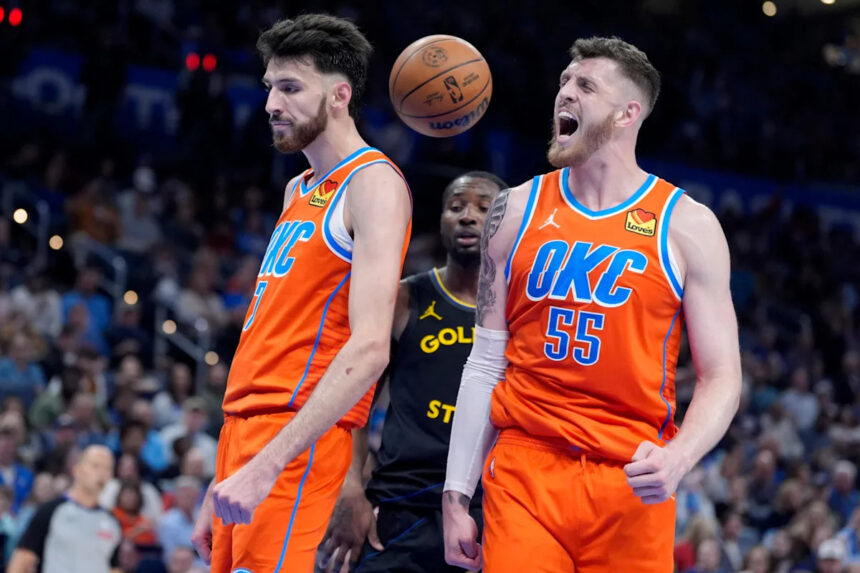
From Clunky to Clinching: How the Chet Holmgren-Isaiah Hartenstein Duo Became OKC’s Secret Weapon
It was, by all accounts, a disaster waiting to happen. When the Oklahoma City Thunder signed Isaiah Hartenstein in the summer of 2024, the plan was simple: add bulk to a frontcourt that had been bullied by the Dallas Mavericks in the Western Conference Semifinals. The execution, however, was anything but simple. For the first few weeks of the experiment, the pairing of Hartenstein and Chet Holmgren looked less like a twin-tower revolution and more like two giants trying to share the same phone booth. The spacing was off. The defensive rotations were late. The offense, once a fluid symphony of motion, ground to a halt.
“The first couple games, we didn’t think it was really going to work out,” Hartenstein admitted recently, a confession that felt like a gut punch to Thunder fans who had dreamed of an unguardable front line.
But something shifted. What began as a clunky, forced marriage of two traditional centers has evolved into one of the most versatile and terrifying frontcourt tandems in the NBA. Here is the story of how the once-awkward pairing of Holmgren and Hartenstein transformed from a theoretical headache into the perfect fit for a championship contender.
The Skepticism Was Real: Why the Twin-Tower Experiment Nearly Failed
Let’s rewind to February 2025. Holmgren, the No. 2 pick in the 2022 draft, had spent his entire basketball life as a center. He was a rim-protecting, three-point-shooting unicorn who thrived as the sole big man, roaming the paint and chasing guards on the perimeter. Then came Hartenstein—a physical, bruising, traditional center who made his living in the dunker’s spot.
The fit was clunky on both ends of the floor. Defensively, Hartenstein’s lack of lateral quickness was exposed when he had to switch onto quicker wings, while Holmgren, used to being the last line of defense, suddenly had to navigate traffic. Offensively, the paint became a demolition zone. Hartenstein, who thrives on offensive rebounds and short roll passes, found Holmgren standing in his spot. Holmgren, who loved to drive from the top of the key, found a 7-footer parked under the rim.
“Anyone watching could see it,” one league scout noted. “They were stepping on each other’s toes. It looked like two guys who had never played together, which, technically, they hadn’t.”
Because both players dealt with significant injuries—Holmgren missed the start of the 2024-25 season with a hip issue, and Hartenstein missed time with a calf strain—the pair didn’t start together until February. The Thunder’s best lineups early in the season featured one center on the floor. When Hartenstein backed up Holmgren, the team looked dominant. When they shared the court, the offense stagnated.
It was a crisis of identity. The Thunder had invested heavily in the idea of twin towers, but the reality was a square peg in a round hole.
The Adjustment: How Holmgren and Hartenstein Found Their Rhythm
The turning point wasn’t a single play or a fiery speech. It was a series of subtle, almost invisible adjustments. The coaching staff, led by Mark Daigneault, realized they had to stop forcing the duo to play like traditional bigs. Instead, they leaned into their unique strengths.
Holmgren’s role changed dramatically. Instead of camping in the paint, he began operating more from the perimeter—not just as a spot-up shooter, but as a playmaker. His ability to drive from the three-point line, combined with his elite passing, created space for Hartenstein to operate in the short roll. Suddenly, Hartenstein wasn’t clogging the lane; he was a release valve.
“Chet had to become a wing on offense,” an assistant coach explained. “He had to trust that Isaiah would clean up the glass and finish around the rim. It took time for Chet to stop thinking like a center and start thinking like a forward.”
Defensively, the switch was even more brilliant. The Thunder stopped asking Hartenstein to guard perimeter players. Instead, they hid him on the weakest offensive player, allowing him to roam as a help defender. Holmgren, with his 7-foot-6 wingspan, became the primary rim protector, but with a twist: he now guarded the opponent’s best big man on the perimeter, using his length to contest shots without leaving the paint vulnerable.
The results were staggering. In the first 10 games of the experiment, the Thunder’s defensive rating with both bigs on the floor was a mediocre 112.3. Over the next 20 games, that number dropped to an elite 103.8. The offense, once clunky, began to hum. Hartenstein’s screen-setting freed Holmgren for open threes, while Holmgren’s gravity pulled defenders away from the rim, allowing Hartenstein to feast on putbacks.
- Key Stat: The Thunder outscored opponents by 12.4 points per 100 possessions with both bigs on the floor in the final 20 games of the regular season.
- Key Adjustment: Holmgren’s three-point attempt rate jumped from 35% to 42% when sharing the court with Hartenstein.
- Key Result: The duo ranked in the 94th percentile in defensive rebounding rate when playing together.
The chemistry wasn’t just tactical; it was personal. Hartenstein, known for his vocal leadership, started calling out defensive sets for Holmgren. Holmgren, in turn, began feeding Hartenstein in the post against mismatches. “We started talking more,” Hartenstein said. “I realized Chet is a basketball genius. He sees things two steps ahead. Once I understood that, I just had to get out of his way sometimes.”
Expert Analysis: Why This Duo is Now a Nightmare Matchup
From a tactical perspective, the Holmgren-Hartenstein pairing is now a nightmare for opposing coaches. The traditional weakness of twin-tower lineups is perimeter defense and offensive spacing. The Thunder have solved both.
Offensively, the duo creates a “pick your poison” dilemma. If a defense switches, Hartenstein can post up a smaller guard. If they drop, Holmgren gets an open three. If they double, both bigs are elite passers—Holmgren averages 3.5 assists per game, while Hartenstein is one of the best passing centers in the league.
“It’s the inverted pick-and-roll that kills you,” one Western Conference assistant coach said. “When Chet sets a screen for Shai [Gilgeous-Alexander], and Hartenstein is in the dunker’s spot, you have to make a choice. Do you help off Hartenstein? He’ll dunk it. Do you stay home? Shai gets to the rim. It’s a math problem with no correct answer.”
Defensively, the duo has become a wall. Opponents shoot just 44.2% at the rim when both bigs are on the floor—a mark that would lead the league. Hartenstein’s physicality allows Holmgren to play more aggressively on the perimeter, knowing there’s a safety net behind him. Meanwhile, Holmgren’s length allows Hartenstein to gamble for steals and deflections.
The emergence of Jaylin Williams as a reliable third big has only deepened the rotation. Williams, a 6-foot-9 forward with a high basketball IQ, allows Daigneault to rest either starter without losing defensive integrity. But the real magic happens when Holmgren and Hartenstein share the floor. They have gone from being a liability to a luxury.
Prediction: The Thunder’s Path to a Championship Runs Through This Duo
So, what does this mean for the Thunder’s title hopes? Everything. The Western Conference is a gauntlet of elite big men—Nikola Jokic, Anthony Davis, Victor Wembanyama, and Domantas Sabonis. The Thunder, once too small to compete, now have the size and versatility to match up with anyone.
In a potential playoff series against the Denver Nuggets, Hartenstein can body Jokic while Holmgren roams as a weak-side shot blocker. Against the Lakers, Holmgren can stretch Davis out to the three-point line, while Hartenstein punishes smaller defenders in the paint. Against the Timberwolves, the duo can switch everything, forcing Rudy Gobert to guard on the perimeter.
“We’re not the same team that lost to Dallas,” Holmgren said recently. “We’re bigger, we’re stronger, and we’re smarter. Isaiah and I have figured out how to make this work. And it’s scary.”
The skepticism is gone. The clunkiness is a distant memory. What remains is a Thunder team that has solved its biggest weakness—the frontcourt—and turned it into a weapon. Chet Holmgren and Isaiah Hartenstein started as an experiment that nearly failed. Now, they are the foundation of a championship contender.
The perfect fit wasn’t born overnight. It was built, brick by brick, through patience, adjustment, and a shared belief that two giants could learn to dance together.
Source: Based on news from Yahoo Sports.