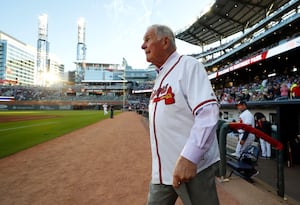
Bobby Cox, Legendary Atlanta Braves Manager, Dies at 84: A Legacy of Humility and Excellence
When you think of the great Atlanta Braves players, there’s Hank Aaron, Dale Murphy, Chipper Jones, and the three big pitchers—Greg Maddux, Tom Glavine, and John Smoltz. But when it comes to the man who orchestrated the symphony from the dugout, there’s only one name: Bobby Cox. On Saturday, the Braves announced that Cox has died at the age of 84, leaving behind a legacy that transcends statistics and championships. He was more than a manager; he was the heartbeat of an era that transformed Atlanta into a baseball capital.
Robert Joseph Cox wasn’t loud. He wasn’t flashy. He was a humble man in a high-profile job who managed to control the universal impulse for self-promotion. In a sport dominated by egos, Cox was a cleats guy—someone who took great pride in being able to wear those cleats to work every day. He didn’t seek the spotlight; the spotlight found him because of his results. From 1990 to 2010, he guided the Braves to 14 consecutive division titles, a feat that may never be equaled in modern baseball. His death marks the end of a chapter, but his influence will ripple through the game for generations.
The Making of a Manager: From Tulsa to the Bronx
Born on May 21, 1941, in Tulsa, Oklahoma, Cox’s journey to immortality began far from the bright lights of Atlanta. He grew up in Selma, a small town in California’s San Joaquin Valley, where he honed his skills on the diamond. After graduating from Selma High School, Cox signed with the Los Angeles Dodgers in 1959, starting his career as a player. It wasn’t a glamorous path—he toiled in the minor leagues for years, eventually being acquired by the Braves in 1966. But his big-league debut didn’t come until 1968, when the New York Yankees signed him. In 220 games over two seasons, Cox hit just .225 with nine home runs. As a player, he was a footnote. As a manager, he became a monument.
Expert Analysis: Cox’s playing career taught him the value of resilience. He saw the game from the bottom up, understanding the grind of a bus ride and the sting of a demotion. This perspective shaped his managerial philosophy: treat every player with respect, but demand accountability. When he took over the Braves as manager in 1978, he was fired after three losing seasons. But Cox didn’t quit. He returned to the Yankees as a coach, then became Toronto’s manager, winning the AL East in 1985. The Braves brought him back in 1990, and the rest is history.
His ability to develop young talent was unmatched. Cox had a gift for knowing when to push and when to pull back. He turned a struggling franchise into a dynasty, not with loud speeches, but with quiet confidence. He trusted his players, and they trusted him back. That bond was the foundation of the Braves’ 1995 World Series title and their sustained dominance through the 1990s and early 2000s.
The Dynasty Builder: 14 Straight Division Titles and a World Series Crown
Under Cox, the Braves became a model of consistency. From 1991 to 2005, they won the National League East every single year—a streak that included five World Series appearances and one championship in 1995. But the numbers only tell part of the story. Cox’s genius was in managing personalities. He had to balance the egos of future Hall of Famers like Maddux, Glavine, and Smoltz, while also nurturing homegrown stars like Chipper Jones and Andruw Jones. He did it by staying out of the way.
- Pitching Staff Management: Cox famously gave his pitchers autonomy. Maddux called his own games; Glavine and Smoltz adjusted on the fly. Cox trusted their instincts, which allowed them to thrive. He never micromanaged, a trait that empowered his aces to become legends.
- Lineup Construction: Cox was a master of platoons and situational hitting. He knew when to insert a pinch-hitter or when to sacrifice bunt. His in-game decisions were rarely flashy, but they were almost always correct.
- Clubhouse Culture: Cox created a family atmosphere. He defended his players fiercely, even earning a record 162 ejections—most of them for arguing calls that went against his guys. His players knew he had their backs, which fostered loyalty and performance.
Expert Analysis: The 1995 World Series victory over the Cleveland Indians was the crowning achievement. Cox’s team was a machine: Tom Glavine pitched eight shutout innings in Game 6, and David Justice hit a solo home run that sealed the 1-0 win. But Cox’s influence went beyond that moment. He kept the Braves competitive year after year, even as free agency and injuries threatened to dismantle the roster. His ability to rebuild on the fly was extraordinary. After the 2005 streak ended, he guided the Braves to the playoffs again in 2010, his final season. It was a fitting farewell.
The Humble Legend: Why Bobby Cox Mattered More Than Wins
Cox’s legacy isn’t just about the 2,504 career wins (fourth all-time) or the 1995 ring. It’s about how he carried himself. In an era of self-promotion and media circuses, Cox remained refreshingly low-key. He rarely gave long interviews, preferring to let his team do the talking. He was a cleats guy—a man who loved the game for the game itself, not for the fame. His players often described him as a father figure, someone who would chew you out in the dugout and then buy you a beer after the game.
Bobby Cox was born May 21, 1941, in Tulsa, Oklahoma. He started his career as a baseball player after graduating from Selma High School in California’s San Joaquin Valley, signing with the Los Angeles Dodgers in 1959. The Braves acquired Cox in 1966, but he didn’t make his big-league debut until the Yankees signed him in 1968. That journey—from minor league bus rides to the Hall of Fame—shaped his humility. He never forgot where he came from, and he never let success change him.
Predictions for His Legacy: In the coming years, expect to see more tributes to Cox’s managerial style. Young managers like Brian Snitker (who coached under Cox) and Dave Roberts will continue to cite his influence. The Braves will likely honor him with a statue at Truist Park, joining the monuments to Aaron and Jones. But the real tribute will be in the way future managers treat their players—with respect, trust, and a quiet confidence that speaks louder than any trophy.
Cox’s death also reminds us of the passing of an era. The 1990s Braves were a cultural force in Atlanta, uniting a city that was still growing into its own. Cox was the steady hand who kept the ship afloat through storms both on and off the field. His 162 ejections weren’t a sign of anger; they were a sign of love. He fought for his players because he believed in them. That belief is what made him legendary.
Conclusion: The Lasting Echo of a Quiet Giant
Bobby Cox is gone, but his impact will never fade. He was the architect of the greatest dynasty in Braves history, a man who turned a franchise into a family. When you think of the great Atlanta Braves players, there’s Hank, Dale, Chipper, and the three big pitchers. But when it comes to managers, there’s only one name. Cox’s legacy is not just in the wins or the titles—it’s in the way he made everyone around him better. He was a humble man in a high-profile job, a cleats guy who took great pride in being able to wear those cleats to work every day.
As the Braves retire his number 6 jersey permanently, fans will remember the man who never sought the spotlight but earned it through decades of excellence. Rest in peace, Bobby Cox. You taught us that greatness doesn’t require a loud voice—just a steady hand and a big heart.
Source: Based on news from Yahoo Sports.