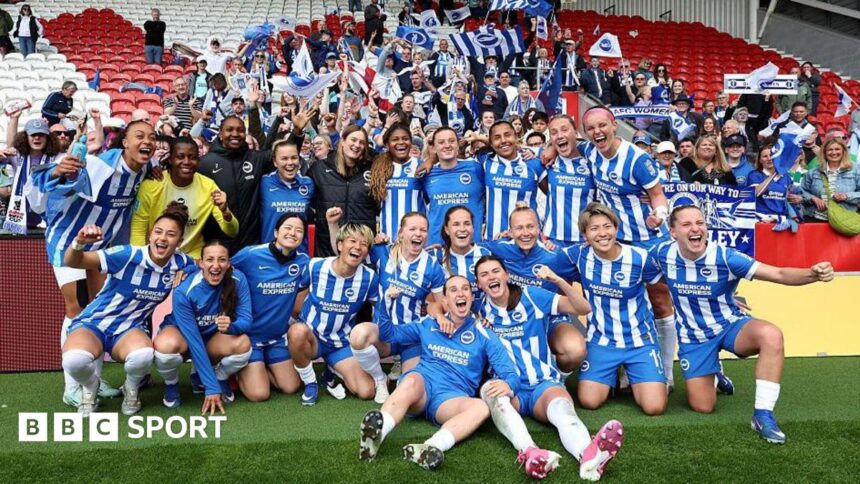
Why Brighton’s First Women’s FA Cup Final Felt Like It Was Coming
For a decade, the Brighton & Hove Albion women’s team has been the quiet architect of a fortress. Not the kind built from stone and mortar, but one constructed from grit, tactical evolution, and a stubborn refusal to accept the status quo. On April 20, 2025, that fortress will open its gates for the biggest day in the club’s history: the Women’s FA Cup final at Wembley Stadium. One victory. That is all that separates the Seagulls from their first major trophy—a piece of silverware that has eluded both the men’s and women’s sides for the club’s entire existence.
The journey to this moment was not a fluke. It was a slow-burn prophecy. When Brighton completed a stunning 3-2 comeback against Liverpool in the semi-final, the football world gasped. But those who have watched the Seagulls’ trajectory knew the truth: this breakthrough was inevitable. Let’s unpack why this final feels less like a surprise and more like a long-awaited coronation.
The Road to Wembley: A Blueprint of Resilience
Brighton’s path to the final reads like a masterclass in knockout football. It was not paved with easy draws or lucky breaks. Instead, it was a gauntlet of three top-tier opponents, each dispatched with a blend of tactical discipline and raw nerve.
- Third Round: Brighton 2-0 Nottingham Forest – A professional, no-nonsense start against a Championship side. The Seagulls controlled possession and struck early, setting the tone for the run.
- Fourth Round: West Ham 1-2 Brighton – The first real test. West Ham, a WSL rival, pushed Brighton to the brink. But a second-half equalizer and a late winner showed the squad’s growing belief in high-pressure moments.
- Quarter-Final: Brighton 3-1 Arsenal – This was the seismic shift. Arsenal, perennial contenders and FA Cup royalty, arrived at the Amex expecting dominance. Instead, Brighton dismantled them with a counter-attacking masterclass. The 3-1 scoreline flattered the Gunners.
- Semi-Final: Liverpool 2-3 Brighton – The ultimate drama. Trailing 2-0 at halftime against a Liverpool side that had beaten them twice in the league this season, Brighton roared back. Goals from Elise Struck and Katherine Kuhlmann flipped the script, and a late winner sent the traveling fans into ecstasy.
Each victory chipped away at the psychological barrier that had kept Brighton from the top tier. The win over Arsenal, in particular, was a statement: this is no longer a club that hopes to compete; it is a club that expects to win.
The Trophy Cabinet Paradox: History vs. Ambition
Let’s address the elephant in the room—the club’s trophy cabinet. The men’s team have won lower-league titles, including the old Third Division South and the Championship, and they are now a stable Premier League side. They famously reached the 1983 FA Cup final, losing to Manchester United in a replay. The women’s team have been a mid-table WSL fixture for years, often finishing between 7th and 10th. The trophy cabinet? Empty.
But that narrative is about to be rewritten. This final is not a lucky break; it is the culmination of a deliberate, multi-year rebuild. Under manager Dario Vidosic, Brighton have transformed from a defensive, reactive side into a fluid, attacking unit. The investment in the women’s program—better training facilities, a dedicated academy pathway, and strategic recruitment—has paid dividends. The squad now boasts players who have won titles elsewhere, like Maya Le Tissier (a former Manchester United captain) and Pauline Bremer (a Bundesliga winner).
Yet, the hunger remains. The men’s 1983 final is a cherished memory, but it is also a ghost. The women have a chance to exorcise that ghost and place the first major silverware in the club’s history. That is a burden, but it is also fuel.
Expert Analysis: Why Brighton Can Win the Final
As a journalist who has watched this team evolve over three seasons, I can tell you that Brighton’s success is not built on luck. It is built on three specific pillars that will be decisive at Wembley.
1. Tactical Flexibility: Vidosic is not married to one system. Against Arsenal, Brighton sat deep and countered. Against Liverpool, they pressed high and played direct. This adaptability makes them unpredictable. Their opponent—likely Chelsea or Manchester City—will not know which Brighton will show up until the first whistle.
2. Set-Piece Dominance: Brighton have scored more set-piece goals than any other WSL team this season. With the height of Megan Connolly and the delivery of Julia Zigiotti Olme, corners and free-kicks are a genuine weapon. In a cup final where nerves can stifle open play, set pieces often decide the outcome.
3. Mental Fortitude: The Liverpool comeback was the proof. Down 2-0 at halftime, many teams would have folded. Brighton did not. They have a core of players who have experienced relegation battles, promotion pushes, and international tournaments. This is a squad that does not panic.
Prediction: If Brighton face Chelsea, the tactical battle will be fascinating. Chelsea are the favorites, but they are vulnerable to fast transitions. Brighton’s winger Katie Robinson has the pace to exploit gaps. If they face Manchester City, the midfield battle between Kirsty Smith and Alex Greenwood will be key. I predict Brighton will win 2-1 in extra time. The narrative is too strong, and the team’s belief is too high.
The Final Piece: What a Trophy Means for Brighton
Winning the Women’s FA Cup would not just fill a cabinet. It would change the entire trajectory of the club. For the men’s side, it would provide a psychological boost—a reminder that silverware is possible. For the women’s program, it would attract new sponsors, better players, and a surge in attendance. The Amex Stadium, which already hosts record crowds for women’s games, could become a permanent fortress.
But beyond the business side, this is about identity. Brighton has always been a club that punches above its weight. The men’s team survived in the Premier League on a fraction of the budget of their rivals. The women’s team have done the same. A trophy would validate that ethos. It would say to the football world: Brighton belongs at the top table.
The final will be played on a warm spring afternoon at Wembley. The Seagulls will walk out to a sea of blue and white. They will face a giant. But they will not be intimidated. Because this journey—through Forest, West Ham, Arsenal, and Liverpool—has been building for years. The final is not the destination. It is the proof of the climb.
Conclusion: The Seagulls’ Destiny
One victory. That is all that stands between Brighton and history. The club’s first major trophy. A place in the annals of English football. For the players, it is a chance to become legends. For the fans, it is a moment of pure, unadulterated joy. For the city, it is a declaration that Brighton is no longer just a seaside town with a plucky men’s team. It is a football powerhouse in its own right.
The Women’s FA Cup final felt like it was coming because it was written in the margins of every hard-fought win, every tactical adjustment, every tear shed in defeat. The script is not finished yet. But the final chapter is ready to be written. And Brighton, against all odds, are holding the pen.
Source: Based on news from BBC Sport.